PRÁTICA COM QUESTÕES OFICIAIS
Questão 17 (1º exame) da UERJ 2015 (inglês)
Texto-base das questões 17 a 21 · 1º Exame de Qualificação
GLOBAL PROTEST GROWS AS CITIZENS LOSE FAITH IN POLITICS AND THE STATE
The demonstrations in Brazil began after a small rise in bus fares that triggered mass protests. Within days this had become a nationwide movement whose concerns had spread far beyond fares: more than a million people were on the streets shouting about everything – from corruption to the cost of living to the amount of money being spent on the World Cup.
In Turkey, it was a similar story. A protest over the future of a city park in Istanbul snowballed too into something bigger, a wider-ranging political confrontation with prime minister.
If the recent scenes have seemed familiar, it is because they shared common features: viral, loosely organised with fractured messages and mostly taking place in urban public locations.
Unlike the protest movement of 1968, or even the end of Soviet influence in Eastern Europe in 1989, these are movements with few discernible leaders and often conflicting ideologies. Their points of reference are not even necessarily ideological, but take inspiration from other protests, including those of the Arab Spring and the Occupy movement. The result has seen a wave of social movements – sometimes short-lived – from Wall Street to Tel Aviv and from Istanbul to Rio de Janeiro, often engaging younger, better educated and wealthier members of society.
In Brazil, the varied banners underlined the difficulty of easy categorisation as protesters held aloft signs expressing a range of demands from education reforms to free bus fares, while denouncing the billions of public dollars spent on stadiums for the 2014 World Cup and the Olympics.
“It’s sort of a Catch-22”, Rodrigues da Cunha, a 63-year-old protester told the Associated Press. “On the one hand, we need some sort of leadership; on the other, we don’t want this to be compromised by being affiliated with any political party.”
As the Economist pointed out, while mass movements in Britain, France, Sweden and Turkey have been inspired by a variety of causes, including falling living standards, authoritarian government and worries about immigration, Brazil does not fit the picture, with youth unemployment at a record low and enjoying the biggest leap in living standards in the country’s history.
So what’s going on? “This is a very peculiar moment”, Saskia Sassen, a sociology professor at Columbia University, New York, told the Observer. She argues that one distinguishing factor is that many of the protest movements of the past decade have been defined by the involvement of what she calls “the modest middle class”, who have often been beneficiaries of the systems they are protesting against, but whose positions have been eroded by neoliberal economic policies that have seen both distribution of wealth and opportunities captured by a narrowing minority. As people have come to feel more distant from government and economic institutions, a large part of the new mass forms of dissent has come to be seen as an opportunity to demonstrate ideas of “citizenship”.
Sassen’s belief that many of the recent protests are middle-class-driven appeared to be confirmed overtly – in the case of Brazil, at least.
theguardian.com
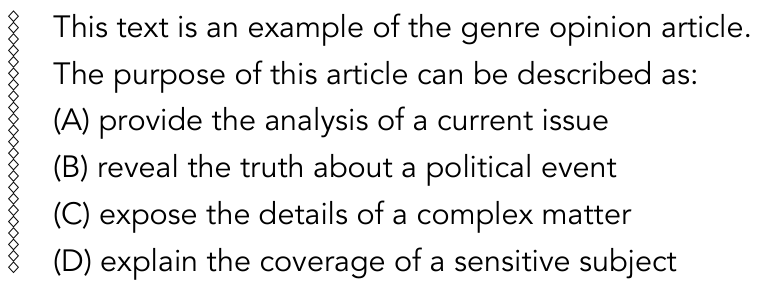
This text is an example of the genre opinion article.
The purpose of this article can be described as:
- Aprovide the analysis of a current issue
- Breveal the truth about a political event
- Cexpose the details of a complex matter
- Dexplain the coverage of a sensitive subject
Reportar erro na questão
Resolução comentada
A questão pede a finalidade (o propósito) de um artigo de opinião, que é o gênero indicado no enunciado. Nesse gênero, o autor não apenas relata fatos: ele interpreta um acontecimento atual, apresenta explicações e traz vozes de especialistas para sustentar a análise.
Veja como o texto faz isso:
- Começa descrevendo protestos recentes no Brasil e na Turquia, que são fatos atuais.
- Aponta o que eles têm em comum: movimentos virais, com pouca liderança e mensagens fragmentadas.
- Compara com protestos antigos (1968 e 1989) e com o Arab Spring e o Occupy.
- Cita a Economist e a socióloga Saskia Sassen, que propõe uma explicação: a "modest middle class" (classe média modesta) teve sua posição erodida por políticas neoliberais.
- Pergunta "So what's going on?" ("E o que está acontecendo?"), o que mostra a intenção de analisar as causas do fenômeno.
Portanto, o objetivo é analisar uma questão atual: a onda global de protestos e suas causas. Isso corresponde a "provide the analysis of a current issue".
Alternativa A.
Por que as outras alternativas estão erradas
- BO texto não pretende revelar uma verdade oculta; apresenta interpretações e opiniões de especialistas, sem desvendar nada escondido.
- CNão se trata de expor detalhes de um assunto complexo; o foco é interpretar causas e características dos protestos, não detalhar minuciosamente um tema.
- DO texto não explica a cobertura jornalística do tema; ele próprio analisa os protestos, apenas citando a imprensa como fonte.
Assunto: Ideia central e finalidade do texto.
Reportar erro na resolução
Ver como caiu na prova
Fonte: UERJ 2015 · 1º Exame de Qualificação. Prova oficial ↗