PRÁTICA COM QUESTÕES OFICIAIS
Questão 16 (2º exame) da UERJ 2013 (inglês)
Texto-base das questões 16 a 21 · 2º Exame de Qualificação
The art of difference
Mutuality in recognizing and negotiating difference is crucial for people to deal with their past and the future; it is also essential in the process of creating a culture of responsibility. How can this be achieved and what is the role of art in this process?
A vision based on ideologies solves both challenges of sharing – the interpretation of the past and the projections of the future. But ideologies are somehow “total”, if not totalitarian, because there is not much space for serious public negotiation. Individuals, then, lose their integrity or are restricted to their private spheres and, in the end, their memories become part of the dominant identity discourse, their aspirations are delegated. Even in less obvious systems of ideological rule, where individual subscription to the official story line seems to be consciously voluntary and collective memories are willingly encouraged for the sake of collective identities, the negotiation of difference is often not welcome: exclusion happens quickly and non-conformist doubts produce suspicion.
A democratic vision – shared aspirations for the future, based on negotiated interpretations of the past that respect diversity – is necessarily found in complex processes of private and public discourse and participatory and inclusive culture. Yet, politics tends to reduce complexity and engineer the balance between the individual and the collective rather than invest in processes of negotiation. We have learned, though, that this social engineering is a phantasm, largely limited and limiting, and, even if successful, often creates paranoid and fatal structures of homogeneity by trying to mould memories and hopes.
Humankind has gathered impressive knowledge about the limitations of the human will and the failures of such “engineering”. Nevertheless, despite this, and maybe even because of it, we cannot give up trying the impossible: to create conditions for equality and solidarity for individuals to flourish. These conditions should be accompanied by narratives of a just, fair and free commonwealth of all. If history and memory seem to make this dream an unlikely scenario, can art play this part?
The role of art is precisely to keep inspiration alive, to deconstruct ideology, to recall the necessary dream of freedom, of the individual and of the common good beyond the “either/or” and beyond simplicity. In this sense, art in general prevents false hopes, and thus generates hope in the most paradoxical way: the only way of hoping that reaches beyond the private sphere without some kind of ideological distortion.
What makes art so unique? And why? Because the best narratives of art are purpose-free, uniquely non-instrumental, simply human. Art narrates what we don’t understand in enlightened ways. Artists in particular offer a wealth of unseen perspectives and unexpected pathways of human exploration. Art makes us aware that all memories are personal, despite the power of collective narratives. Arts and culture empower people to think freely, to imagine the unimagined, to feel responsible across borders and boundaries. Hopefully, the narratives of the future will be intercultural – and art will be the ally in the art of difference that needs to be further developed. “Art is about difference, art is difference”, as stated by Igor Dobricic*. And it is difference that will be at the origin of the new bonding narratives of confidence.
GOTTFRIED WAGNER
alliancepublishing.org
*Igor Dobricic – dramaturgo sérvio
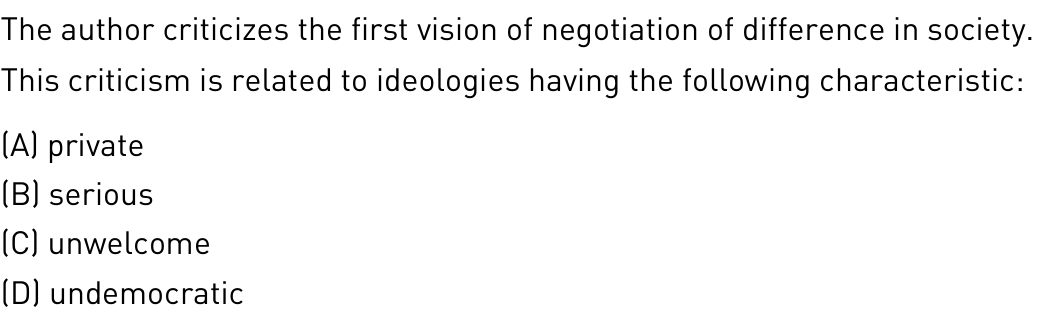
The author criticizes the first vision of negotiation of difference in society. This criticism is related to ideologies having the following characteristic:
- Aprivate
- Bserious
- Cunwelcome
- Dundemocratic
Reportar erro na questão
Resolução comentada
A questão pede qual característica das ideologias motiva a crítica do autor à primeira visão (a baseada em ideologias, descrita no segundo parágrafo).
O autor diz que as ideologias são "total, if not totalitarian", pois "there is not much space for serious public negotiation" (não há muito espaço para negociação pública séria). Com isso, os indivíduos perdem a integridade, suas memórias são absorvidas pelo discurso dominante e as diferenças não são bem-vindas, levando à exclusão.
Então, a crítica é que as ideologias, sendo totalizantes e até totalitárias, não abrem espaço para debate público e participação. A palavra que resume isso é "undemocratic" (antidemocrático), em contraste com a "democratic vision" apresentada no terceiro parágrafo, que é a alternativa defendida pelo autor.
Conferindo as demais opções:
- "private": é a esfera à qual os indivíduos ficam restritos, não uma característica da ideologia.
- "serious": qualifica a negociação pública que falta, não a ideologia.
- "unwelcome": refere-se à negociação da diferença, que é mal vista, e não à ideologia em si.
Alternativa D.
Por que as outras alternativas estão erradas
- A"Private" é a esfera a que os indivíduos ficam restritos sob a ideologia, não uma característica da ideologia.
- B"Serious" qualifica a negociação pública que falta, não a ideologia.
- C"Unwelcome" descreve a negociação da diferença, que é rejeitada, e não a ideologia em si.
Assunto: Inferência e ponto de vista do autor.
Reportar erro na resolução
Ver como caiu na prova
Fonte: UERJ 2013 · 2º Exame de Qualificação. Prova oficial ↗