PRÁTICA COM QUESTÕES OFICIAIS
Questão 21 (1º exame) da UERJ 2012 (inglês)
Texto-base das questões 16 a 21 · 1º Exame de Qualificação
Happiness
It was almost nightfall. The whole day: rain, torrents of rain. Drenched to the bone, I arrived in a little Calabrian village. I had to find a hearth where I could dry out, a corner where I could sleep. The streets were deserted, the doors bolted. The dogs were the only ones to scent the stranger’s breath; they began to bark from within the courtyards. The peasants in this region are wild and misanthropic, suspicious of strangers. I hesitated at every door, extended my hand, but did not dare to knock.
O for my late grandfather in Crete!, who took his lantern each evening and made the rounds of the village to see if any stranger had come. He would take him home, feed him, give him a bed for the night, and then in the morning see him off with a cup of wine and a slice of bread. Here in the Calabrian villages there were no such grandfathers.
Suddenly I saw an open door at the edge of the village. Inclining my head, I looked in: a murky corridor with a lighted fire at the far end and an old lady bent over it. She seemed to be cooking. I crossed the threshold and entered. I reached the fire and sat down on a stool which I found in front of the hearth. The old lady was squatting on another stool, stirring the meal with a wooden spoon. I felt that she eyed me rapidly, without turning. But she said nothing. Taking off my jacket, I began to dry it. I sensed happiness rising in me like warmth, from my feet to my shins, my thighs, my breast. Hungrily, avidly, I breathed in the delicious smell of the steam rising from the pot. Once more I realized to what an extent earthly happiness is made to the measure of man. It is not a rare bird which we must pursue at one moment in heaven, at the next in our minds. Happiness is a domestic bird in our own courtyards.
As soon as we finished, she prepared a bed for me on a bench to the right of the table. I lay down, and she lay down on the other bench opposite me. Outside the rain was falling by the bucketful. For a considerable time I heard the water cackle on the roof, mixed with the old lady’s calm, quiet breathing. She must have been tired, for she fell asleep the moment she inclined her head. Little by little, with the rain and the old lady’s respiration, I too slipped into sleep. When I awoke, I saw daylight peering through the cracks in the door.
The old lady had already risen and placed a saucepan on the fire to prepare the morning milk. I looked at her now in the sparse daylight. Shriveled and hump, she could fit into the palm of your hand. Her legs were so swollen that she had to stop at every step and catch her breath. But her eyes, only her large, pitch-black eyes, gleamed with youthful, unaging brilliance. How beautiful she must have been in her youth, I thought to myself, cursing man’s fate, his inevitable deterioration. Sitting down opposite each other again, we drank the milk. Then I rose and slung my carpetbag over my shoulder. I took out my wallet, but the old lady colored deeply.
“No, no,” she murmured, extending her hand.
As I looked at her in astonishment, the whole of her wrinkled face suddenly gleamed.
“Goodbye, and God bless you,” she said. “May the Lord repay you for the good you’ve done me. Since my husband died I’ve never slept so well.”
NIKOS KAZANTZAKIS*
http://grammar.about.com
* Nikos Kazantzakis (1883-1957) was one of the most important Greek writers of the 20th century.
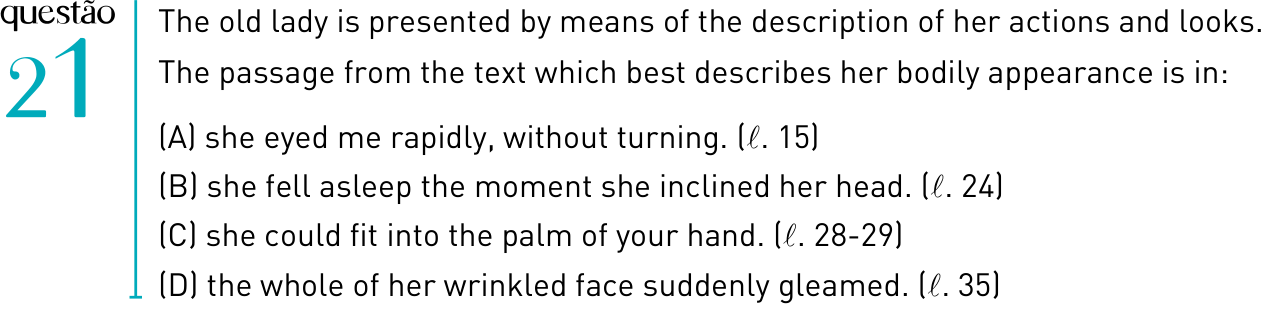
The old lady is presented by means of the description of her actions and looks.
The passage from the text which best describes her bodily appearance is in:
- Ashe eyed me rapidly, without turning. (\ell. 15)
- Bshe fell asleep the moment she inclined her head. (\ell. 24)
- Cshe could fit into the palm of your hand. (\ell. 28-29)
- Dthe whole of her wrinkled face suddenly gleamed. (\ell. 35)
Reportar erro na questão
Resolução comentada
A pergunta pede o trecho que melhor descreve a aparência física da velha, isto é, como seu corpo é, e não o que ela faz.
Vamos classificar cada trecho:
- she eyed me rapidly, without turning: ela me olhou rapidamente, sem se virar. Descreve uma ação (o olhar), não o corpo.
- she fell asleep the moment she inclined her head: ela adormeceu assim que inclinou a cabeça. Também é uma ação.
- she could fit into the palm of your hand: ela cabia na palma da mão. Descreve o tamanho e a constituição física da velha, minúscula e encolhida. Vem logo depois de Shriveled and hump (encolhida e corcunda), que é descrição do corpo.
- the whole of her wrinkled face suddenly gleamed: todo o rosto enrugado dela de repente se iluminou. Traz um traço físico (wrinkled), mas o foco é a reação dela, que sorri ao se despedir; e fala só do rosto, não do corpo todo.
Como a questão fala em aparência corporal, a que melhor a retrata é a comparação com o tamanho de uma mão, que mostra o corpo diminuto.
Alternativa C.
Pegadinha: A alternativa D engana porque contém "wrinkled", um traço físico, mas a ideia central é a ação de o rosto se iluminar.
Por que as outras alternativas estão erradas
- ADescreve uma ação (o modo de olhar), não a aparência do corpo.
- BDescreve uma ação (adormecer), sem nenhum traço físico.
- DEmbora cite o rosto enrugado, o foco é a reação de alegria ao se despedir, e não o corpo.
Assunto: Informações explícitas e detalhes.
Reportar erro na resolução
Ver como caiu na prova
Fonte: UERJ 2012 · 1º Exame de Qualificação. Prova oficial ↗