PRÁTICA COM QUESTÕES OFICIAIS
Questão 33 (1º semestre) do Sírio-Libanês 2026
Read the text to answer questions from 31 to 33. · Prova II
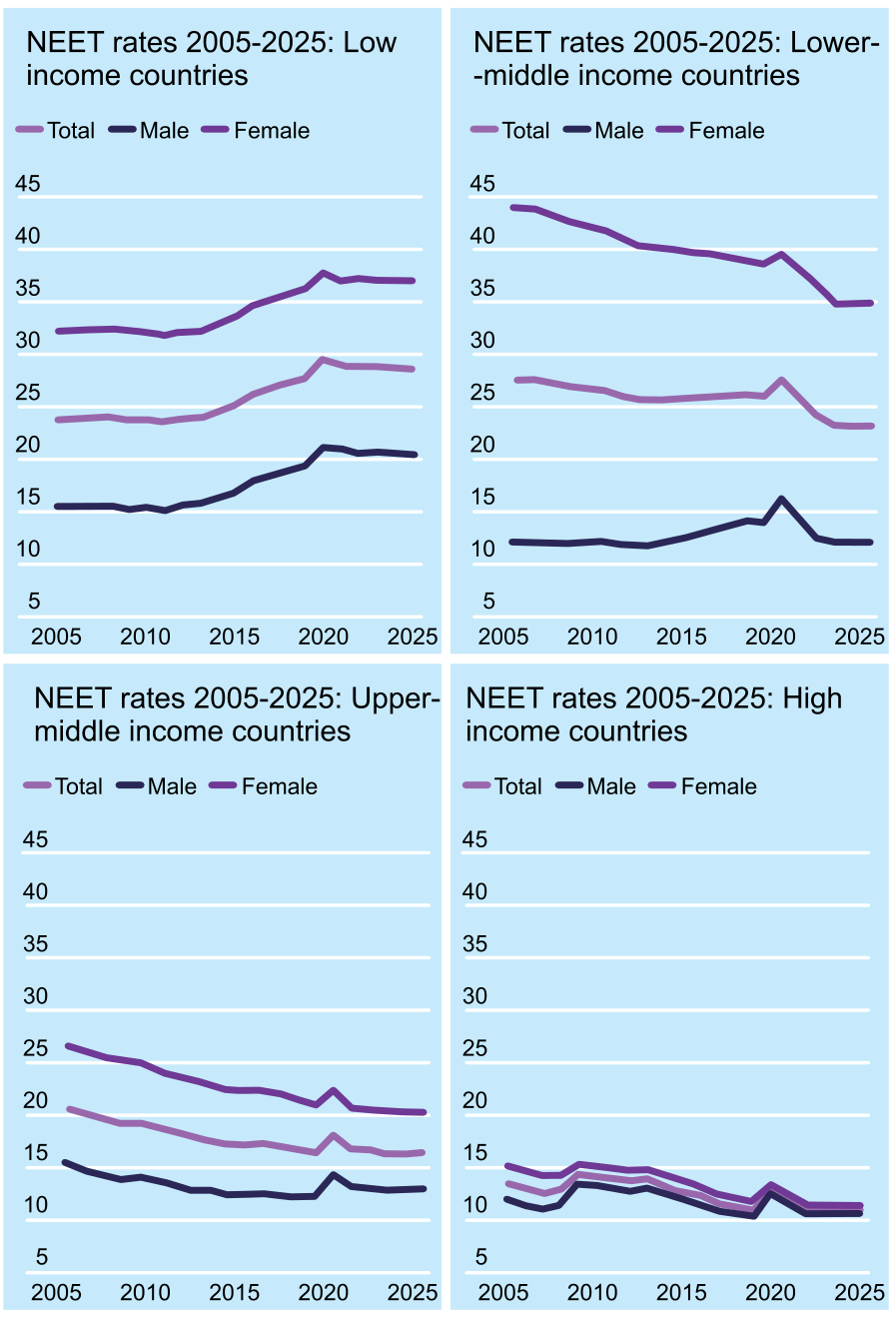
The International Labour Organization (ILO) estimates that in 2025 around 262 million — or one in four — young people aged between 15 and 24 — are neither employed nor studying: they are, in other words, Not in Employment, Education or Training (NEET). In 2015, the United Nations adopted a Sustainable Development Goal (SDG) to substantially reduce the NEET rate — the way in which progress towards achieving the effective integration of young people into the world of work is to be measured internationally. Using this indicator, however, progress until now has been rather modest. According to the ILO’s latest Global Employment Trends for Youth, 2024 edition, 110 countries — where a little over one half of the world’s youth live — are on track to fulfil the SDG goal. In contrast to the rest of the world, low-income1 countries as a whole have experienced a sustained increase in NEET rates in the years following the covid-19 pandemic (figure 1).
Figure 1: NEET rates by sex,
by country income group, 2005-2025
Young NEETs comprise the unemployed — or rather, all young unemployed people who are not at the same time in education — as well as a much larger group of young people who do not have a job and are not engaged in any formal learning activity but who are also, for one reason or another, not actively looking for work.
(Niall O’Higgins. www.ilo.org, 12.08.2025. Adaptado.)
1income: money that is earned from doing work or received from investments.
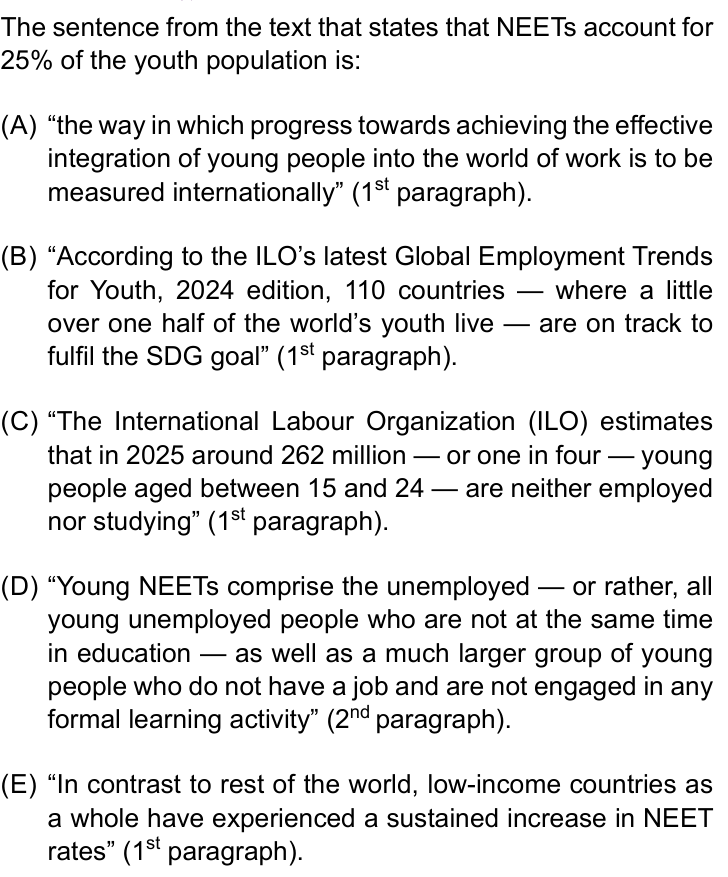
The sentence from the text that states that NEETs account for 25% of the youth population is:
- A“the way in which progress towards achieving the effective integration of young people into the world of work is to be measured internationally” (1st paragraph).
- B“According to the ILO’s latest Global Employment Trends for Youth, 2024 edition, 110 countries — where a little over one half of the world’s youth live — are on track to fulfil the SDG goal” (1st paragraph).
- C“The International Labour Organization (ILO) estimates that in 2025 around 262 million — or one in four — young people aged between 15 and 24 — are neither employed nor studying” (1st paragraph).
- D“Young NEETs comprise the unemployed — or rather, all young unemployed people who are not at the same time in education — as well as a much larger group of young people who do not have a job and are not engaged in any formal learning activity” (2nd paragraph).
- E“In contrast to rest of the world, low-income countries as a whole have experienced a sustained increase in NEET rates” (1st paragraph).
Você já respondeu questões neste aparelho. Crie sua conta grátis para guardar o histórico e refazer as que errou.
Resposta salva no seu histórico.
Reportar erro na questão
Resolução comentada
A questão pede o trecho que expressa a ideia de que os NEETs são 25% dos jovens. Basta converter a proporção em porcentagem: "one in four" significa 1 em cada 4, ou seja, \frac{1}{4} = 0{,}25 = 25\%.
Procurando essa expressão no texto, ela aparece só na primeira frase: "around 262 million — or one in four — young people aged between 15 and 24 — are neither employed nor studying". Nela, "neither employed nor studying" é a definição de NEET, e "one in four" dá a proporção em relação aos jovens de 15 a 24 anos.
Conferindo as outras:
- A trata de como o progresso é medido, sem dar proporção.
- B fala de 110 países onde pouco mais da metade dos jovens vive, que é outra proporção, e não a de NEETs.
- D explica quem são os NEETs (desempregados e inativos), sem porcentagem.
- E trata do aumento das taxas nos países de baixa renda.
Portanto, só o trecho da primeira frase informa que 25% dos jovens são NEETs.
Alternativa C.
Por que as outras alternativas estão erradas
- ADescreve como o progresso é medido internacionalmente, sem citar proporção de NEETs.
- BA proporção citada (pouco mais da metade) refere-se aos jovens em países que cumprirão a meta, não aos NEETs.
- DDefine quem compõe o grupo NEET, sem dar porcentagem.
- EFala do aumento das taxas de NEET nos países de baixa renda, não de 25% dos jovens.
Assunto: Informações explícitas e detalhes.
Reportar erro na resolução
Ver como caiu na prova
Fonte: Sírio-Libanês 2026 · 1º semestre · Prova II. Prova oficial ↗