Questão 14 da Santa Casa 2027
Leia o texto para responder às questões de 14 a 18. · Conhecimentos Gerais
Published research from the University of Vienna and the Swiss Federal Institute of Technology Zurich now establishes that human activity has pushed the planet’s rotation into territory unlike anything in 3.6 million years — and the engineers who keep Global Positioning System (GPS) working are already watching the numbers.
The finding, published in March 2026 in the Journal of Geophysical Research: Solid Earth, quantifies precisely what glaciologists and geodesists had been building toward: Earth’s days are currently lengthening at 1.33 milliseconds per century due to climate-driven ice melt and sea-level rise. That rate is, by the geological record stretching back to the Late Pliocene (a period in Earth’s history that lasted from about 5.33 million to 2.58 million years ago), without precedent.
A companion finding — from a separate 2023 study by Ki-Weon Seo and colleagues at Seoul National University — adds a second human fingerprint: agricultural groundwater extraction shifted Earth’s rotational pole roughly 80 centimeters eastward between 1993 and 2010 alone, making groundwater pumping the single largest climate-related driver of polar drift, according to that research.
Together, the two lines of work establish something that the prior generation of Earth scientists could not have stated with confidence: humanity has become, in the span of decades, a geological force potent enough to alter the mechanics of how the planet moves through space.
(Maxwell Templeton. www.techtimes.com, 04.06.2026. Adaptado.)
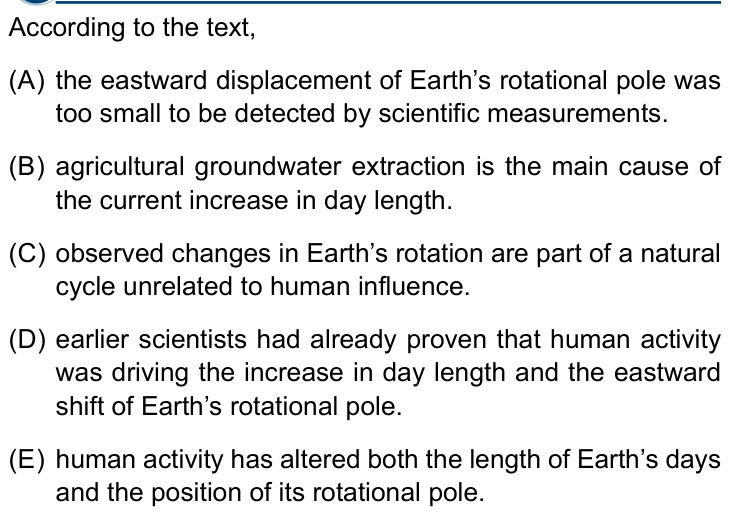
According to the text,
- Athe eastward displacement of Earth’s rotational pole was too small to be detected by scientific measurements.
- Bagricultural groundwater extraction is the main cause of the current increase in day length.
- Cobserved changes in Earth’s rotation are part of a natural cycle unrelated to human influence.
- Dearlier scientists had already proven that human activity was driving the increase in day length and the eastward shift of Earth’s rotational pole.
- Ehuman activity has altered both the length of Earth’s days and the position of its rotational pole.
Reportar erro na questão
Ver como caiu na prova
Fonte: Santa Casa 2027 · Conhecimentos Gerais. Prova oficial ↗