PRÁTICA COM QUESTÕES OFICIAIS
Questão 17 da Santa Casa 2025
Leia o texto e examine o gráfico para responder às questões de 11 a 17. · Conhecimentos Gerais
Most don’t work anymore, but Americans age 70 and older have seen their share of collective wealth surge during the pandemic. As a group, they have accumulated more than $14 trillion in additional net worth since the end 2019, based on Federal Reserve data. Their share of the country’s wealth has jumped to a record 30%, even though they account for 11% of the population.
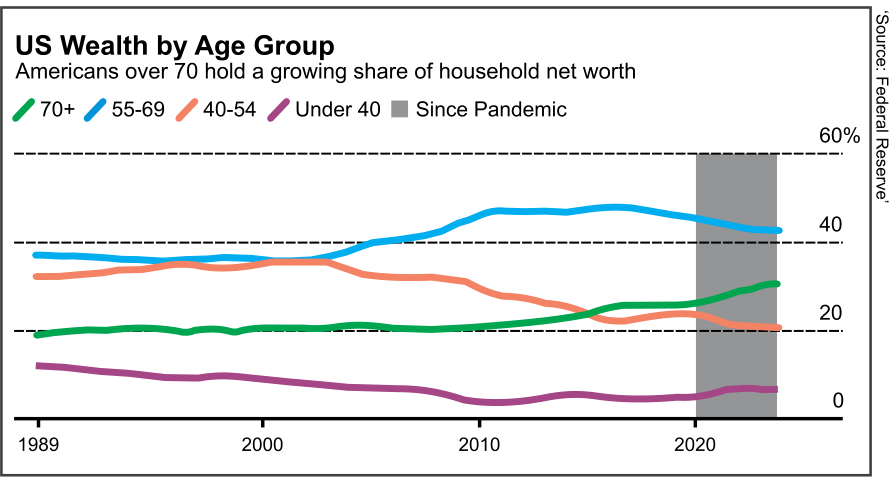
The aging population helps explain some of the gains: there are about 2.3 million more people over 70 in the country than in 2019. But one major driver was the surge in home values and stocks during the pandemic, which benefited older generations most likely to own a house — or two — and hold equities or mutual funds.
Although people who are over 70 are typically retired, a rising portion of that age group is still working. The share of adults age 65 and more in the labor force reached a historic low of 10% in the mid-1980s but has since almost doubled, even after many retired early at the onset of the covid-19 health crisis.
Older Americans also have been the beneficiaries of good timing with the stock market, despite recessions along the way. Since 2019, those age 70 and older have collectively gained about $5 trillion in equity gains. Close to 38% of the nation’s corporate equities and mutual fund shares were held by people in that age group, the highest share on record in data going back to 1989.
(Alex Tanzi. www.bnnbloomberg.ca, 2023. Adaptado.)
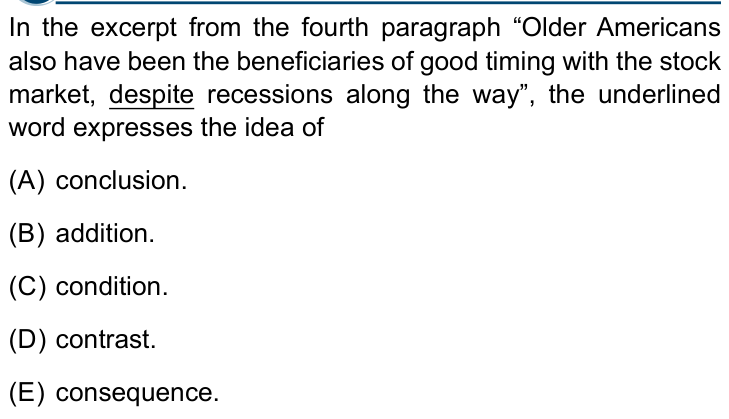
In the excerpt from the fourth paragraph “Older Americans also have been the beneficiaries of good timing with the stock market, despite recessions along the way”, the underlined word expresses the idea of
- Aconclusion.
- Baddition.
- Ccondition.
- Dcontrast.
- Econsequence.
Você já respondeu questões neste aparelho. Crie sua conta grátis para guardar o histórico e refazer as que errou.
Resposta salva no seu histórico.
Reportar erro na questão
Resolução comentada
Despite é uma preposição que significa "apesar de" e introduz uma ideia de concessão, ou seja, um fato que seria um obstáculo, mas que não impede o que se afirma na oração principal. Em português, a concessão é um tipo de contraste, e é assim que as alternativas a tratam.
No trecho, há duas ideias:
- Os americanos mais velhos se beneficiaram do bom momento do mercado de ações.
- Houve recessões ao longo do caminho.
As recessões normalmente prejudicariam os ganhos no mercado. Mesmo assim, o benefício ocorreu. A tradução fica: "foram beneficiados pelo bom momento do mercado de ações, apesar das recessões pelo caminho".
As demais ideias não cabem:
- Conclusão e consequência exigiriam conectivos como therefore, thus ou as a result.
- Adição exigiria besides, moreover ou in addition.
- Condição exigiria if, unless ou provided that.
Como despite opõe os dois fatos, indicando que um ocorreu apesar do outro, a ideia expressa é de contraste.
Alternativa D.
Por que as outras alternativas estão erradas
- AConclusão seria marcada por conectivos como therefore ou thus, e as recessões não são uma conclusão do benefício.
- BAdição seria expressa por moreover, besides ou in addition, e despite não soma ideias, as opõe.
- CCondição seria expressa por if ou unless, e o trecho não diz que o benefício depende das recessões.
- EConsequência seria marcada por as a result ou so, mas as recessões não causam o benefício, elas o contrariam.
Assunto: Conectivos e relações lógicas.
Reportar erro na resolução
Ver como caiu na prova
Fonte: Santa Casa 2025 · Conhecimentos Gerais. Prova oficial ↗