PRÁTICA COM QUESTÕES OFICIAIS
Questão 16 da Santa Casa 2025
Leia o texto e examine o gráfico para responder às questões de 11 a 17. · Conhecimentos Gerais
Most don’t work anymore, but Americans age 70 and older have seen their share of collective wealth surge during the pandemic. As a group, they have accumulated more than $14 trillion in additional net worth since the end 2019, based on Federal Reserve data. Their share of the country’s wealth has jumped to a record 30%, even though they account for 11% of the population.
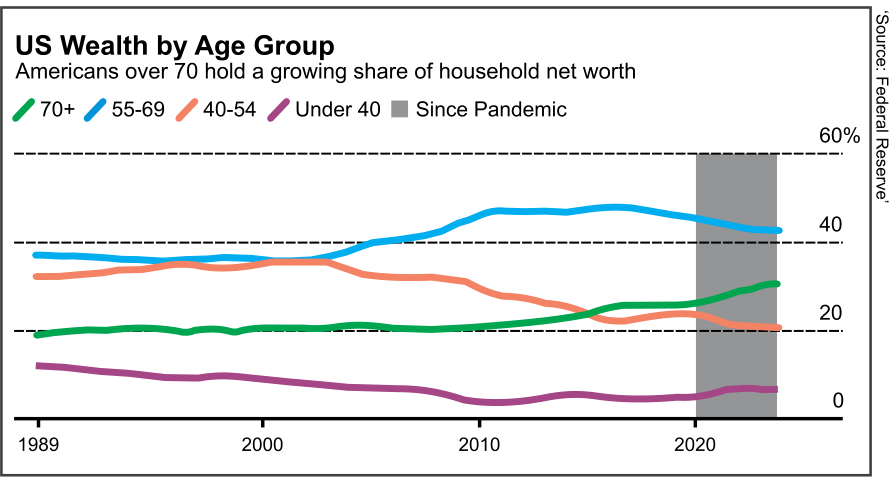
The aging population helps explain some of the gains: there are about 2.3 million more people over 70 in the country than in 2019. But one major driver was the surge in home values and stocks during the pandemic, which benefited older generations most likely to own a house — or two — and hold equities or mutual funds.
Although people who are over 70 are typically retired, a rising portion of that age group is still working. The share of adults age 65 and more in the labor force reached a historic low of 10% in the mid-1980s but has since almost doubled, even after many retired early at the onset of the covid-19 health crisis.
Older Americans also have been the beneficiaries of good timing with the stock market, despite recessions along the way. Since 2019, those age 70 and older have collectively gained about $5 trillion in equity gains. Close to 38% of the nation’s corporate equities and mutual fund shares were held by people in that age group, the highest share on record in data going back to 1989.
(Alex Tanzi. www.bnnbloomberg.ca, 2023. Adaptado.)
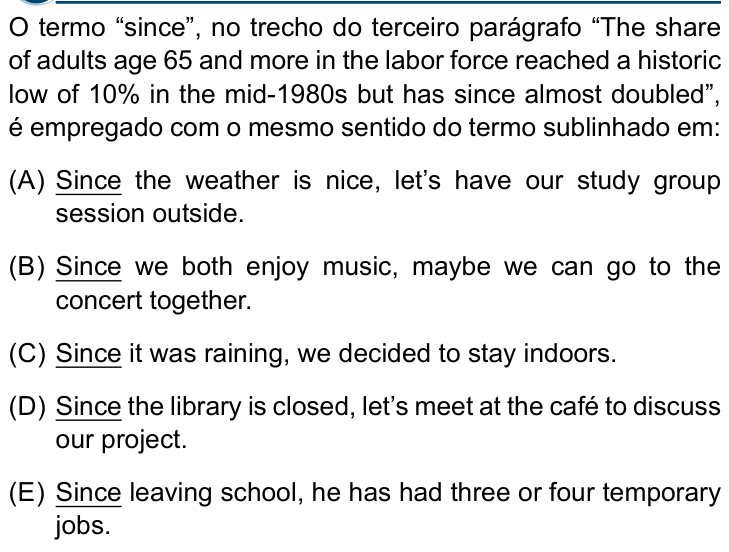
O termo “since”, no trecho do terceiro parágrafo “The share of adults age 65 and more in the labor force reached a historic low of 10% in the mid-1980s but has since almost doubled”, é empregado com o mesmo sentido do termo sublinhado em:
- ASince the weather is nice, let’s have our study group session outside.
- BSince we both enjoy music, maybe we can go to the concert together.
- CSince it was raining, we decided to stay indoors.
- DSince the library is closed, let’s meet at the café to discuss our project.
- ESince leaving school, he has had three or four temporary jobs.
Você já respondeu questões neste aparelho. Crie sua conta grátis para guardar o histórico e refazer as que errou.
Resposta salva no seu histórico.
Reportar erro na questão
Resolução comentada
No trecho do texto, "has since almost doubled" usa since como advérbio de tempo: significa "desde então", "de lá para cá". A porcentagem chegou a 10% em meados dos anos 1980 e, desse momento até hoje, quase dobrou.
O since também pode ser conjunção causal, com o sentido de "já que", "visto que". Ou pode marcar ponto de partida no tempo, como preposição ou conjunção ("desde").
Veja cada alternativa:
- (A), (B), (C) e (D): since equivale a "já que" / "como" e indica causa. Exemplo: "Since the weather is nice" = "Como o tempo está bom". Nenhuma tem ideia de tempo.
- (E): "Since leaving school, he has had three or four temporary jobs" = "Desde que saiu da escola, ele teve três ou quatro empregos temporários". Aqui since indica tempo, o ponto de partida de um período que chega até o presente, e vem com o present perfect ("has had"), como no texto ("has since almost doubled").
Portanto, o sentido temporal ("desde") aparece apenas em (E).
Alternativa E.
Pegadinha: As alternativas A a D usam since como "já que" (causa), sentido muito comum e que engana quem não lembra do uso temporal "desde".
Por que as outras alternativas estão erradas
- ASince tem sentido causal ("já que o tempo está bom"), não temporal.
- BSince é causal ("já que ambos gostamos de música"), sem noção de tempo.
- CSince é causal, justifica a decisão de ficar em casa; não indica "desde quando".
- DSince é causal ("já que a biblioteca está fechada"), não temporal.
Assunto: Conectivos e relações lógicas.
Reportar erro na resolução
Ver como caiu na prova
Fonte: Santa Casa 2025 · Conhecimentos Gerais. Prova oficial ↗