PRÁTICA COM QUESTÕES OFICIAIS
Questão 11 da Santa Casa 2025
Leia o texto e examine o gráfico para responder às questões de 11 a 17. · Conhecimentos Gerais
Most don’t work anymore, but Americans age 70 and older have seen their share of collective wealth surge during the pandemic. As a group, they have accumulated more than $14 trillion in additional net worth since the end 2019, based on Federal Reserve data. Their share of the country’s wealth has jumped to a record 30%, even though they account for 11% of the population.
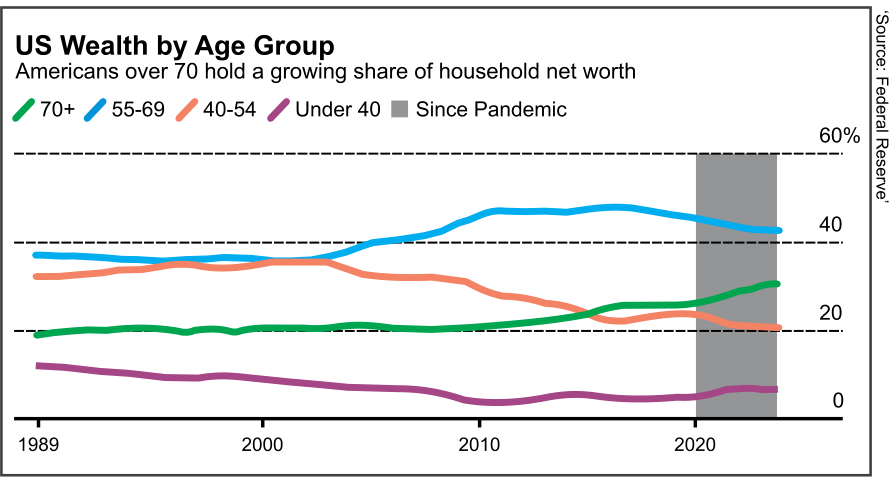
The aging population helps explain some of the gains: there are about 2.3 million more people over 70 in the country than in 2019. But one major driver was the surge in home values and stocks during the pandemic, which benefited older generations most likely to own a house — or two — and hold equities or mutual funds.
Although people who are over 70 are typically retired, a rising portion of that age group is still working. The share of adults age 65 and more in the labor force reached a historic low of 10% in the mid-1980s but has since almost doubled, even after many retired early at the onset of the covid-19 health crisis.
Older Americans also have been the beneficiaries of good timing with the stock market, despite recessions along the way. Since 2019, those age 70 and older have collectively gained about $5 trillion in equity gains. Close to 38% of the nation’s corporate equities and mutual fund shares were held by people in that age group, the highest share on record in data going back to 1989.
(Alex Tanzi. www.bnnbloomberg.ca, 2023. Adaptado.)
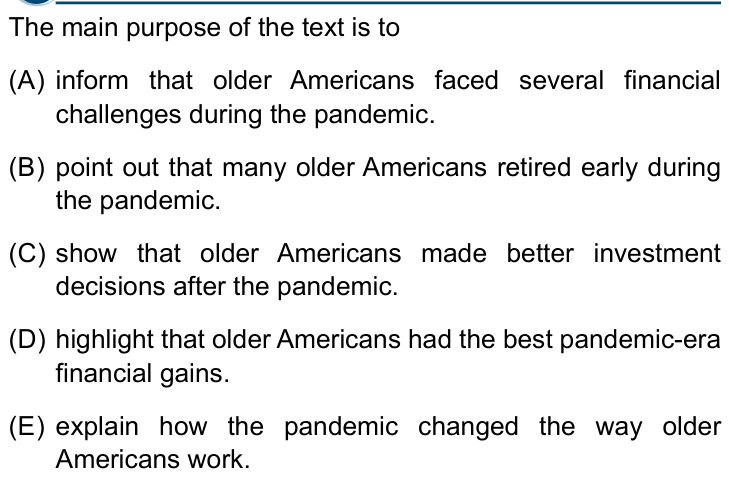
The main purpose of the text is to
- Ainform that older Americans faced several financial challenges during the pandemic.
- Bpoint out that many older Americans retired early during the pandemic.
- Cshow that older Americans made better investment decisions after the pandemic.
- Dhighlight that older Americans had the best pandemic-era financial gains.
- Eexplain how the pandemic changed the way older Americans work.
Você já respondeu questões neste aparelho. Crie sua conta grátis para guardar o histórico e refazer as que errou.
Resposta salva no seu histórico.
Reportar erro na questão
Resolução comentada
A pergunta pede a ideia central do texto, e não um detalhe isolado. Vale ver o que o texto diz do começo ao fim.
-
O primeiro parágrafo traz a tese: os americanos com 70 anos ou mais acumularam mais de US$ 14 trilhões em patrimônio na pandemia e chegaram a 30% da riqueza do país, embora sejam só 11% da população.
-
O gráfico reforça isso: a linha verde (70+) sobe, sobretudo na área cinza "Since Pandemic", e passa a faixa de 40-54 anos.
-
Os demais parágrafos explicam as causas desse ganho: envelhecimento da população, valorização de imóveis e ações, mais idosos trabalhando e boa fase da bolsa (cerca de US$ 5 trilhões em ações).
Tudo gira em torno de um único ponto: os mais velhos tiveram grandes ganhos de riqueza na pandemia. É isso que diz a alternativa D ("highlight that older Americans had the best pandemic-era financial gains").
As outras alternativas pegam só detalhes ou contradizem o texto. O texto não fala em dificuldades financeiras, a aposentadoria precoce é citada de passagem, não se fala em decisões de investimento "melhores" (foi "good timing") e a mudança no trabalho não é o foco.
Alternativa D.
Por que as outras alternativas estão erradas
- AO texto trata de ganhos de riqueza, não de dificuldades financeiras dos idosos na pandemia.
- BA aposentadoria precoce aparece só como detalhe secundário, não como objetivo do texto.
- CO texto fala em boa sorte de momento ("good timing") e em valorização, não em decisões de investimento melhores, e trata do período durante a pandemia.
- EO trabalho dos idosos é só um dos fatores citados; o texto não diz que a pandemia mudou o modo de trabalhar.
Assunto: Ideia central e finalidade do texto.
Reportar erro na resolução
Ver como caiu na prova
Fonte: Santa Casa 2025 · Conhecimentos Gerais. Prova oficial ↗