PRÁTICA COM QUESTÕES OFICIAIS
Questão 40 do ITA 2022
Leia o texto destacado para responder às questões de 38 a 40. · 1ª fase
Meritocracy has become a leading social ideal. Politicians across the ideological spectrum continually return to the theme that the rewards of life—money, power, jobs, university admission—should be distributed according to skill and effort. The most common metaphor is the ‘even playing field’ upon which players can rise to the position that fits their merit. Conceptually and morally, meritocracy is presented as the opposite of systems such as hereditary aristocracy, in which one’s social position is determined by the lottery of birth. Under meritocracy, wealth and advantage are merit’s rightful compensation, not the fortuitous windfall of external events. And most people don’t just think the world should be run meritocratically, they think it is meritocratic. However, although widely held, the belief that merit rather than luck determines success or failure in the world is demonstrably false. This is not least because merit itself is, in large part, the result of luck. Talent and the capacity for determined effort, sometimes called ‘grit’, depend a great deal on one’s genetic endowments and upbringing.
Perhaps more disturbing, simply holding meritocracy as a value seems to promote discriminatory behaviour. The management scholar Emilio Castilla at the Massachusetts Institute of Technology and the sociologist Stephen Benard at Indiana University studied attempts to implement meritocratic practices, such as performance-based compensation in private companies. They found that, in companies that explicitly held meritocracy as a core value, managers assigned greater rewards to male employees over female employees with identical performance evaluations. This preference disappeared where meritocracy was not explicitly adopted as a value.
This is surprising because impartiality is the core of meritocracy’s moral appeal. The ‘even playing field’ is intended to avoid unfair inequalities based on gender, race and the like. Yet Castilla and Benard found that, ironically, attempts to implement meritocracy leads to just the kinds of inequalities that it aims to eliminate. They suggest that this ‘paradox of meritocracy’ occurs because explicitly adopting meritocracy as a value convinces subjects of their own moral sincerity. Satisfied that they are just, they become less inclined to examine their own behaviour for signs of prejudice.
As with any ideology, part of its draw is that it justifies the status quo, explaining why people belong where they happen to be in the social order. It is a well-established psychological principle that people prefer to believe that the world is just.
Fonte: https://bigthink.com/. Publicado em 23/03/2019. Acesso em 20/08/2021. Adaptado.
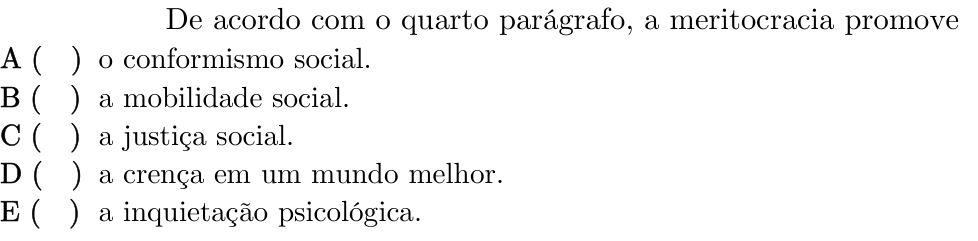
De acordo com o quarto parágrafo, a meritocracia promove
- Ao conformismo social.
- Ba mobilidade social.
- Ca justiça social.
- Da crença em um mundo melhor.
- Ea inquietação psicológica.
Reportar erro na questão
Resolução comentada
O quarto parágrafo diz: "As with any ideology, part of its draw is that it justifies the status quo, explaining why people belong where they happen to be in the social order". Em português: como toda ideologia, parte do seu apelo é justificar o status quo, explicando por que as pessoas pertencem ao lugar que ocupam na ordem social.
Ou seja, a meritocracia leva as pessoas a aceitar a situação existente como legítima: quem está embaixo "merece" estar, e quem está em cima também. Isso favorece a aceitação da ordem vigente, e não sua mudança. Esse é o conformismo social.
O parágrafo ainda acrescenta que as pessoas preferem acreditar que o mundo é justo ("people prefer to believe that the world is just"). Isso reforça a ideia de conforto psicológico e de aceitação, o oposto de inquietação.
Conferindo as demais ideias:
- Mobilidade social: o texto não diz que a meritocracia a promova, apenas que justifica as posições já ocupadas.
- Justiça social: os parágrafos anteriores mostram que ela produz desigualdades, como a preferência por homens.
- Mundo melhor e inquietação: não aparecem no parágrafo.
Alternativa A.
Pegadinha: A alternativa C engana ao confundir a crença de que o mundo é justo com a promoção efetiva de justiça social.
Por que as outras alternativas estão erradas
- BO texto diz que a meritocracia justifica as posições atuais, não que facilite a ascensão social.
- COs parágrafos anteriores mostram que ela gera desigualdades, e o quarto fala em justificar o status quo, não em promover justiça.
- DO texto fala em crença de que o mundo é justo, não em crença em um mundo melhor.
- EA ideia é de conforto em acreditar num mundo justo, o oposto de inquietação.
Assuntos: interpretação de texto, meritocracia, inferência.
Reportar erro na resolução
Ver como caiu na prova
Fonte: ITA 2022 · 1ª fase. Prova oficial ↗