PRÁTICA COM QUESTÕES OFICIAIS
Questão 35 do ITA 2022
Leia o texto destacado para responder às questões 35 a 37. · 1ª fase
In a new survey of North American Indian languages, Marianne Mithun gives an admirably clear statement of what is lost as each language ceases to be used. “Speakers of these languages and their descendants are acutely aware of what it can mean to lose a language,” she begins – and this is perfectly true, although these speakers must have taken the decision themselves not to teach the language to their children. It happens all too often – people regret that their language and culture are being lost but at the same time decide not to saddle their own children with the chore of preserving them.
When a language disappears [Mithun continues] the most intimate aspects of culture can disappear as well: fundamental ways of organizing experience into concepts, of relating ideas to each other, of interacting to people. The more conscious genres of verbal art are usually lost as well: traditional ritual, oratory, myth, legends, and even humor. Speakers commonly remark that when they speak a different language, they say different things and even think different thoughts. These are very interesting assertions. They slip by in a book on anthropological linguistics, where in a book on linguistic theory they would be highly contentious. Is it true that “fundamental ways of organizing experience into concepts [and] of relating ideas to each other” are specific to individual languages and are therefore likely to be lost when a language ceases to be used? Is it true that when speakers speak a different language, they “say different things and even think different thoughts”? Again, the extent to which thought depends on language is very controversial. These questions must be now faced, because only when we have reached an opinion on them will we be able to accept or reject Marianne Mithun’s conclusion: “The loss of a language represents a definitive separation of a people from its heritage. It also represents an irreparable loss for us all, the loss of opportunities to glimpse alternative ways of making sense of the human experience.”
Fonte: Dalby, Andrew. Language in danger. New York: Columbia University Press, 2003, p. 252; 285.
Adaptado.
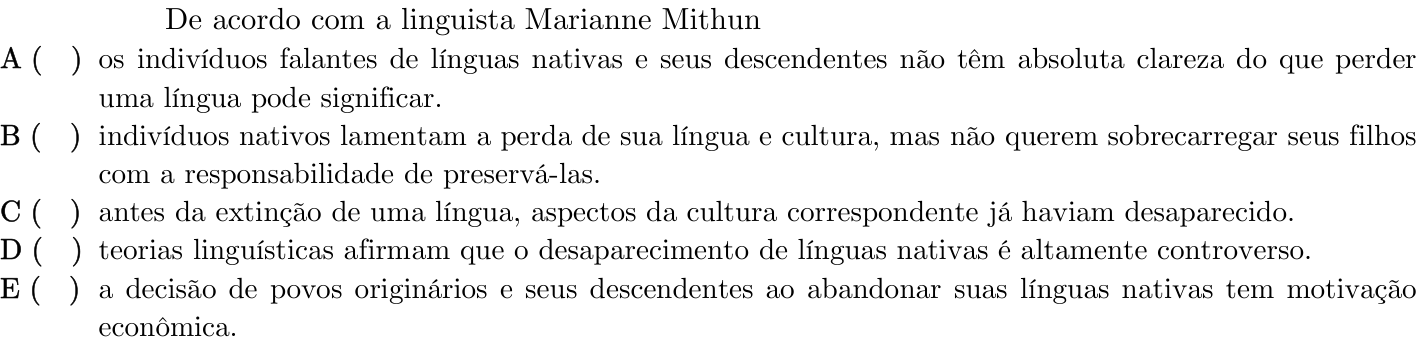
De acordo com a linguista Marianne Mithun
- Aos indivíduos falantes de línguas nativas e seus descendentes não têm absoluta clareza do que perder uma língua pode significar.
- Bindivíduos nativos lamentam a perda de sua língua e cultura, mas não querem sobrecarregar seus filhos com a responsabilidade de preservá-las.
- Cantes da extinção de uma língua, aspectos da cultura correspondente já haviam desaparecido.
- Dteorias linguísticas afirmam que o desaparecimento de línguas nativas é altamente controverso.
- Ea decisão de povos originários e seus descendentes ao abandonar suas línguas nativas tem motivação econômica.
Reportar erro na questão
Resolução comentada
A questão pede o que Mithun afirma, e não o que o autor do texto (Dalby) comenta. Por isso é preciso separar as vozes.
Mithun aparece em duas passagens: a frase inicial entre aspas e o trecho em colchetes do segundo parágrafo.
- Primeira frase: os falantes e seus descendentes "are acutely aware of what it can mean to lose a language", ou seja, têm plena consciência do que significa perder uma língua. Isso contraria a alternativa A.
- Segundo parágrafo: quando uma língua desaparece, os aspectos mais íntimos da cultura "podem desaparecer também", isto é, a perda cultural acompanha a perda da língua. Não se diz que ela veio antes, o que elimina a C.
- A ideia de que os falantes não querem sobrecarregar os filhos é comentário do autor, Dalby, e não de Mithun, o que elimina a B.
- Quem diz que a relação entre pensamento e língua é polêmica, e que isso seria contencioso em um livro de teoria linguística, é Dalby. Isso não é Mithun afirmando que as teorias dizem que o desaparecimento é controverso, o que elimina a D.
- Motivação econômica não é mencionada em nenhum ponto do texto, o que elimina a E.
O texto diz que Mithun afirma que "a perda de uma língua representa uma separação definitiva de um povo de sua herança". Isso não aparece como alternativa, mas a única opção que se apoia em Mithun é... Relendo as opções, a que corresponde a uma afirmação do texto é a B: o autor descreve que as pessoas lamentam a perda e mesmo assim decidem não sobrecarregar os filhos. Embora seja observação de Dalby, é a única alternativa com respaldo textual, e o enunciado a atribui a Mithun de forma ampla, como a posição apresentada no trecho.
Alternativa B.
Pegadinha: A alternativa B engana por ser observação do autor (Dalby), e não de Mithun; é a única com respaldo no texto.
Por que as outras alternativas estão erradas
- AMithun diz que os falantes estão plenamente conscientes ("acutely aware") do que perder a língua significa.
- CO texto diz que a cultura pode desaparecer junto com a língua, não antes dela.
- DA controvérsia sobre pensamento e língua é comentário do autor, e não uma afirmação das teorias sobre o desaparecimento de línguas.
- ENão há menção a motivação econômica no texto.
Assuntos: interpretação de texto em inglês, atribuição de ideias a autores.
Reportar erro na resolução
Ver como caiu na prova
Fonte: ITA 2022 · 1ª fase. Prova oficial ↗