PRÁTICA COM QUESTÕES OFICIAIS
Questão 36 do ITA 2020
Texto-base das questões 36 a 38 · 1ª fase
As questões de 36 a 38 referem-se ao texto destacado:
“Of course they’re fake videos, everyone can see they're not real. All the same, they really did say those things, didn't they?” These are the words of Vivienne Rook, the fictional politician played by Emma Thompson in the brilliant dystopian BBC TV drama Years and Years. The episode in question, set in 2027, tackles the subject of “deepfakes” – videos in which a living person's face and voice are digitally manipulated to say anything the programmer wants.
Rook perfectly sums up the problem with these videos – even if you know they are fake, they leave a lingering impression. And her words are all the more compelling because deepfakes are real and among us already. Last year, several deepfake porn videos emerged online, appearing to show celebrities such as Emma Watson, Gal Gadot and Taylor Swift in explicit situations.
[...]
In some cases, the deepfakes are almost indistinguishable from the real thing – which is particularly worrying for politicians and other people in the public eye. Videos that may initially have been created for laughs could easily be misinterpreted by viewers. Earlier this year, for example, a digitally altered video appeared to show Nancy Pelosi, the speaker of the US House of Representatives, slurring drunkenly through a speech. The video was widely shared on Facebook and YouTube, before being tweeted by President Donald Trump with the caption: “PELOSI STAMMERS THROUGH NEWS CONFERENCE”. The video was debunked, but not before it had been viewed millions of times. Trump has still not deleted the tweet, which has been retweeted over 30,000 times.
The current approach of social media companies is to filter out and reduce the distribution of deepfake videos, rather than outright removing them – unless they are pornographic. This can result in victims suffering severe reputational damage, not to mention ongoing humiliation and ridicule from viewers.
“Deepfakes are one of the most alarming trends I have witnessed as a Congresswoman to date,” said US Congresswoman Yvette Clarke in a recent article for Quartz. “If the American public can be made to believe and trust altered videos of presidential candidates, our democracy is in grave danger. We need to work together to stop deepfakes from becoming the defining feature of the 2020 elections.”
Of course, it’s not just democracy that is at risk, but also the economy, the legal system and even individuals themselves. Clarke warns that, if deepfake technology continues to evolve without a check, video evidence could lose its credibility during trials. It is not hard to imagine it being used by disgruntled ex-lovers, employees and random people on the internet to exact revenge and ruin people’s reputations. The software for creating these videos is already widely available.
Fonte: Curtis, Sophie. https://www.mirror.co.uk/tech/deepfake-videos-creepy-new-internet-18289900. Adaptado. Acessado em Agosto/2019.
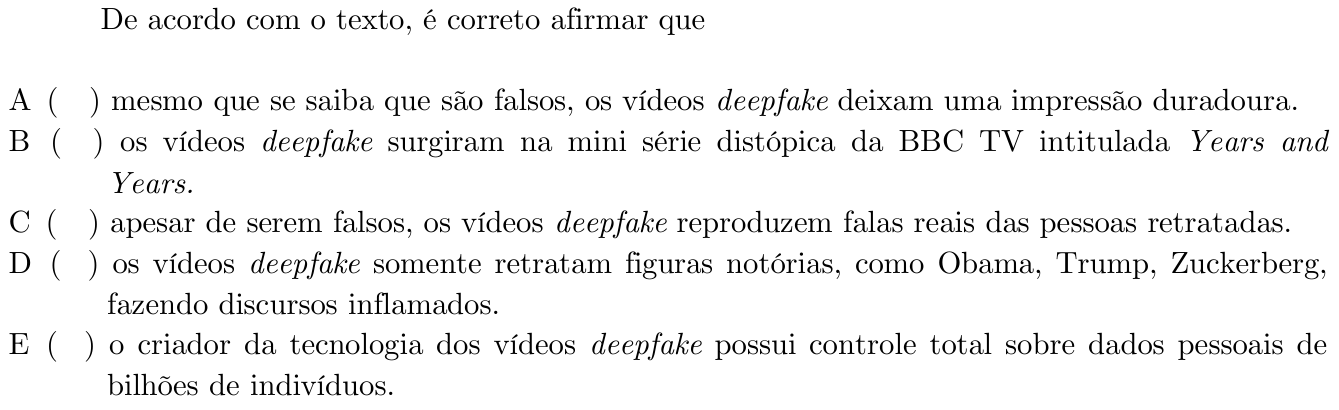
De acordo com o texto, é correto afirmar que
- Amesmo que se saiba que são falsos, os vídeos deepfake deixam uma impressão duradoura.
- Bos vídeos deepfake surgiram na mini série distópica da BBC TV intitulada Years and Years.
- Capesar de serem falsos, os vídeos deepfake reproduzem falas reais das pessoas retratadas.
- Dos vídeos deepfake somente retratam figuras notórias, como Obama, Trump, Zuckerberg, fazendo discursos inflamados.
- Eo criador da tecnologia dos vídeos deepfake possui controle total sobre dados pessoais de bilhões de indivíduos.
Reportar erro na questão
Resolução comentada
O texto diz, no segundo parágrafo: "Rook perfectly sums up the problem with these videos – even if you know they are fake, they leave a lingering impression". Em português: mesmo sabendo que são falsos, os vídeos deixam uma impressão que persiste ("lingering" = duradoura, que demora a passar).
Confira as demais alternativas com o texto:
- Os deepfakes não surgiram na série. A série Years and Years é ficção e apenas trata do tema; o texto afirma que os deepfakes "are real and among us already".
- Os vídeos são manipulados digitalmente para que a pessoa diga "anything the programmer wants". Logo, as falas não são reais. A fala de Rook ("they really did say those things") é a ironia que mostra o problema: a impressão fica, mesmo sendo falso.
- Os alvos citados não são só figuras notórias em discursos: há também vídeos pornográficos com celebridades. Além disso, o texto fala de ex-amantes e pessoas comuns como vítimas possíveis. Obama e Zuckerberg nem aparecem no trecho.
- O texto não fala de um criador que controle dados de bilhões de pessoas. Diz apenas que o software é amplamente acessível.
Só a primeira ideia está de acordo com o texto.
Alternativa A.
Por que as outras alternativas estão erradas
- BA série é ficção sobre o tema; o texto diz que os deepfakes são reais e já existem, não que nasceram na série.
- COs vídeos manipulam rosto e voz para dizer o que o programador quiser; as falas não são reais.
- DRestringe os alvos a figuras notórias em discursos, mas o texto cita também vídeos pornográficos e vítimas comuns; Obama e Zuckerberg não aparecem.
- EO texto não menciona controle de dados de bilhões de pessoas; diz só que o software está amplamente disponível.
Assuntos: interpretação de texto em inglês, deepfakes.
Reportar erro na resolução
Ver como caiu na prova
Fonte: ITA 2020 · 1ª fase. Prova oficial ↗