PRÁTICA COM QUESTÕES OFICIAIS
Questão 34 do ITA 2020
Texto-base das questões 33 a 35 · 1ª fase
As questões de 33 a 35 referem-se ao texto destacado a seguir.
If there is any doubt about the persistent power of literature in the face of digital culture, it should be banished by the recent climb of George Orwell’s 1984 up the Amazon “Movers and Shakers” list. There is much that’s resonant for us in Orwell’s dystopia in the face of Edward Snowden’s revelations about the NSA [...]. We look to 1984 as a clear cautionary tale, even a prophecy, of systematic abuse of power taken to the end of the line. [...]
However, after “THE END” of his dystopian novel 1984, George Orwell includes another chapter, an appendix, called “The Principles of Newspeak.” Since it has the trappings of a tedious scholarly treatise, readers often skip the appendix. But it changes our whole understanding of the novel. Written from some unspecified point in the future, it suggests that Big Brother was eventually defeated. The victory is attributed not to individual rebels or to The Brotherhood, an anonymous resistance group, but rather to language itself. The appendix details Oceania’s attempt to replace Oldspeak, or English, with Newspeak, a linguistic shorthand that reduces the world of ideas to a set of simple, stark words. “The whole aim of Newspeak is to narrow the range of thought.” It will render dissent “literally impossible, because there will be no words in which to express it.”
Fonte: Frost, Laura. http://qz.com/95696. Adaptado. Acesso em agosto de 2019.
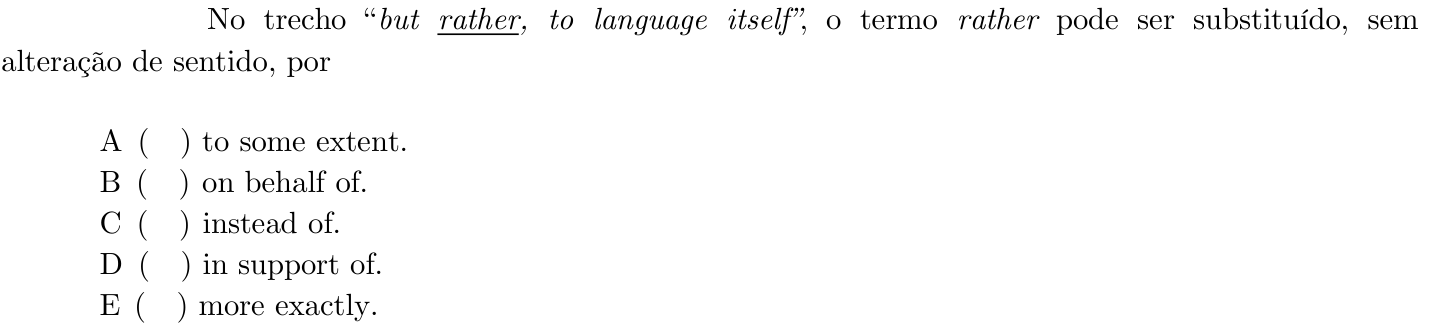
No trecho “but rather, to language itself”, o termo rather pode ser substituído, sem alteração de sentido, por
- Ato some extent.
- Bon behalf of.
- Cinstead of.
- Din support of.
- Emore exactly.
Reportar erro na questão
Resolução comentada
O sentido de rather depende da construção em que ele aparece. Aqui, o texto afirma que a vitória é atribuída “não a rebeldes individuais nem à Irmandade, mas sim à própria linguagem”.
A estrutura “not ... but rather ...” rejeita uma explicação e apresenta outra em seu lugar. Nesse contexto, rather introduz uma correção ou uma formulação mais precisa: não foram aqueles grupos os responsáveis pela vitória, e sim a linguagem. Por isso, “more exactly”, que significa “mais precisamente”, é a melhor substituição entre as opções.
Embora rather possa aparecer com sentido de preferência ou substituição em outros contextos, “instead of” significa “em vez de” e exige outra estrutura. A troca direta produziria “but instead of to language itself”, construção inadequada e que não preserva a afirmação do texto.
As demais expressões indicam grau, representação ou apoio, não a correção apresentada nessa passagem.
Alternativa E.
Pegadinha: A alternativa C engana por associar “rather” à ideia de substituição, mas “instead of” não funciona na construção apresentada.
Por que as outras alternativas estão erradas
- A“To some extent” significa “até certo ponto” e introduz uma ideia de grau, não de correção.
- B“On behalf of” significa “em nome de”, indicando representação.
- C“Instead of” significa “em vez de” e não pode substituir diretamente “rather” nessa estrutura.
- D“In support of” significa “em apoio a”, sentido ausente na passagem.
Assuntos: vocabulário em contexto, conectivos.
Reportar erro na resolução
Ver como caiu na prova
Fonte: ITA 2020 · 1ª fase. Prova oficial ↗