PRÁTICA COM QUESTÕES OFICIAIS
Questão 16 (Inglês) do ITA 2018
Texto-base das questões 16 a 20 · Inglês
As questões de 16 a 20 referem-se ao texto a seguir:
AUGMENTATION OF BRAIN FUNCTION: FACTS, FICTION AND CONTROVERSY
Augmentation of brain function is no longer just a theme of science fiction. __________(I) advances in neural sciences, it has become a matter of reality that a person may consider at some point in life, for example as a treatment of a neurodegenerative disease. Currently, several approaches offer enhancements for sensory, motor and cognitive brain functions,__________(II) for mood and emotions. Such enhancements may be achieved pharmacologically, using brain implants for recordings, stimulation and drug delivery,__________(III) employing brain-machine interfaces, or even by ablation of certain brain areas.
In this Research Topic, we welcome papers critically evaluating the existing methods of brain augmentation, introducing new approaches and probing particular parts of brain circuitry and particular neuronal mechanisms as candidates for an enhancement. We welcome scientists from different fields: from neuroscience of microcircuits to systems neuroscience of large-scale networks and neural engineering. The work can be experimental or computational. Reviews and papers on philosophical and ethical issues are __________(IV) welcome.
While the scope of possible relevant topics is broad, the authors are encouraged to clearly indicate how their studies address the announced theme of brain augmentation.
Important Note: All contributions to this Research Topic must be within the scope of the section and journal to which they are submitted, as defined in their mission statements. Frontiers reserves the right to guide an out-of-scope manuscript to a more suitable section or journal at any stage of peer review.
Fonte: http://journal.frontiersin.org/researchtopic/1563/augmentation-of-brain-function-facts-fiction-and-controversy. Acesso em: 15 jul. 2017.
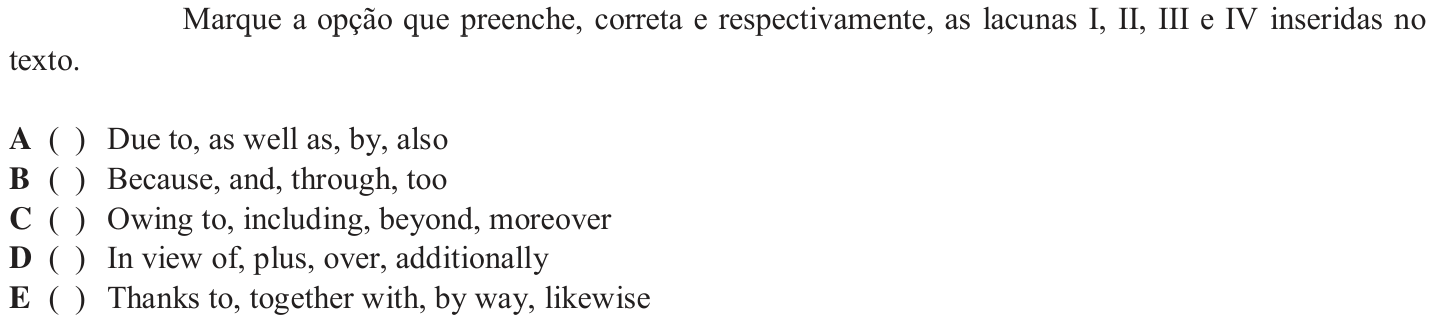
Marque a opção que preenche, correta e respectivamente, as lacunas I, II, III e IV inseridas no texto.
- ADue to, as well as, by, also
- BBecause, and, through, too
- COwing to, including, beyond, moreover
- DIn view of, plus, over, additionally
- EThanks to, together with, by way, likewise
Reportar erro na questão
Resolução comentada
Cada lacuna pede uma classe de palavra e uma regência específicas.
Lacuna I: vem antes de "advances in neural sciences", um grupo nominal. Falta uma preposição composta, como due to (devido a) ou thanks to. Because sozinho exigiria uma oração (because of seria a forma correta).
Lacuna II: "enhancements for sensory, motor and cognitive brain functions, ____ for mood and emotions". A ideia é de adição, e as well as cabe aqui ("...bem como para humor e emoções"). Including também seria possível, mas a lista já é de itens paralelos e as opções precisam fechar com as demais lacunas.
Lacuna III: "pharmacologically, using brain implants..., ____ employing brain-machine interfaces". O paralelismo pede by ("by employing"), ligado ao método ("by using... by employing"). Through employing, beyond e over não funcionam, e by way exigiria by way of.
Lacuna IV: "papers on philosophical and ethical issues are ____ welcome". Aqui o sentido é "também são bem-vindos", e also se encaixa. Too viria no fim da frase, não antes do adjetivo.
A única opção com as quatro lacunas corretas é a que tem Due to, as well as, by, also.
Alternativa A.
Por que as outras alternativas estão erradas
- B"Because" exige uma oração (seria "because of") e "too" não se posiciona antes de "welcome".
- C"Beyond" não indica o meio ("by employing") e "moreover" é conectivo de frase, não cabe antes de "welcome".
- D"Over" não indica meio antes de "employing" e "additionally" não encaixa antes de "welcome".
- E"By way" está incompleto (seria "by way of") e "likewise" não cabe na lacuna IV.
Assunto: Conectivos e relações lógicas.
Reportar erro na resolução
Ver como caiu na prova
Fonte: ITA 2018 · Inglês. Prova oficial ↗