PRÁTICA COM QUESTÕES OFICIAIS
Questão 6 (Inglês) do ITA 2015
Texto-base das questões 01 a 06 · Inglês
As questões de 1 a 6 referem-se ao texto a seguir:
THE MAN IN THE CONVERTIBLE
One morning, well after I was diagnosed with cancer, I got an email from Robbee Kosak, Carnegie Mellon’s vice president for advancement. She told me a story. She said she had been driving home from work the night before, and she found herself behind a man in a convertible. It was a warm, gorgeous, early-spring evening, and the man had his top down and all his windows lowered. His arm was hanging over the driver’s side door, and his fingers were tapping along to the music on his radio. His head was bobbing along, too, as the wind blew through his hair. Robbee changed lanes and pulled a little closer. From the side, she could see that the man had a slight smile on his face, the kind of absentminded smile a person might have when he’s all alone, happy in his own thoughts. Robbee found herself thinking: “Wow, this is the epitome of a person appreciating this day and this moment.” The convertible eventually turned the corner, and that’s when Robbee got a look at the man’s full face. “Oh my God,” she said to herself. “It’s Randy Pausch!” She was so struck by the sight of me. She knew that my cancer diagnosis was grim. And yet, as she wrote in her email, she was moved by how contented I seemed. In this private moment, I was obviously in high spirits. Robbee wrote in her email: “You can never know how much that glimpse of you made my day, reminding me of what life is all about.” I read Robbee’s email several times. I came to look at it as a feedback loop of sorts. It has not always been easy to stay positive through my cancer treatment. When you have a dire medical issue, it’s tough to know how you’re really faring emotionally. I had wondered whether a part of me was acting when I was with other people. Maybe at times I forced myself to appear strong and upbeat. Many cancer patients feel obliged to put up a brave front. Was I doing that, too? But Robbee had come upon me in an unguarded moment. I’d like to think she saw me as I am. She certainly saw me as I was that evening. Her mail was just a paragraph, but it meant a great deal to me. She had given me a window into myself. I was still fully engaged. I still knew life was good. I was doing OK.
Fonte: PAUSCH, R. The last lecture. New York, Hyperion, 2008. p.64-65.
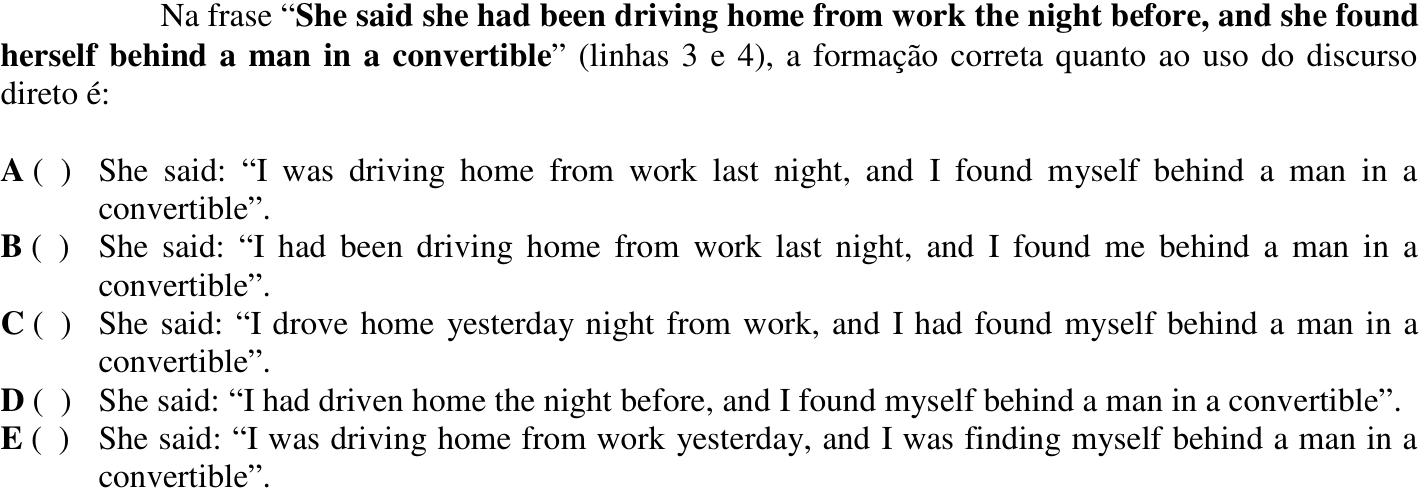
Na frase “She said she had been driving home from work the night before, and she found herself behind a man in a convertible” (linhas 3 e 4), a formação correta quanto ao uso do discurso direto é:
- AShe said: “I was driving home from work last night, and I found myself behind a man in a convertible”.
- BShe said: “I had been driving home from work last night, and I found me behind a man in a convertible”.
- CShe said: “I drove home yesterday night from work, and I had found myself behind a man in a convertible”.
- DShe said: “I had driven home the night before, and I found myself behind a man in a convertible”.
- EShe said: “I was driving home from work yesterday, and I was finding myself behind a man in a convertible”.
Você já respondeu questões neste aparelho. Crie sua conta grátis para guardar o histórico e refazer as que errou.
Resposta salva no seu histórico.
Reportar erro na questão
Resolução comentada
Na passagem do discurso indireto para o direto, desfazemos o recuo dos tempos verbais (backshift) e trocamos as expressões de tempo e os pronomes.
- Tempos verbais: no indireto, had been driving (past perfect continuous) vem do past continuous was driving no direto. Found (past simple) vem do mesmo found no direto, já que o found do indireto não recuou.
- Pronomes: o sujeito she passa a I. O pronome reflexivo herself passa a myself.
- Expressão de tempo: the night before passa a last night.
Montando a frase: She said: “I was driving home from work last night, and I found myself behind a man in a convertible”.
Conferindo as demais: found me exige o reflexivo myself. Had found, had driven e was finding mudam o tempo verbal indevidamente. The night before e yesterday night não são as formas corretas para o discurso direto. Yesterday night nem é natural em inglês.
Alternativa A.
Por que as outras alternativas estão erradas
- BUsa had been driving, que mantém o recuo do indireto, e found me em vez de found myself.
- CYesterday night não é natural em inglês, e had found muda o tempo verbal sem necessidade.
- DMantém the night before e had driven, formas do discurso indireto, além de omitir from work.
- EWas finding myself é um tempo contínuo incorreto aqui, e yesterday altera a expressão last night.
Assunto: Tempos verbais e verbos modais.
Reportar erro na resolução
Ver como caiu na prova
Fonte: ITA 2015 · Inglês. Prova oficial ↗