PRÁTICA COM QUESTÕES OFICIAIS
Questão 2 (Inglês) do ITA 2014
Texto-base das questões 01 a 07 · Inglês
As questões de 1 a 7 referem-se ao texto a seguir:
A HISTORY OF PI
The history of Pi, says the author, though a small part of the history of mathematics, is nevertheless a mirror of the history of man. Petr Beckmann holds up this mirror, giving the background of the times when Pi made progress — and also when it did not, because science was being stifled by militarism or religious fanaticism. The mathematical level of this book is flexible, and there is plenty for readers of all ages and interests. ABOUT THE AUTHOR Petr Beckmann was born in Prague, Czechoslovakia, in 1924. Until 1963, he worked as a research scientist for the Czechoslovak Academy of Sciences, when he was invited as a Visiting Professor to the University of Colorado, where he decided to stay permanently as professor of electrical engineering. Dr. Beckmann has authored 11 books and more than 50 scientific papers, mostly on probability theory and electromagnetic wave propagation. History is one of his side interests; another is linguistics (he is fluent in five languages and he has worked out a new generative grammar which enables a computer to construct trillions of grammatical sentences from a dictionary of less than 100 unprocessed words). He also publishes a monthly pro-science, pro-technology, pro-free enterprise newsletter Access to Energy, in which he promotes the viewpoint that clean energy can be made plentiful, but that access to it is blocked by government interference and environmental paranoia.
BECKMANN, Petr. A History of Pi. New York: Barnes & Noble Books, 1983.
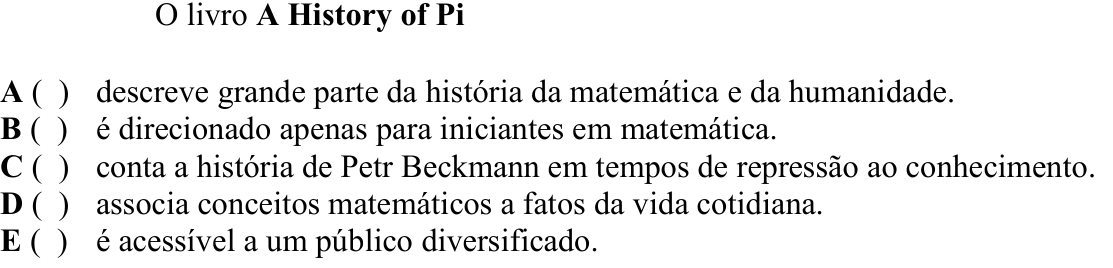
O livro A History of Pi
- Adescreve grande parte da história da matemática e da humanidade.
- Bé direcionado apenas para iniciantes em matemática.
- Cconta a história de Petr Beckmann em tempos de repressão ao conhecimento.
- Dassocia conceitos matemáticos a fatos da vida cotidiana.
- Eé acessível a um público diversificado.
Você já respondeu questões neste aparelho. Crie sua conta grátis para guardar o histórico e refazer as que errou.
Resposta salva no seu histórico.
Reportar erro na questão
Resolução comentada
O primeiro parágrafo do texto resume o livro. Vamos conferir o que ele diz.
- O autor afirma que a história de Pi é "a small part of the history of mathematics", ou seja, uma parte pequena, e não "grande parte" dela.
- Beckmann mostra o contexto histórico dos períodos em que Pi progrediu ou não, por causa de militarismo ou fanatismo religioso. Isso é pano de fundo histórico, e o livro não é uma biografia dele.
- A frase decisiva é: "The mathematical level of this book is flexible, and there is plenty for readers of all ages and interests". Em tradução: o nível matemático é flexível e há muito para leitores de todas as idades e interesses.
Isso significa que o livro pode ser lido por pessoas de perfis variados, isto é, por um público diversificado. Ele não se restringe a iniciantes e também não afirma ligar a matemática ao cotidiano.
Alternativa E.
Por que as outras alternativas estão erradas
- AO texto diz que a história de Pi é apenas uma pequena parte da história da matemática, não grande parte.
- BContradiz "readers of all ages and interests"; o livro não se limita a iniciantes.
- CA biografia de Beckmann está na seção sobre o autor; o livro trata da história de Pi, não da vida dele.
- DO texto não menciona fatos da vida cotidiana; fala de contexto histórico, militarismo e fanatismo religioso.
Assunto: Informações explícitas e detalhes.
Reportar erro na resolução
Ver como caiu na prova
Fonte: ITA 2014 · Inglês. Prova oficial ↗