PRÁTICA COM QUESTÕES OFICIAIS
Questão 8 (Inglês) do ITA 2011
Texto-base das questões 08 a 12 · Inglês
As questões de 8 a 12 referem-se ao seguinte texto:
Our Imaginary, Hotter Selves
Avatars might serve therapeutic purposes, helping those with social phobia become more confident.
by Sharon Begley
Anyone who has ever had a bad hair day, when looking like a latter-day Medusa makes you feel cranky and antisocial and plodding, can sympathize with the Oakland Raiders - and not because the players get helmet hair. The Raiders alternated between mostly black and mostly white uniforms, depending on whether they were playing at home or away. Knowing that appearance affects people's mood and outlook, psychologists wondered whether uniform color influenced the Raiders' aggressiveness. Using data from the 1970s and 1980s, they found that the team racked up way more penalty yards - a measure of aggression - when they wore black than when they wore white, for infractions both minor (encroachment) and major (roughing the kicker). The pattern held even when the scientists took into account different conditions and styles of play at home and away. But while the 1988 finding has become a classic in psychology, the explanation remains controversial. Do referees, because of black's cultural baggage, see black-clad players as meaner and badder than those in, say, baby blue? Or does wearing black make players see themselves as tougher and meaner - and therefore cause them to play that way?
Jeremy Bailenson and Nick Yee of Stanford University had this and other classic studies in mind when they started wondering about the effect of being able to alter one's appearance. They weren't going to study wardrobe choices, however. Their quarry is avatars, digital representations of players in such games as Second Life. "Your physical appearance changes how people treat you," says Bailenson. "But independent of that, when you perceive yourself in a certain way, you act differently." He and Yee call it "the Proteus effect," after the shape-changing Greek god. The effect of appearance on behavior, they find, carries over from the virtual world to the real one, with intriguing consequences. (...)
http://www.newsweek.com. Acesso em 5/6/2010.
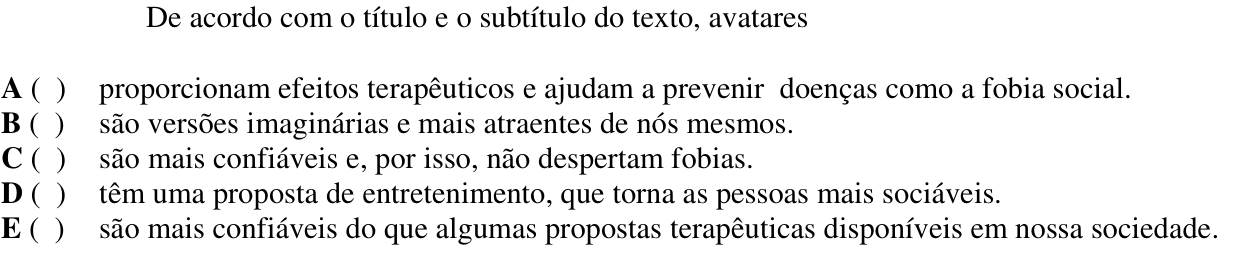
De acordo com o título e o subtítulo do texto, avatares
- Aproporcionam efeitos terapêuticos e ajudam a prevenir doenças como a fobia social.
- Bsão versões imaginárias e mais atraentes de nós mesmos.
- Csão mais confiáveis e, por isso, não despertam fobias.
- Dtêm uma proposta de entretenimento, que torna as pessoas mais sociáveis.
- Esão mais confiáveis do que algumas propostas terapêuticas disponíveis em nossa sociedade.
Você já respondeu questões neste aparelho. Crie sua conta grátis para guardar o histórico e refazer as que errou.
Resposta salva no seu histórico.
Reportar erro na questão
Resolução comentada
A questão pede só o que o título e o subtítulo dizem, sem recorrer ao corpo do texto.
- Título: Our Imaginary, Hotter Selves = "Nossos eus imaginários e mais atraentes ("mais gatos")". Ou seja, os avatares são versões imaginárias de nós mesmos, com aparência melhorada.
- Subtítulo: Avatars might serve therapeutic purposes, helping those with social phobia become more confident = "Avatares poderiam ter fins terapêuticos, ajudando quem tem fobia social a ficar mais confiante".
Note o verbo might ("poderiam"): é possibilidade, não certeza. Além disso, o subtítulo fala em ajudar quem já tem fobia social a ganhar confiança, não em prevenir a doença, nem em comparar com outras terapias, nem em falar de entretenimento.
Confronte com as alternativas: (A) diz "prevenir", que o texto não afirma; (C) inverte a ideia, pois confident se refere à pessoa, não ao avatar; (D) e (E) acrescentam informações ausentes. Só a (B) traduz o título: versões imaginárias e mais atraentes de nós mesmos (imaginary, hotter selves).
Alternativa B.
Pegadinha: A alternativa A engana por usar o termo "terapêuticos" e "fobia social", mas troca "ajudar quem tem fobia" por "prevenir doenças".
Por que as outras alternativas estão erradas
- AFala em prevenir a fobia social, mas o subtítulo diz ajudar quem já tem fobia a ficar mais confiante, e ainda como possibilidade (might).
- CConfunde a confiança (confident) que a pessoa ganha com avatares serem confiáveis; nada diz que não despertam fobias.
- DAtribui aos avatares uma proposta de entretenimento que torna as pessoas mais sociáveis, ideia que não está no título nem no subtítulo.
- ECompara avatares a outras terapias, comparação que o texto não faz.
Assunto: Informações explícitas e detalhes.
Reportar erro na resolução
Ver como caiu na prova
Fonte: ITA 2011 · Inglês. Prova oficial ↗