PRÁTICA COM QUESTÕES OFICIAIS
Questão 11 (Inglês) do ITA 2010
As perguntas de 9 a 13 correspondem ao texto a seguir: · Inglês
Hanging in the balance
TOKYO
For the first time since the second world war, Japan conducts jury-like trials
WHEN 72-year-old Katsuyoshi Fujii shuffled into a Tokyo court on August 3rd with a rope tied around his waist, having confessed to stabbing a neighbour, his fate was all but sealed. Crime may be exceedingly low in Japan but anyone who is prosecuted almost inevitably ends up behind bars. The conviction rate for all prosecutions is 99\% and confessions—made in police custody without a lawyer present—are almost as common. But on this occasion, for the first time since 1943, citizens from outside the legal profession stood in judgment of Mr Fujii, alongside professional judges. These “lay judges” not only help determine innocence or guilt but punishment too. They can even order the death penalty, though Mr Fujii got 15 years.
This is a big change for Japan, where, according to Takashi Maruta of Kansei Gakuin University, trials have long been “ceremonial”, with lots of legal jargon and little questioning by judges of police evidence. Citizen juries were suspended during the second world war because eligible jurors, men over 30, were away fighting. After a spate of executions of innocent people in the late 1980s, pressure mounted to bring civilians back into the courtroom. Some legal scholars such as Mr Maruta wanted American-style juries; what they got was a fudge in which lay judges sit alongside the professionals. The experiment will, however, be studied by other Asian countries such as South Korea and Taiwan that share aspects of Japan’s system.
In a society of hierarchy and deference towards authority, laymen will rarely dare to argue with professional judges. Opinion polls suggest a large majority of Japanese people are loth even to take part in a trial.
That said, in Mr Fujii’s case, the judges took the unusual step of cross-questioning the accused and the victim’s son. More than 2,000 people showed up to get tickets for the trial. It may be an imperfect way to democratise the judicial process, but it looks like a step in the right direction. With Japan about to hold an election that could end 55 years of almost uninterrupted one-party rule, the \boxed{\text{I}} ordinary citizens can fill the power vacuum by taking part in public life, the \boxed{\text{II}}
The Economist, de 8/8/2009.
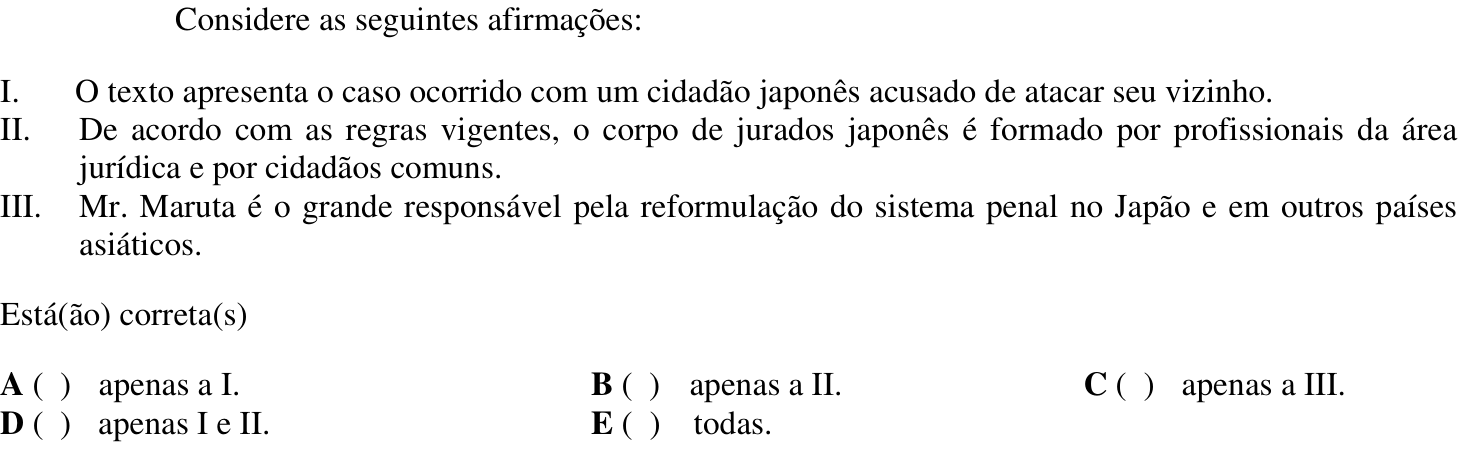
Considere as seguintes afirmações:
I. O texto apresenta o caso ocorrido com um cidadão japonês acusado de atacar seu vizinho.
II. De acordo com as regras vigentes, o corpo de jurados japonês é formado por profissionais da área jurídica e por cidadãos comuns.
III. Mr. Maruta é o grande responsável pela reformulação do sistema penal no Japão e em outros países asiáticos.
Está(ão) correta(s)
- Aapenas a I.
- Bapenas a II.
- Capenas a III.
- Dapenas I e II.
- Etodas.
Você já respondeu questões neste aparelho. Crie sua conta grátis para guardar o histórico e refazer as que errou.
Resposta salva no seu histórico.
Reportar erro na questão
Resolução comentada
Vamos conferir cada afirmação com o texto.
I. O texto abre com o caso de Katsuyoshi Fujii, de 72 anos, que confessou ter esfaqueado (stabbing) um vizinho (neighbour). Ele é o acusado do julgamento. Afirmação correta.
II. O texto diz que cidadãos de fora da área jurídica julgaram Fujii "alongside professional judges" (ao lado de juízes profissionais). Esses "lay judges" ajudam a determinar inocência, culpa e pena. Ou seja, o corpo julgador mistura profissionais e cidadãos comuns. Afirmação correta.
III. Maruta aparece como professor da Kansei Gakuin University. Ele é citado como alguém que considera os julgamentos "ceremonial" e que queria júris no estilo americano. O que se obteve foi um "fudge", um meio-termo diferente do que ele queria. Ele não é o responsável pela reforma. O texto diz apenas que outros países asiáticos, como Coreia do Sul e Taiwan, vão estudar o experimento, sem nenhuma ligação com Maruta. Afirmação incorreta.
Assim, só I e II estão corretas.
Alternativa D.
Pegadinha: A afirmação III engana ao transformar Maruta, apenas um estudioso citado, no responsável pela reforma, e ao estender o efeito a outros países asiáticos.
Por que as outras alternativas estão erradas
- AIgnora que a II também está correta: os lay judges atuam ao lado de juízes profissionais.
- BIgnora que a I também está correta: o texto narra o caso de Fujii, que esfaqueou o vizinho.
- CA III é falsa: Maruta é só um estudioso que queria júri americano, não o responsável pela reforma.
- EInclui a III, que atribui a Maruta um papel que o texto não lhe dá.
Assunto: Informações explícitas e detalhes.
Reportar erro na resolução
Ver como caiu na prova
Fonte: ITA 2010 · Inglês. Prova oficial ↗