PRÁTICA COM QUESTÕES OFICIAIS
Questão 10 (Inglês) do ITA 2008
Texto-base das questões 07 a 10 · Inglês
As questões de 7 a 10 referem-se ao texto a seguir:
Taking Measure With Hardware and Software
The researchers who founded National Instruments Corp switched from building their own equipment to beefing up other people’s.
“You could start a company.” That offhand comment by Jim Truchard got Jeff Kodosky and Bill Nowlin thinking. Within days, Truchard and his two employees at the Applied Research Laboratories (ARL) at the University of Texas at Austin (UT) decided to give it a go. That was in February 1976. By May, the trio had incorporated. Today, National Instruments Corp has annual Sales topping $425 million, employs more than 3100 people, sells some 1500 hardware and software products, and, for five years running, has been rated by Fortune magazine as one of the 100 best companies to work for.
At ARL, Truchard headed an underwater acoustic measurements lab. “I had about two dozen different projects, all the way from basic acoustics to pragmatic testing of military sonar beam formers,” he says. Truchard went into science because of Sputnik. “I was right on the cusp of that movement. We were all taking Russian and physics,” he says. He earned bachelor’s and master’s degrees in physics and did his PhD — on a nonlinear parametric acoustic receiving array — in electrical engineering, all at UT. Kodosky and Nowlin both worked part-time for Truchard while enrolled at UT. Nowlin earned a master’s in electrical engineering and Kodosky, who has a bachelor’s in physics from Rensselaer Polytechnic Institute, worked toward a PhD; he drifted between theoretical high-energy physics and computer science but did not complete the degree. (…)
Physics intuition
Both Kodosky and Truchard point to their physics training as playing a role in their success with National Instruments. Says Truchard, “Acoustical measurements are fairly tricky, and it happens to be a smaller area where you didn’t have off-the-shelf equipment. You had to build equipment. That background, and the measurements themselves, created a basis.” What’s more, he adds, “the physics background helps create good intuition. I think having solved differential equations and learned about gradients, you know how things are going to work out. I’ve always felt it helped me develop intuition about business.”
In leaving academic research, says Kodosky, “we took a giant step back from what we were working on. ARL was cutting edge. Now it was customers who were doing the interesting experiments.” Still, he and Truchard say they have more impact on science by supplying tools than they would have had as researchers. “We can have a nonlinear effect on the productivity of the science and engineering community. There is plenty of anecdotal evidence that our virtual instrumentation can make people 5 to 10 times as productive,” Kodosky says. “I personally would find it frustrating [to do research] because it’s slow, but dropping by a customer’s site every couple of years is fun. We live vicariously through them.”
Toni Feder
Physics Today, July 2004
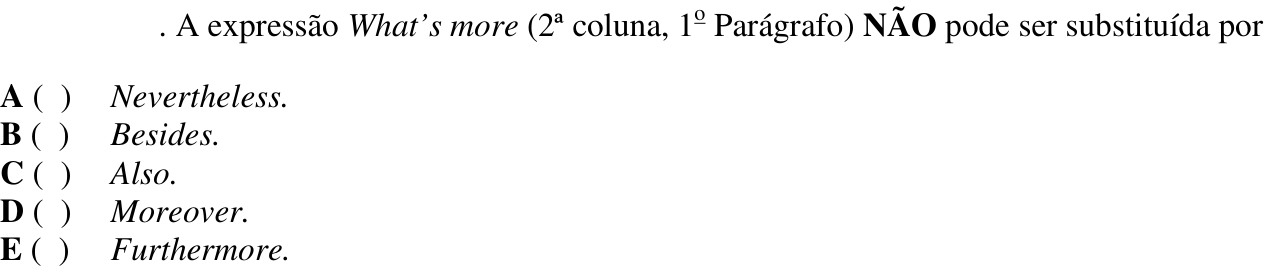
A expressão What’s more (2a coluna, 1o Parágrafo) NÃO pode ser substituída por
- ANevertheless.
- BBesides.
- CAlso.
- DMoreover.
- EFurthermore.
Você já respondeu questões neste aparelho. Crie sua conta grátis para guardar o histórico e refazer as que errou.
Resposta salva no seu histórico.
Reportar erro na questão
Resolução comentada
What's more é um conector aditivo: serve para acrescentar um argumento novo ao que já foi dito, equivale a "além disso". No texto, Truchard diz que a formação em física criou uma base para o trabalho e então acrescenta: "What's more, the physics background helps create good intuition". A segunda frase soma mais uma vantagem à primeira, sem contraste.
Vamos ver cada opção:
- Besides significa "além disso", então pode substituir.
- Also significa "também", então pode substituir.
- Moreover significa "além do mais", então pode substituir.
- Furthermore significa "além disso", então pode substituir.
- Nevertheless significa "no entanto" ou "mesmo assim". É um conector de oposição ou concessão, e o trecho não tem contraste: a ideia seguinte reforça a anterior.
Portanto, a única opção que mudaria o sentido do trecho, e que não pode substituir a expressão, é Nevertheless.
Alternativa A.
Por que as outras alternativas estão erradas
- BBesides é aditivo ("além disso") e pode substituir a expressão.
- CAlso é aditivo ("também") e mantém o sentido de acréscimo.
- DMoreover é sinônimo direto de what's more, "além do mais".
- EFurthermore também é aditivo ("além disso") e pode substituir a expressão.
Assunto: Conectivos e relações lógicas.
Reportar erro na resolução
Ver como caiu na prova
Fonte: ITA 2008 · Inglês. Prova oficial ↗