PRÁTICA COM QUESTÕES OFICIAIS
Questão 28 (Português e Inglês) da 2ª fase do IME 2027
PARA AS QUESTÕES DE 21 A 30, RESPONDA DE ACORDO COM O TEXTO 3 A SEGUIR. · Português e Inglês
Texto 3
A Pilot of Many Firsts: Amelia Earhart’s Enduring Legacy 94 Years Ago, She Flew Solo Across the Atlantic
At age 20, while serving as a Red Cross nurse’s aide in Toronto in 1917, Amelia Mary Earhart’s interest in flight was sparked by stories she heard from World War I pilots. Three years later in Los Angeles she paid $10 (equivalent to $160 today) to take a brief flight in an airplane piloted by air racer Frank Hawks. “By the time I had got two or three hundred feet off the ground,” she said, “I knew I had to fly.”
Working as a photographer, truck driver and telephone company stenographer, Earhart saved enough to take flying lessons from pilot Anita “Neta” Snook. She also purchased a chromium yellow Kinner Airster airplane nicknamed “The Canary” with which she set in 1922 her first world record for a woman pilot by flying at the altitude of 14,000 feet. By 1932, Earhart was known as the first woman to cross the Atlantic in an airplane (which she accomplished in 1928 as a passenger because she wasn’t instrument rated) and as the first woman to fly an autogiro (a rotorcraft that generates lift using an unpowered, freely spinning rotor) as well as being a competitive air racer.
On May 20, 1932, the fifth anniversary of Charles Lindbergh’s transatlantic flight, Earhart took off from Harbour Grace, Newfoundland, in a Lockheed Vega 5B aircraft, aiming to fly to Paris. Fourteen hours and 56 minutes later, after a journey of 2,026 miles, she landed in a pasture near Culmore, Northern Ireland. During her history-making flight as the first woman and second person to fly solo across the Atlantic, Earhart battled nausea and dealt with strong northerly winds, icy conditions that forced her to fly just above the ocean’s waves, and a broken exhaust manifold that caused flames to shoot out of the side of the engine. In recognition of her achievement, Congress awarded Earhart the Distinguished Flying Cross, and President Herbert Hoover presented her the National Geographic Society’s Gold Medal.
Earhart would go on to set many other records, including being the first person to fly nonstop and solo from Hawaii to the U.S. mainland and setting the speed record between Mexico City and Washington, D.C. She used her fame to advocate for opportunities for women in all walks of life and served as the first president of the women’s pilot organization, ‘The Ninety-Nines.’ And yes, her untimely death while attempting the first circumnavigation of the globe in 1937 in a Lockheed Electra 10E airplane has become the stuff of mythology. It is the focus of the National Archives’ recent release of over 4,000 pages of documentary materials related to her disappearance in the western Pacific.
Perhaps Earhart’s legacy is best summed up by her statement: “The most difficult thing is the decision to act. The rest is merely tenacity. The fears are paper tigers.”
Adapted from:<https://www.faa.gov/blog/clearedfortakeoff/pilot-many-firsts-amelia earharts-enduring-legacy> [Accessed on June 30th, 2026].
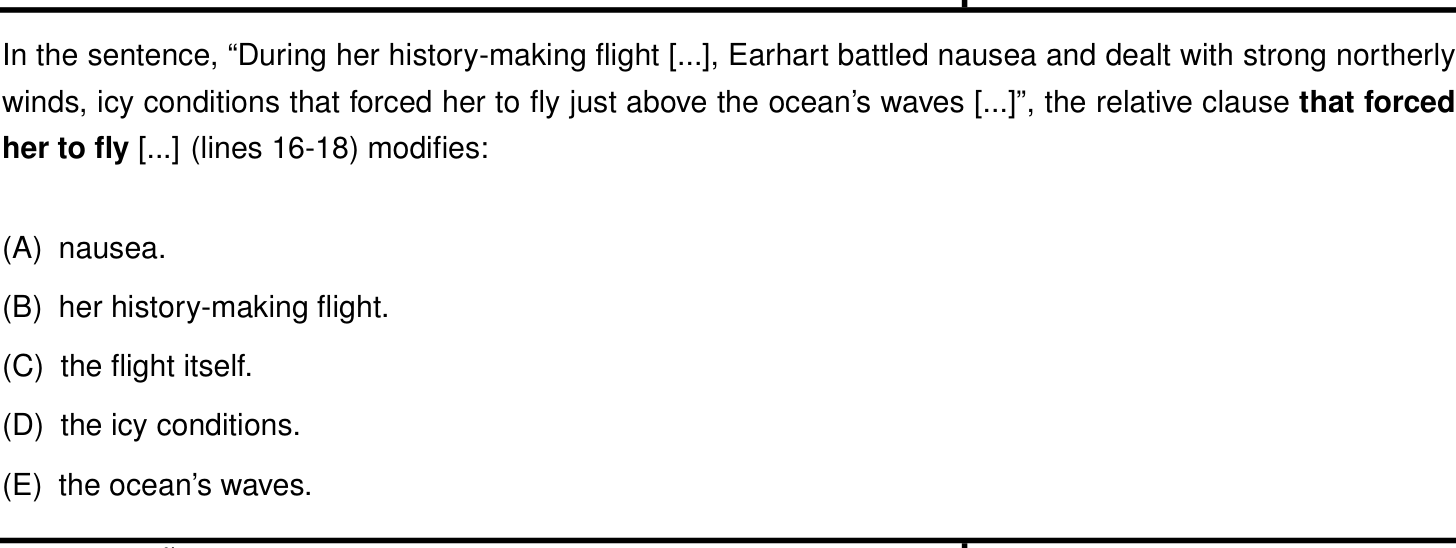
In the sentence, “During her history-making flight [...], Earhart battled nausea and dealt with strong northerly winds, icy conditions that forced her to fly just above the ocean’s waves [...]”, the relative clause that forced her to fly [...] (lines 16-18) modifies:
- Anausea.
- Bher history-making flight.
- Cthe flight itself.
- Dthe icy conditions.
- Ethe ocean’s waves.
Você já respondeu questões neste aparelho. Crie sua conta grátis para guardar o histórico e refazer as que errou.
Resposta salva no seu histórico.
Reportar erro na questão
Resolução comentada
Uma oração relativa com that se refere a um termo anterior, o antecedente, e o modifica. Para achá-lo, pergunte: o que "forçou" Earhart a voar logo acima das ondas?
- Na frase, "strong northerly winds, icy conditions" formam uma aposição à lista anterior. "Icy conditions" é o último núcleo nominal antes de that.
- O verbo da relativa é forced, no passado e sem s. Ele concorda com um sujeito plural ou com um sujeito sem marca de singular, e conditions é plural. Nausea e flight são singulares, mas nem o sentido os aceita.
- Pelo sentido, não é a náusea que obriga a voar baixo. Os fatores externos, como o gelo, é que obrigam: o gelo se acumula nas asas em altitude, então ela precisou descer até perto do mar.
- The ocean's waves é só o complemento de just above e não pode ser quem "forçou".
Logo, that forced her to fly just above the ocean's waves modifica the icy conditions.
Alternativa D.
Por que as outras alternativas estão erradas
- ANausea é singular e está longe da relativa; náusea não obriga a voar baixo.
- BA flight é o termo da abertura da frase, distante de that; o sentido não cabe.
- CÉ a mesma ideia de B, e o voo em si não foi a causa de ter de voar baixo.
- EThe ocean's waves é o objeto da locução just above, posterior ao verbo forced, e não pode ser seu sujeito.
Assunto: Referência pronominal e pronomes.
Reportar erro na resolução
Ver como caiu na prova
Fonte: IME 2ª fase 2027 · Português e Inglês. Prova oficial ↗