Questão 58 da FUVEST 2026
Texto para as questões 58 e 59 · V1
Nearly a century ago, Edwin Hubble discovered that the universe is getting larger. Modern measurements of how fast it is expanding disagree, however, suggesting that our understanding of the laws of physics might be off. Everyone expected the sharp vision of the James Webb Space Telescope to bring the answer into focus. But a long-awaited analysis of the telescope’s observations released late Monday evening once again gleans conflicting expansion rates from different types of data, while homing in on possible sources of error at the heart of the conflict.
Two rival teams have led the effort to measure the cosmic expansion rate, which is known as the Hubble constant, or \text{H}_0. One of these teams, led by Adam Riess of Johns Hopkins University, has consistently measured \text{H}_0 to be about 8 percent higher than the theoretical prediction for how fast space should be expanding, based on the cosmos’s known ingredients and governing equations. This discrepancy, known as the Hubble tension, suggests that the theoretical model of the cosmos might be missing something—some extra ingredient or effect that speeds up cosmic expansion.
Riess and his team released their latest measurement of \text{H}_0 based on Webb data this spring, getting a value that agrees with their earlier estimates.
But for years a rival team led by Wendy Freedman of the University of Chicago has urged caution, arguing that cleaner measurements were needed. Her team’s own measurements of \text{H}_0 have invariably landed closer than Riess’ to the theoretical prediction, implying that the Hubble tension may not be real.
Since the Webb telescope started taking data in 2022, the astrophysics community has awaited Freedman’s multipronged analysis using the telescope’s observations of three types of stars. Now, the results are in: Two types of stars yield \text{H}_0 estimates that align with the theoretical prediction, while the third—the same type of star Riess uses—matches his team’s higher \text{H}_0 value.
Disponível em https://wired.com/. 08 Sep 2024. Adaptado.
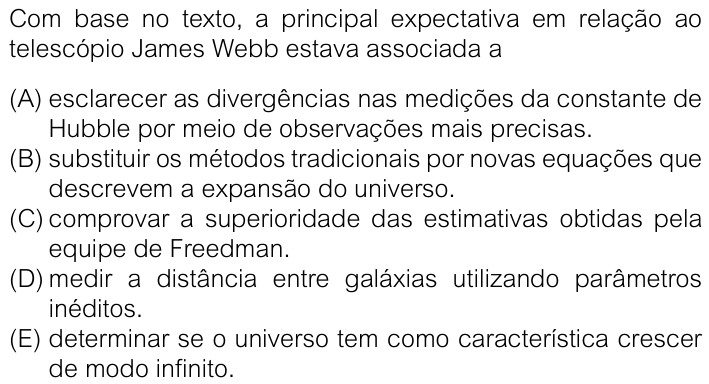
Com base no texto, a principal expectativa em relação ao telescópio James Webb estava associada a
- Aesclarecer as divergências nas medições da constante de Hubble por meio de observações mais precisas.
- Bsubstituir os métodos tradicionais por novas equações que descrevem a expansão do universo.
- Ccomprovar a superioridade das estimativas obtidas pela equipe de Freedman.
- Dmedir a distância entre galáxias utilizando parâmetros inéditos.
- Edeterminar se o universo tem como característica crescer de modo infinito.
Reportar erro na questão
Resolução comentada
O trecho que responde à questão está no primeiro parágrafo: "Everyone expected the sharp vision of the James Webb Space Telescope to bring the answer into focus". Em português: "Todos esperavam que a visão aguçada do telescópio James Webb trouxesse a resposta para o foco".
Precisamos saber de que "resposta" se fala. A frase anterior explica: as medições modernas da velocidade de expansão do universo (a constante de Hubble, \text{H}_0) discordam entre si. Logo, a expectativa era que o telescópio, com sua visão nítida (observações mais precisas), resolvesse essa divergência.
O próprio texto mostra que a expectativa foi frustrada: a análise "once again gleans conflicting expansion rates", ou seja, continuou apresentando taxas conflitantes. Mas a pergunta é sobre o que se esperava, não sobre o resultado.
Conferindo as demais opções: o texto não fala em substituir métodos nem em criar novas equações; nenhuma das equipes é apontada de antemão como superior; não há menção a parâmetros inéditos para medir distâncias; e a questão de o universo crescer infinitamente nem aparece.
Alternativa A.
Por que as outras alternativas estão erradas
- BO texto não menciona substituir métodos tradicionais nem novas equações; as equações teóricas são o que se quer testar.
- CO Webb não foi esperado para dar razão a Freedman; o resultado, aliás, deu razão parcial a ambas as equipes.
- DNão há referência a medir distâncias entre galáxias com parâmetros inéditos; o foco é a taxa de expansão.
- EO texto não discute se o universo cresce infinitamente, apenas a velocidade atual da expansão.
Assuntos: interpretação de texto, constante de Hubble.
Reportar erro na resolução
Ver como caiu na prova