Questão 42 da FUVEST 2022
TEXTO PARA AS QUESTÕES DE 42 A 44
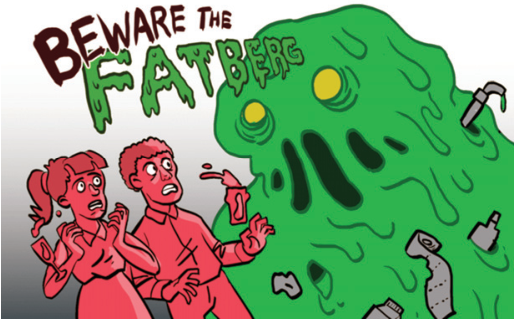
Fatbergs are a growing scourge infesting cities around the world—some are more than 800 feet long and weigh more than four humpback whales. These gross globs, which can cause sewer systems to block up and even overflow, have been plaguing the U.S., Great Britain and Australia for the past decade, forcing governments and utilities companies to send workers down into the sewers armed with water hoses, vacuums and scrapers with the unenviable task of prying them loose.
"It is hard not to think of [fatbergs] as a tangible symbol of the way we live now, the ultimate product of our disposable, out of sight, out of mind culture," wrote journalist Tim Adams in The Guardian.
At their core, fatbergs are the accumulation of oil and grease that's been poured down the drain, congealing around flushed nonbiological waste like tampons, condoms and baby wipes. When fat sticks to the side of sewage pipes, the wipes and other detritus get stuck, accumulating layer upon layer of gunk in a sort of slimy snowball effect.
Fatbergs also collect other kinds of debris—London fatbergs have been cracked open to reveal pens, false teeth and even watches.
Restaurants are a big contributor to fatbergs: Thames Water, the London utilities company, found nine out of 10 fast-food eateries lacked adequate grease traps to stop fat from entering the sewers. Homeowners also contribute to the problem by pouring grease and fat down the sink.
Even though its component materials are soft, fatbergs themselves can be tough as rocks. Researchers have found a host of dangerous bacteria in fatbergs, including listeria and e.coli.
Fatbergs are notorious for their fetid smell, which can make even the hardiest sewer workers gag, and chipping away at one can release noxious gases.
The key to fatberg prevention is remembering the four Ps: Pee, poo, puke and (toilet) paper are the only things that should be flushed.
Newsweek, 14 March, 2019. Adaptado.
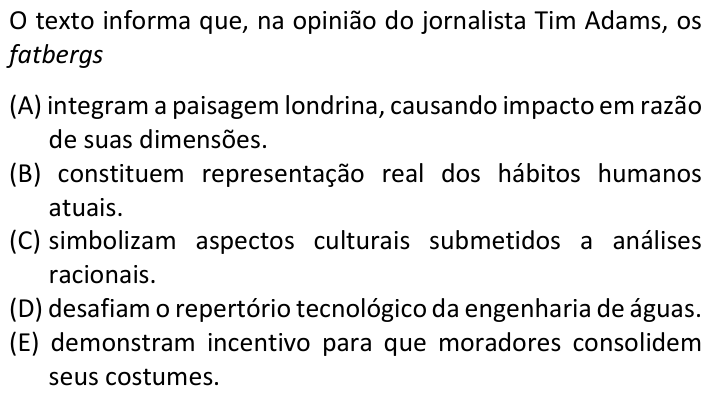
O texto informa que, na opinião do jornalista Tim Adams, os fatbergs
- Aintegram a paisagem londrina, causando impacto em razão de suas dimensões.
- Bconstituem representação real dos hábitos humanos atuais.
- Csimbolizam aspectos culturais submetidos a análises racionais.
- Ddesafiam o repertório tecnológico da engenharia de águas.
- Edemonstram incentivo para que moradores consolidem seus costumes.
Reportar erro na questão
Resolução comentada
O trecho de Tim Adams diz: "It is hard not to think of [fatbergs] as a tangible symbol of the way we live now, the ultimate product of our disposable, out of sight, out of mind culture". Em português: é difícil não pensar nos fatbergs como um símbolo tangível (concreto, palpável) do nosso modo de vida atual, o produto máximo de uma cultura descartável, do "longe dos olhos, longe da mente".
Ou seja, para o jornalista, o fatberg é a materialização visível dos hábitos de consumo e descarte de hoje: jogamos fora o que não queremos ver e esquecemos o problema.
Comparando com as alternativas:
- A fala de Adams não trata de Londres nem das dimensões dos fatbergs.
- Ele não fala de engenharia nem de tecnologia para limpeza de esgotos.
- Ele não fala de análise racional; ao contrário, fala de uma cultura que não quer pensar no assunto ("out of mind").
- Ele não fala de incentivo a costumes.
- "Tangible symbol of the way we live now" corresponde a uma representação concreta dos hábitos humanos atuais.
Alternativa B.
Por que as outras alternativas estão erradas
- AAdams não fala de paisagem londrina nem de tamanho; isso vem de outros trechos do texto.
- CA citação critica uma cultura do descarte e do não pensar, não fala de análise racional.
- DA opinião de Adams não trata de tecnologia ou engenharia de águas.
- EOs fatbergs são apresentados como resultado dos hábitos, não como incentivo para consolidá-los.
Assuntos: interpretação de texto, inglês.
Reportar erro na resolução
Ver como caiu na prova