PRÁTICA COM QUESTÕES OFICIAIS
Questão 58 da FUVEST 2021
Texto-base das questões 56 a 58
TEXTO PARA AS QUESTÕES DE 56 A 58
As astronomers gaze into the depths of space, they do so with unease: They don’t know precisely what the universe is made of.
Surprisingly, no one knows the stars’ exact chemical composition: how many carbon, nitrogen and oxygen atoms they have relative to hydrogen, the most common element.
These numbers are crucial, because they affect how stars live and die, what types of planets form and even how readily life might arise on other worlds.
Twenty years ago, astronomers expressed confidence in the numbers they had been working with. Now, not so much. The problem lies not in the far corners of the cosmos, but much closer to home. Astonishingly, scientists don’t know exactly what the sun is made of. As a result, they don’t know what the other stars are made of, either.
“The sun is a fundamental yardstick,” says Martin Asplund, an astrophysicist at the Max Planck Institute for Astrophysics, in Germany. “When we determine the abundance of a certain element in a star or a galaxy or a gas cloud anywhere in the universe, we use the sun as a reference point.”
The sun’s location in the Milky Way also makes it a good representative of the entire galaxy. Most stars reside in giant galaxies like the Milky Way, which makes the sun a touchstone for the entire cosmos.
For nearly a century, astronomers have judged stars normal or not by seeing whether their chemical compositions match the sun’s. Most stars near us do; some don’t.
Scientific American. 1 July 2020. Adaptado.
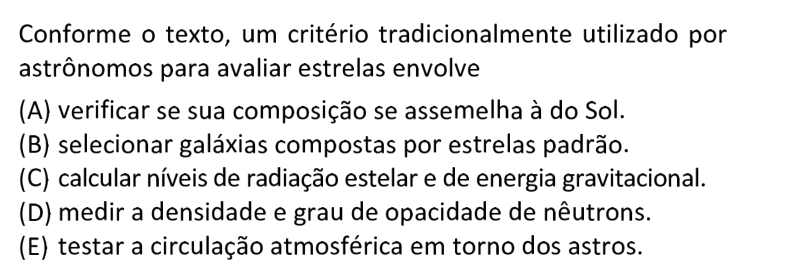
Conforme o texto, um critério tradicionalmente utilizado por astrônomos para avaliar estrelas envolve
- Averificar se sua composição se assemelha à do Sol.
- Bselecionar galáxias compostas por estrelas padrão.
- Ccalcular níveis de radiação estelar e de energia gravitacional.
- Dmedir a densidade e grau de opacidade de nêutrons.
- Etestar a circulação atmosférica em torno dos astros.
Você já respondeu questões neste aparelho. Crie sua conta grátis para guardar o histórico e refazer as que errou.
Resposta salva no seu histórico.
Reportar erro na questão
Resolução comentada
A pergunta pede o critério que os astrônomos usam tradicionalmente para julgar estrelas. Procure no texto a referência ao tempo: o último parágrafo diz "For nearly a century, astronomers have judged stars normal or not by seeing whether their chemical compositions match the sun's".
Traduzindo: "Há quase um século, os astrônomos julgam se as estrelas são normais ou não vendo se suas composições químicas coincidem com a do Sol".
Isso reforça a ideia anterior do texto, em que o Sol é uma "régua fundamental" (fundamental yardstick) e um ponto de referência para medir a abundância de elementos em estrelas, galáxias e nuvens de gás.
Portanto, o critério é comparar a composição química da estrela com a do Sol.
As demais alternativas citam procedimentos que o texto não menciona: selecionar galáxias, calcular radiação e energia gravitacional, medir densidade e opacidade de nêutrons, ou testar circulação atmosférica. O texto só trata de composição química (carbono, nitrogênio, oxigênio em relação ao hidrogênio).
Alternativa A.
Por que as outras alternativas estão erradas
- BO texto diz que o Sol representa a galáxia, mas não fala em selecionar galáxias de estrelas padrão como critério de avaliação.
- CRadiação estelar e energia gravitacional não são citadas no texto.
- DDensidade e opacidade de nêutrons não aparecem no texto.
- ECirculação atmosférica dos astros não é mencionada; o critério é químico.
Assunto: Informações explícitas e detalhes.
Reportar erro na resolução
Ver como caiu na prova