Questão 38 da FUVEST 2010
Texto para as questões de 36 a 38

Last month America’s unemployment rate climbed to 8,1%, the highest in a quarter of a century. For those newly out of a job, the chances of finding another soon are the worst since records began 50 years ago. In China 20m migrant workers (maybe 3% of the labour force) have been laid off. Cambodia’s textile industry, its main source of exports, has cut one worker in ten. In Spain the building bust has pushed the jobless rate up by two-thirds in a year, to 14.8% in January. And in Japan, where official unemployment used to be all but unknown, tens of thousands of people on temporary contracts are losing not just their jobs but also the housing provided by their employers.
The next phase of the world’s economic downturn is taking shape: a global jobs crisis. Its contours are only just becoming clear, but the severity, breadth and likely length of the recession, together with changes in the structure of labour markets in both rich and emerging economies, suggest the world is about to undergo its biggest increase in unemployment for decades.
The Economist, March 14th 2009.
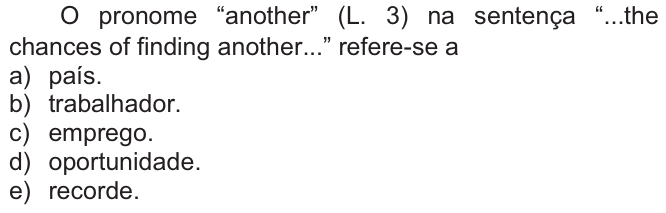
O pronome “another” (L. 3) na sentença “...the chances of finding another...” refere-se a
- Apaís.
- Btrabalhador.
- Cemprego.
- Doportunidade.
- Erecorde.
Reportar erro na questão
Resolução comentada
O pronome another ('outro/outra') substitui um substantivo que já foi mencionado, para não repeti-lo. Por isso, é preciso descobrir qual substantivo foi omitido depois dele.
O trecho completo é: "For those newly out of a job, the chances of finding another soon are the worst since records began 50 years ago."
- Those newly out of a job são as pessoas que acabaram de ficar sem emprego ("a job").
- A estrutura é finding another (job), ou seja, "encontrar outro emprego".
- Em tradução: "para os que acabaram de perder o emprego, as chances de encontrar outro em breve são as piores desde que os registros começaram, há 50 anos".
Testando as demais opções: worker não faz sentido, pois quem procura é o trabalhador, e não ele que é encontrado. Country e record aparecem no texto, mas não se encaixam semanticamente. Chance (oportunidade) já é o núcleo da expressão "chances of finding", e another chance of finding seria redundante e sem lógica.
O que se encontra é outro job, retomando a expressão "out of a job".
Alternativa C.
Por que as outras alternativas estão erradas
- A'Country' não faz sentido: ninguém procura 'encontrar outro país' nesse contexto; América é só o lugar da taxa de desemprego.
- BO desempregado procura um posto de trabalho, não outro trabalhador.
- D'Chances' é o substantivo antes de 'of finding'; o que se encontra é o emprego, não outra oportunidade.
- E'Records' aparece depois, em 'since records began', e não é algo que se 'encontre' como objeto da busca.
Assuntos: referência pronominal, interpretação de texto em inglês.
Reportar erro na resolução
Ver como caiu na prova