PRÁTICA COM QUESTÕES OFICIAIS
Questão 40 (1º exame) da FUVEST 2002
Texto para as questões de 36 a 40 · V
IF PUBLIC speaking gives you the willies, the chances are you’ll be just as scared of virtual people, experts have discovered. But in the long run these “avatars” will help you overcome your fears.
Mel Slater at University College London, and his colleague David-Paul Pertaub have developed a VR environment to help people overcome their phobias. In their virtual seminar room, people have to give a presentation to eight computer-generated people who can appear by turns fascinated, bored stiff or just annoyingly neutral.
While it’s not the first time VR has been used to treat phobias, such as fear of spiders or flying, no one knew if the technique could also help people to overcome their social phobias.
To find out, Pertaub watched how people behave in seminars and programmed the virtual people to do the same things: crossing their arms, frowning, yawning and putting their feet on the table. “Our negative audience is very negative,” says Slater.
Then Slater and Pertaub compared the performances of 43 volunteers who gave a talk either to an attentive audience or to an unenthusiastic one. Surprisingly, the subjects responded as if the avatars were real.
21 July 2001 • New Scientist • www.newscientist.com
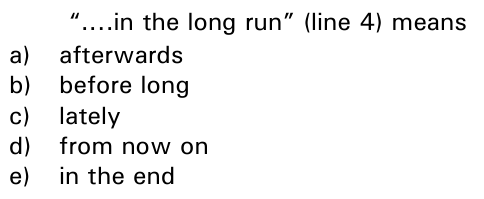
“....in the long run” (line 4) means
- Aafterwards
- Bbefore long
- Clately
- Dfrom now on
- Ein the end
Você já respondeu questões neste aparelho. Crie sua conta grátis para guardar o histórico e refazer as que errou.
Resposta salva no seu histórico.
Reportar erro na questão
Resolução comentada
A expressão in the long run indica o resultado final, depois de um período longo de tempo. Em português, equivale a "a longo prazo" ou "no fim das contas".
No texto: "But in the long run these 'avatars' will help you overcome your fears". Ou seja, o medo de falar em público pode até aparecer no começo, mas, com o tempo e o uso, os avatares ajudarão a vencê-lo.
Agora compare com as alternativas:
- afterwards = depois, em seguida. Marca apenas posterioridade, sem a ideia de longo prazo.
- before long = daqui a pouco, em breve. É o contrário de long run, que fala em prazo longo.
- lately = ultimamente, recentemente. Refere-se ao passado.
- from now on = de agora em diante. Marca um ponto de partida, não o resultado final.
- in the end = no final, por fim. É o que mais se aproxima do sentido de resultado final após um longo processo.
Portanto, o sentido mais próximo é in the end.
Alternativa E.
Pegadinha: A alternativa B engana por conter a palavra "long" e soar parecida, mas "before long" significa em breve, o oposto de longo prazo.
Por que as outras alternativas estão erradas
- A"afterwards" só indica algo posterior, sem a ideia de resultado final a longo prazo.
- B"before long" significa em breve, ou seja, curto prazo, o oposto de "in the long run".
- C"lately" significa recentemente e refere-se ao passado, enquanto o texto fala do futuro.
- D"from now on" significa de agora em diante, indicando início de uma situação e não o resultado final.
Assunto: Expressões idiomáticas e phrasal verbs.
Reportar erro na resolução
Ver como caiu na prova
Fonte: FUVEST 2002 · 1º exame. Prova oficial ↗