PRÁTICA COM QUESTÕES OFICIAIS
Questão 21 da FMABC 2026
Leia o texto para responder às questões de 21 a 25. · Conhecimentos Gerais
Global population growth is expected to slow between now and 2100. The population more than tripled in the last 75 years, but the United Nations (UN) expects it to grow by only about 1.9 billion between now and 2100 (from 8.2 billion to 10.2 billion). The population is expected to peak at 10.3 billion in 2084 and then decline to 10.2 billion through the end of the century.
The world’s three most populous countries in 2025 are expected to have radically different trajectories in the coming decades. Those countries are India (which has about 1.5 billion people today), China (1.4 billion) and the United States (347 million). India is expected to continue growing until it peaks at 1.7 billion people in 2061. Then it’s expected to gradually decline to 1.5 billion by 2100. China’s population has begun to shrink. It is projected to fall sharply to 633 million by 2100. Meanwhile, the United States (US) population is expected to grow slowly and steadily to 421 million by 2100.
Also, the world’s population is expected to get older. The world’s median age is projected to rise to 42 by 2100, up from 31 today and 22 in 1950. The number of people ages 65 and older is expected to more than double, from 857 million today to 2.4 billion by 2100. That would increase their share of the global population from 10% to 24%. By 2100, the world is expected to have roughly equal shares of people under 25 and people 65 and older. That would be a major shift from today, when younger people outnumber older adults by about four-to-one. In 1950, that gap was even wider, at about ten-to-one.
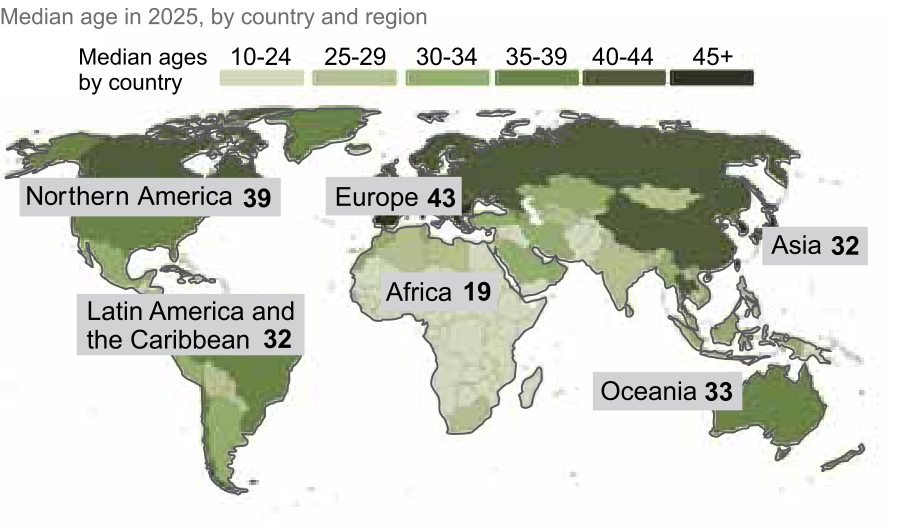
Looking at countries rather than regions, the median age in the US is 39. It ranks among the oldest third of countries globally but is slightly younger than many high-income countries in Europe and East Asia.
(Manolo Corichi et al. www.pewresearch.org, 09.07.2025. Adaptado.)
According to the text,
- Athe median age of the world’s population will stay unchanged until 2100.
- Byoung people will always outnumber older adults throughout this century.
- CChina’s population will grow significantly until the end of the century.
- Dthe global population will keep shrinking rapidly before growing again later on.
- Ethe world’s population is projected to decrease slightly after peaking in 2084.
Você já respondeu questões neste aparelho. Crie sua conta grátis para guardar o histórico e refazer as que errou.
Resposta salva no seu histórico.
Reportar erro na questão
Resolução comentada
Vamos conferir cada afirmação com o texto.
O primeiro parágrafo diz que a população mundial deve atingir o pico de 10,3 bilhões em 2084 e depois cair para 10,2 bilhões até o fim do século. A queda é de apenas 0,1 bilhão, ou seja, uma redução pequena.
Isso corresponde à alternativa E: a população "is projected to decrease slightly after peaking in 2084" ("deve diminuir levemente depois de atingir o pico em 2084").
As demais contradizem o texto:
- A idade mediana mundial sobe de 31 hoje para 42 em 2100, então não fica inalterada.
- Em 2100, os jovens (menos de 25 anos) e os idosos (65 anos ou mais) terão participações aproximadamente iguais. Logo, os jovens não superam os idosos o tempo todo.
- A população da China já começou a encolher e deve cair para 633 milhões em 2100, não crescer.
- A população global ainda cresce até 2084, e só depois cai levemente. Não há encolhimento rápido seguido de retomada.
Alternativa E.
Por que as outras alternativas estão erradas
- AO texto diz que a idade mediana mundial sobe de 31 para 42 até 2100.
- BEm 2100 jovens e idosos terão participações praticamente iguais, então os jovens não superam os idosos durante todo o século.
- CA China já encolhe e deve cair para 633 milhões em 2100.
- DA população global cresce até 2084 e depois cai só levemente, sem retomada do crescimento.
Assunto: Informações explícitas e detalhes.
Reportar erro na resolução
Ver como caiu na prova
Fonte: FMABC 2026 · Conhecimentos Gerais. Prova oficial ↗