PRÁTICA COM QUESTÕES OFICIAIS
Questão 13 da FAMERP 2025
Leia o texto e examine o gráfico para responder às questões de 11 a 17. · Conhecimentos Gerais
When Tinder (a mobile dating app) was launched on college campuses in America in 2012, it quickly became a hit. Although online dating had been around since Match.com, a website for lonely hearts, launched in 1995, it had long struggled to shed1 an image of desperation. But Tinder, by letting users sift through photos of countless potential dates with a simple swipe, made it easy and fun.
Soon Tinder and its rivals had transformed dating. A report found that 30% of American adults had used an online dating service, including more than half of those aged between 18 and 29. One in five couples of that age had met through such a service. Usage surged during the pandemic, as lonely locked-down singles searched for partners. The market capitalisation of Bumble, a rival to Tinder, surged to $13 billion on its first day of trading2 in February 2021. Later that year the value of Match Group, which owns Tinder, Hinge and scores of other dating services, reached nearly $50 billion.
Today roughly 350 million people around the world have a dating app on their phone, up from 250 million in 2018, according to a research firm. In June 2024 Tokyo’s government even said it would launch a matchmaking app of its own to pair up singles in the city. Yet lately online dating has lost its spark. The apps were downloaded 237 million times globally in 2023, down from 287 million in 2020. According to a research firm, the number of people who use them at least once a month has dwindled from 154 million in 2021 to 137 million in the second quarter of 2024.
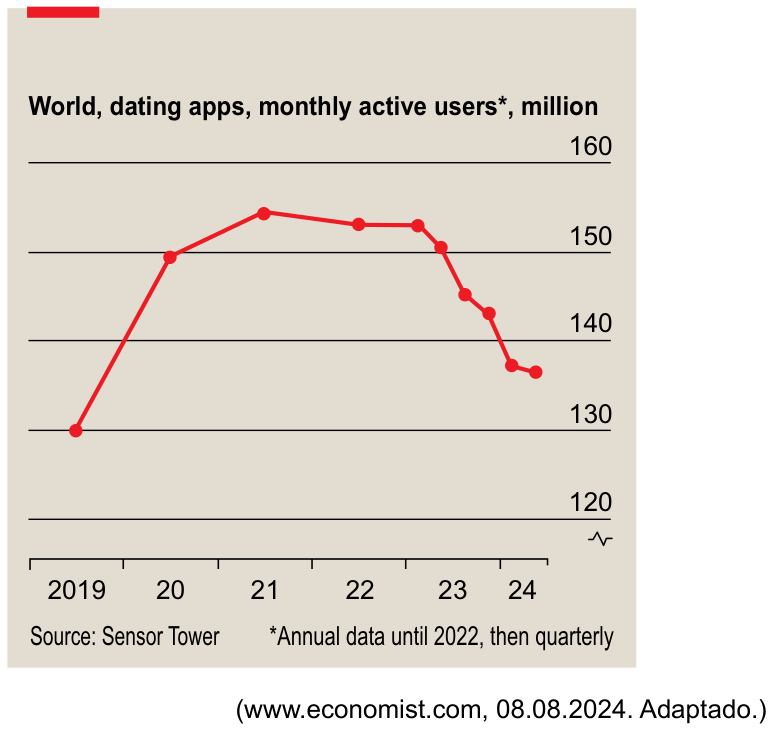
(www.economist.com, 08.08.2024. Adaptado.)
1 to shed: to get rid of something that is no longer wanted.
2 trading: the activity of buying and selling things.
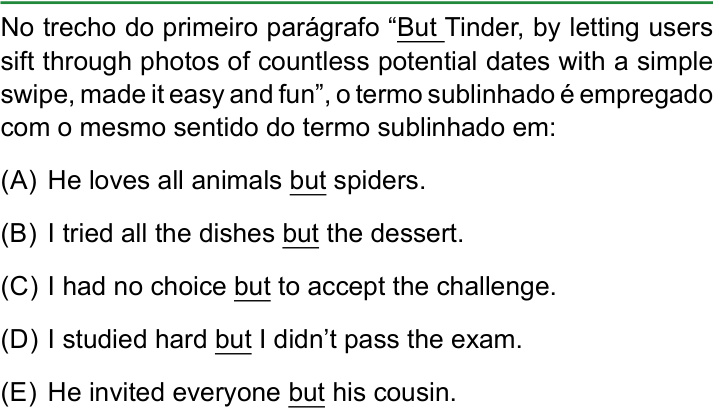
No trecho do primeiro parágrafo “But Tinder, by letting users sift through photos of countless potential dates with a simple swipe, made it easy and fun”, o termo sublinhado é empregado com o mesmo sentido do termo sublinhado em:
- AHe loves all animals but spiders.
- BI tried all the dishes but the dessert.
- CI had no choice but to accept the challenge.
- DI studied hard but I didn’t pass the exam.
- EHe invited everyone but his cousin.
Você já respondeu questões neste aparelho. Crie sua conta grátis para guardar o histórico e refazer as que errou.
Resposta salva no seu histórico.
Reportar erro na questão
Resolução comentada
No texto, "But" é conjunção coordenativa adversativa: contrasta a ideia anterior (o namoro online "had long struggled to shed an image of desperation", ou seja, tinha má fama) com a nova (o Tinder o tornou fácil e divertido). Equivale a "mas", "porém".
A palavra "but" tem mais de um uso em inglês, então vale conferir cada frase:
- (A) "all animals but spiders": aqui "but" é preposição de exceção, com sentido de "exceto" ("todos os animais, menos aranhas").
- (B) "all the dishes but the dessert": também exceção, "todos os pratos, menos a sobremesa".
- (C) "no choice but to accept": "but" = "other than", ou seja, "nenhuma escolha a não ser aceitar". Também é exceção.
- (D) "I studied hard but I didn't pass": "but" liga duas orações opostas, com sentido de "mas". Estudei muito, porém não passei. É a mesma ideia de contraste do texto.
- (E) "everyone but his cousin": exceção, "todos, menos o primo".
Só em (D) o "but" é conjunção adversativa, como no trecho do Tinder.
Alternativa D.
Pegadinha: As alternativas A, B, C e E usam "but" com sentido de exceção ("exceto"), que engana quem só pensa em "but" = "mas"; só a D mantém o sentido adversativo.
Por que as outras alternativas estão erradas
- A"but" é preposição de exceção ("exceto aranhas"), não conjunção adversativa.
- B"but the dessert" indica exceção ("menos a sobremesa"), não contraste entre orações.
- C"no choice but to" significa "nenhuma escolha a não ser", sentido de exceção.
- E"everyone but his cousin" quer dizer "todos menos o primo", exceção.
Assunto: Conectivos e relações lógicas.
Reportar erro na resolução
Ver como caiu na prova
Fonte: FAMERP 2025 · Conhecimentos Gerais. Prova oficial ↗