PRÁTICA COM QUESTÕES OFICIAIS
Questão 12 da FAMERP 2025
Leia o texto e examine o gráfico para responder às questões de 11 a 17. · Conhecimentos Gerais
When Tinder (a mobile dating app) was launched on college campuses in America in 2012, it quickly became a hit. Although online dating had been around since Match.com, a website for lonely hearts, launched in 1995, it had long struggled to shed1 an image of desperation. But Tinder, by letting users sift through photos of countless potential dates with a simple swipe, made it easy and fun.
Soon Tinder and its rivals had transformed dating. A report found that 30% of American adults had used an online dating service, including more than half of those aged between 18 and 29. One in five couples of that age had met through such a service. Usage surged during the pandemic, as lonely locked-down singles searched for partners. The market capitalisation of Bumble, a rival to Tinder, surged to $13 billion on its first day of trading2 in February 2021. Later that year the value of Match Group, which owns Tinder, Hinge and scores of other dating services, reached nearly $50 billion.
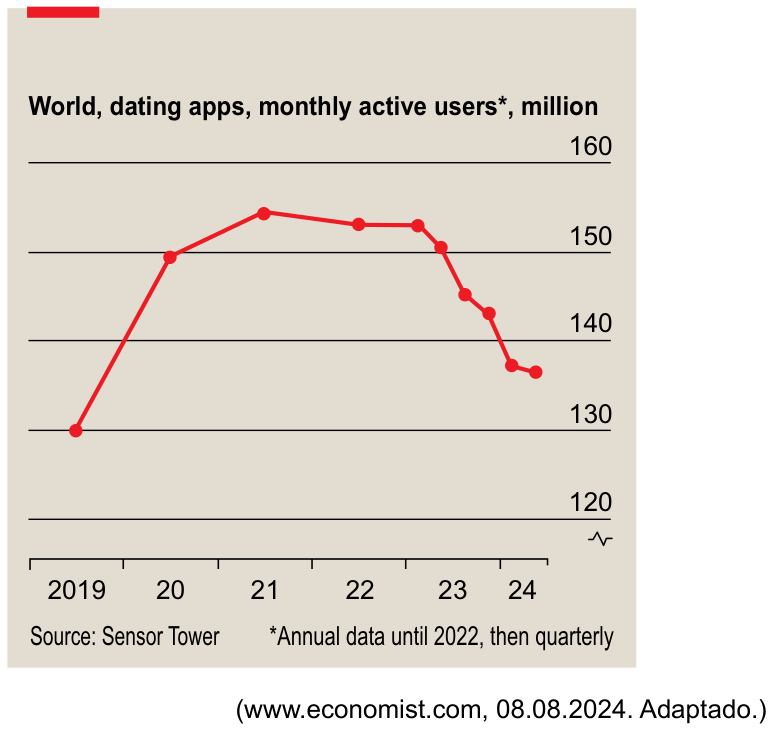
Today roughly 350 million people around the world have a dating app on their phone, up from 250 million in 2018, according to a research firm. In June 2024 Tokyo’s government even said it would launch a matchmaking app of its own to pair up singles in the city. Yet lately online dating has lost its spark. The apps were downloaded 237 million times globally in 2023, down from 287 million in 2020. According to a research firm, the number of people who use them at least once a month has dwindled from 154 million in 2021 to 137 million in the second quarter of 2024.
(www.economist.com, 08.08.2024. Adaptado.)
1 to shed: to get rid of something that is no longer wanted.
2 trading: the activity of buying and selling things.
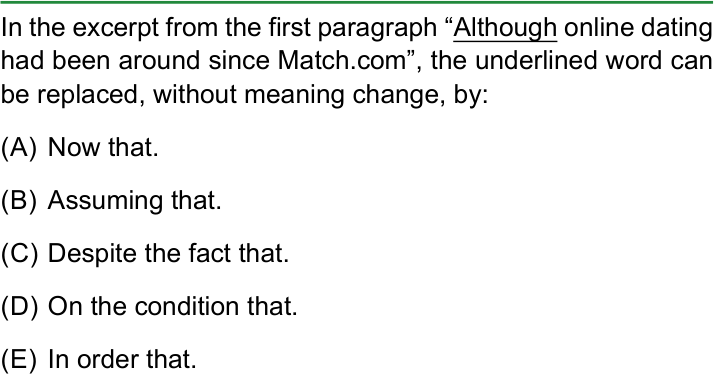
In the excerpt from the first paragraph “Although online dating had been around since Match.com”, the underlined word can be replaced, without meaning change, by:
- ANow that.
- BAssuming that.
- CDespite the fact that.
- DOn the condition that.
- EIn order that.
Você já respondeu questões neste aparelho. Crie sua conta grátis para guardar o histórico e refazer as que errou.
Resposta salva no seu histórico.
Reportar erro na questão
Resolução comentada
"Although" é uma conjunção concessiva: introduz uma ideia que, contrariando a expectativa, não impede o fato da oração principal. Na frase, o namoro online existia desde 1995 (Match.com), mas ainda assim tinha dificuldade de se livrar da imagem de desespero ("had long struggled to shed an image of desperation"). Há, portanto, contraste, e não causa, condição ou finalidade.
Vamos testar cada opção:
- Now that = "agora que", ideia de causa. Não serve.
- Assuming that = "supondo que", hipótese. Não serve.
- Despite the fact that = "apesar de que / embora", concessão. Mantém o sentido.
- On the condition that = "com a condição de que", condição. Não serve.
- In order that = "a fim de que", finalidade. Não serve.
Portanto, a única expressão equivalente a "although" é despite the fact that.
Alternativa C.
Por que as outras alternativas estão erradas
- A"Now that" (agora que) expressa causa, não concessão.
- B"Assuming that" (supondo que) expressa hipótese.
- D"On the condition that" expressa condição, não contraste.
- E"In order that" expressa finalidade.
Assunto: Conectivos e relações lógicas.
Reportar erro na resolução
Ver como caiu na prova
Fonte: FAMERP 2025 · Conhecimentos Gerais. Prova oficial ↗