PRÁTICA COM QUESTÕES OFICIAIS
Questão 16 da FAMERP 2024
Leia o texto para responder às questões de 11 a 16. · Conhecimentos Gerais
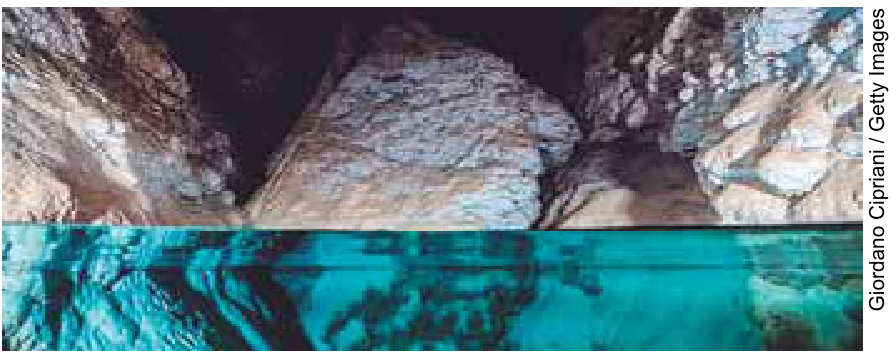
Discoveries of aquifers — underground earth formations that hold water — often create excitement around their ability to ease water scarcity in a region. The United States recently announced the discovery of five aquifers in Niger, one of Africa’s most water scarce countries, containing over 600 billion cubic metres of water. To put it into perspective, Egypt’s current water demand is 114 billion cubic metres of water per year.
These are welcome announcements. Due to a changing climate and the increasing demands of a growing population, many of Africa’s surface water resources — such as dams and rivers — are facing serious risks. They’re being overused and slowly decreasing.
Alternative water sources, like aquifers, need to be explored. They are highly prevalent across the African continent, but they’re not always going to help address water scarcity. For instance, early research findings deemed Kenya’s Turkana aquifer water unfit for use due to high salinity. It’s important to bear these challenges in mind so that expectations can be managed. It is also useful for planners and governments, as they need to think of other ways around the water scarcity problem.
(Gaathier Mahed. https://theconversation.com, 21.03.2023. Adaptado.)
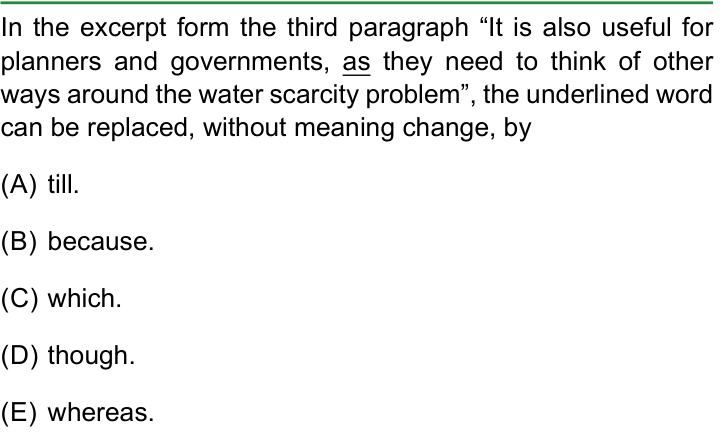
In the excerpt form the third paragraph “It is also useful for planners and governments, as they need to think of other ways around the water scarcity problem”, the underlined word can be replaced, without meaning change, by
- Atill.
- Bbecause.
- Cwhich.
- Dthough.
- Ewhereas.
Você já respondeu questões neste aparelho. Crie sua conta grátis para guardar o histórico e refazer as que errou.
Resposta salva no seu histórico.
Reportar erro na questão
Resolução comentada
Na frase, "as" aparece antes de uma oração que explica a razão de a informação ser útil: é útil para planejadores e governos porque eles precisam pensar em outras formas de contornar a escassez de água. Logo, "as" funciona como conjunção causal, com o mesmo sentido de "because" (porque, já que).
Veja o que cada outra opção faria com a frase:
- till (até): marcaria limite de tempo, o que não faz sentido aqui.
- which (o qual): é pronome relativo e não se encaixa antes de "they need".
- though (embora): indicaria concessão, ideia contrária à da frase.
- whereas (enquanto, ao passo que): indicaria contraste, e não há contraste entre as orações.
Só "because" mantém a relação de causa e consequência original.
Alternativa B.
Por que as outras alternativas estão erradas
- A"till" indica tempo (até), mas a oração expressa causa.
- C"which" é pronome relativo e não pode introduzir a oração "they need..." nesse contexto.
- D"though" expressa concessão (embora), o que inverte o sentido da frase.
- E"whereas" expressa contraste (enquanto), sem relação com a ideia de causa.
Assunto: Conectivos e relações lógicas.
Reportar erro na resolução
Ver como caiu na prova
Fonte: FAMERP 2024 · Conhecimentos Gerais. Prova oficial ↗