PRÁTICA COM QUESTÕES OFICIAIS
Questão 14 do Einstein 2027
Read the text to answer questions from 11 to 14. · Prova I
1 If artificial intelligence (AI) systems shape decisions that affect people’s lives, they should do so impartially. But guaranteeing the fairness1 of AI systems is far more complex than it might sound. What counts as fair in one domain may be inappropriate in another. In criminal justice, fairness may prioritise avoiding disproportionate harm to particular communities. In education, it may focus on equal opportunities for all. In finance, it often involves balancing access to credit with risk analysis.
A deeper issue lies in the data itself. AI systems learn from historical datasets that reflect past decisions, institutional practices, and social inequalities. When a model is trained to replicate observed outcomes, it may reproduce existing injustices under the appearance of objectivity.
Let’s take a look at hiring decisions. If a company historically promoted fewer women into senior roles, an AI system trained to predict “successful” job candidates may learn patterns that favour characteristics more common among men, even if gender is not explicitly included as an input. A fundamental question is whether AI systems mirror the world as it was, or attempt to correct for known injustices.
The idea of fairness is also complicated by how it is assessed. Many assessments examine a single protected attribute, such as gender or race, in isolation. While common, this approach can obscure how discrimination operates in practice. An automated hiring system might appear fair when comparing men and women overall, and fair when comparing ethnic groups overall, yet it might also consistently disadvantage older women from minority backgrounds.
5 Societies change, demographics shift and language evolves. A system that performs satisfactorily today may produce unfair outcomes tomorrow. In particular, recent advances in large language models (LLMs)2 add further complexity. Unlike traditional systems that make specific predictions, LLMs generate language based on vast collections of historical text which, inevitably, contain imbalances. Fairness is therefore an ongoing responsibility requiring monitoring, and a willingness to revise or withdraw systems when harms emerge. Together, challenges suggest that fairness in AI is not a purely technical problem but a moving target shaped by social values and historical context.
(Michael Mayowa Farayola. https://theconversation.com,
12.05.2026. Adapted.)
1 fairness: the quality of being impartial and free from bias.
2 large language models (LLMs): AI systems trained on massive amounts of text data to understand and generate human-like language.
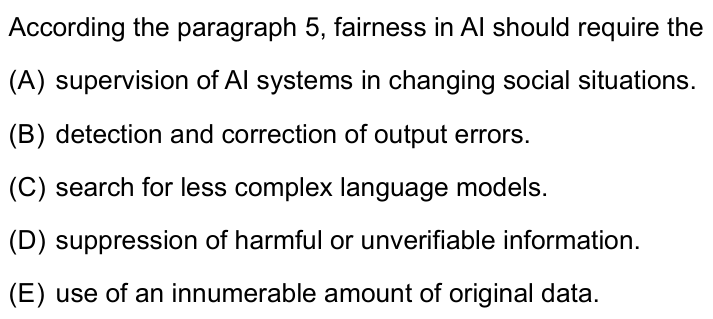
According the paragraph 5, fairness in AI should require the
- Asupervision of AI systems in changing social situations.
- Bdetection and correction of output errors.
- Csearch for less complex language models.
- Dsuppression of harmful or unverifiable information.
- Euse of an innumerable amount of original data.
Você já respondeu questões neste aparelho. Crie sua conta grátis para guardar o histórico e refazer as que errou.
Resposta salva no seu histórico.
Reportar erro na questão
Resolução comentada
O parágrafo 5 (o último) começa dizendo que sociedades mudam, a demografia se altera e a linguagem evolui, então um sistema que hoje funciona bem pode gerar resultados injustos amanhã.
Depois, o texto conclui: "Fairness is therefore an ongoing responsibility requiring monitoring, and a willingness to revise or withdraw systems when harms emerge". Em português: a justiça é uma responsabilidade contínua, que exige monitoramento e disposição para revisar ou retirar sistemas quando surgirem danos.
Ou seja, o que se pede é acompanhar (supervisionar) os sistemas de IA de forma permanente, justamente porque o contexto social muda.
Comparando com as alternativas:
- Supervisionar sistemas em contextos sociais em mudança corresponde a "monitoring" + "societies change".
- Nenhuma outra alternativa tem apoio no trecho: o texto não fala de corrigir erros de saída, de modelos menos complexos, de suprimir informação nem de quantidade enorme de dados.
Portanto, a ideia central do parágrafo é monitoramento contínuo diante de mudanças sociais.
Alternativa A.
Por que as outras alternativas estão erradas
- BO parágrafo fala em monitorar e revisar sistemas quando surgem danos, não em detectar e corrigir erros de saída.
- CO texto diz que os LLMs trazem complexidade, mas não propõe buscar modelos menos complexos.
- DNão há menção a suprimir informação nociva ou não verificável.
- EO texto não defende uma quantidade incontável de dados originais; ao contrário, aponta que dados históricos contêm desequilíbrios.
Assunto: Informações explícitas e detalhes.
Reportar erro na resolução
Ver como caiu na prova
Fonte: Einstein 2027 · Prova I. Prova oficial ↗