PRÁTICA COM QUESTÕES OFICIAIS
Questão 13 do Einstein 2027
Read the text to answer questions from 11 to 14. · Prova I
1 If artificial intelligence (AI) systems shape decisions that affect people’s lives, they should do so impartially. But guaranteeing the fairness1 of AI systems is far more complex than it might sound. What counts as fair in one domain may be inappropriate in another. In criminal justice, fairness may prioritise avoiding disproportionate harm to particular communities. In education, it may focus on equal opportunities for all. In finance, it often involves balancing access to credit with risk analysis.
A deeper issue lies in the data itself. AI systems learn from historical datasets that reflect past decisions, institutional practices, and social inequalities. When a model is trained to replicate observed outcomes, it may reproduce existing injustices under the appearance of objectivity.
Let’s take a look at hiring decisions. If a company historically promoted fewer women into senior roles, an AI system trained to predict “successful” job candidates may learn patterns that favour characteristics more common among men, even if gender is not explicitly included as an input. A fundamental question is whether AI systems mirror the world as it was, or attempt to correct for known injustices.
The idea of fairness is also complicated by how it is assessed. Many assessments examine a single protected attribute, such as gender or race, in isolation. While common, this approach can obscure how discrimination operates in practice. An automated hiring system might appear fair when comparing men and women overall, and fair when comparing ethnic groups overall, yet it might also consistently disadvantage older women from minority backgrounds.
5 Societies change, demographics shift and language evolves. A system that performs satisfactorily today may produce unfair outcomes tomorrow. In particular, recent advances in large language models (LLMs)2 add further complexity. Unlike traditional systems that make specific predictions, LLMs generate language based on vast collections of historical text which, inevitably, contain imbalances. Fairness is therefore an ongoing responsibility requiring monitoring, and a willingness to revise or withdraw systems when harms emerge. Together, challenges suggest that fairness in AI is not a purely technical problem but a moving target shaped by social values and historical context.
(Michael Mayowa Farayola. https://theconversation.com,
12.05.2026. Adapted.)
1 fairness: the quality of being impartial and free from bias.
2 large language models (LLMs): AI systems trained on massive amounts of text data to understand and generate human-like language.
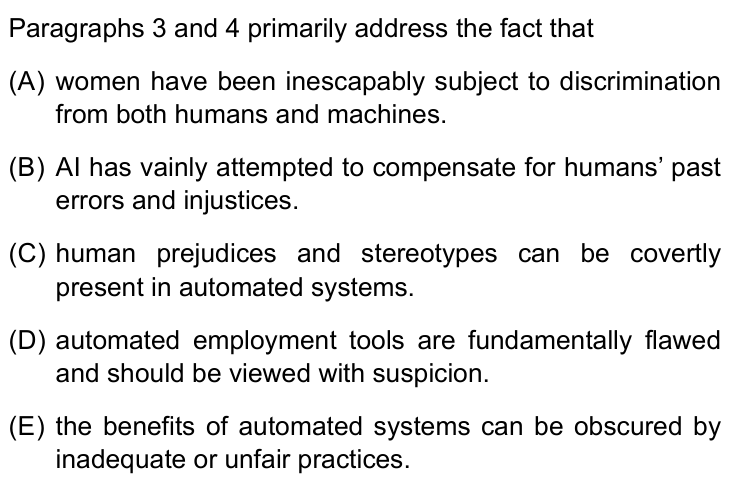
Paragraphs 3 and 4 primarily address the fact that
- Awomen have been inescapably subject to discrimination from both humans and machines.
- BAI has vainly attempted to compensate for humans’ past errors and injustices.
- Chuman prejudices and stereotypes can be covertly present in automated systems.
- Dautomated employment tools are fundamentally flawed and should be viewed with suspicion.
- Ethe benefits of automated systems can be obscured by inadequate or unfair practices.
Você já respondeu questões neste aparelho. Crie sua conta grátis para guardar o histórico e refazer as que errou.
Resposta salva no seu histórico.
Reportar erro na questão
Resolução comentada
Os parágrafos 3 e 4 trazem exemplos sobre contratação (hiring).
-
Parágrafo 3: se a empresa promovia poucas mulheres, o sistema treinado com esses dados pode aprender padrões que favorecem características mais comuns entre homens, mesmo sem usar o gênero como variável. O viés histórico entra no sistema de forma indireta, sem aparecer.
-
Parágrafo 4: a avaliação de justiça costuma olhar um único atributo protegido (gênero ou raça) isoladamente. O sistema pode parecer justo para homens e mulheres no total, e justo entre grupos étnicos no total, mas ainda assim prejudicar mulheres mais velhas de minorias. Ou seja, a discriminação fica oculta.
-
A ideia comum aos dois parágrafos é que o preconceito humano e a desigualdade podem estar presentes de modo disfarçado nos sistemas automatizados, difíceis de perceber à primeira vista.
Conclusão: isso corresponde à alternativa que fala em preconceitos e estereótipos "covertly present" (presentes de forma encoberta) em sistemas automatizados.
Alternativa C.
Por que as outras alternativas estão erradas
- AGeneraliza demais: o texto não diz que mulheres são "inescapavelmente" discriminadas; trata de um exemplo hipotético.
- BO texto não afirma que a IA tentou compensar erros em vão; apenas levanta a questão se ela espelha ou corrige o passado.
- DExagera: o texto não diz que as ferramentas são fundamentalmente falhas nem recomenda desconfiança geral.
- EInverte a ideia: o que fica obscurecido é a discriminação, não os benefícios dos sistemas.
Assunto: Ideia central e finalidade do texto.
Reportar erro na resolução
Ver como caiu na prova
Fonte: Einstein 2027 · Prova I. Prova oficial ↗