PRÁTICA COM QUESTÕES OFICIAIS
Questão 15 do Einstein 2025
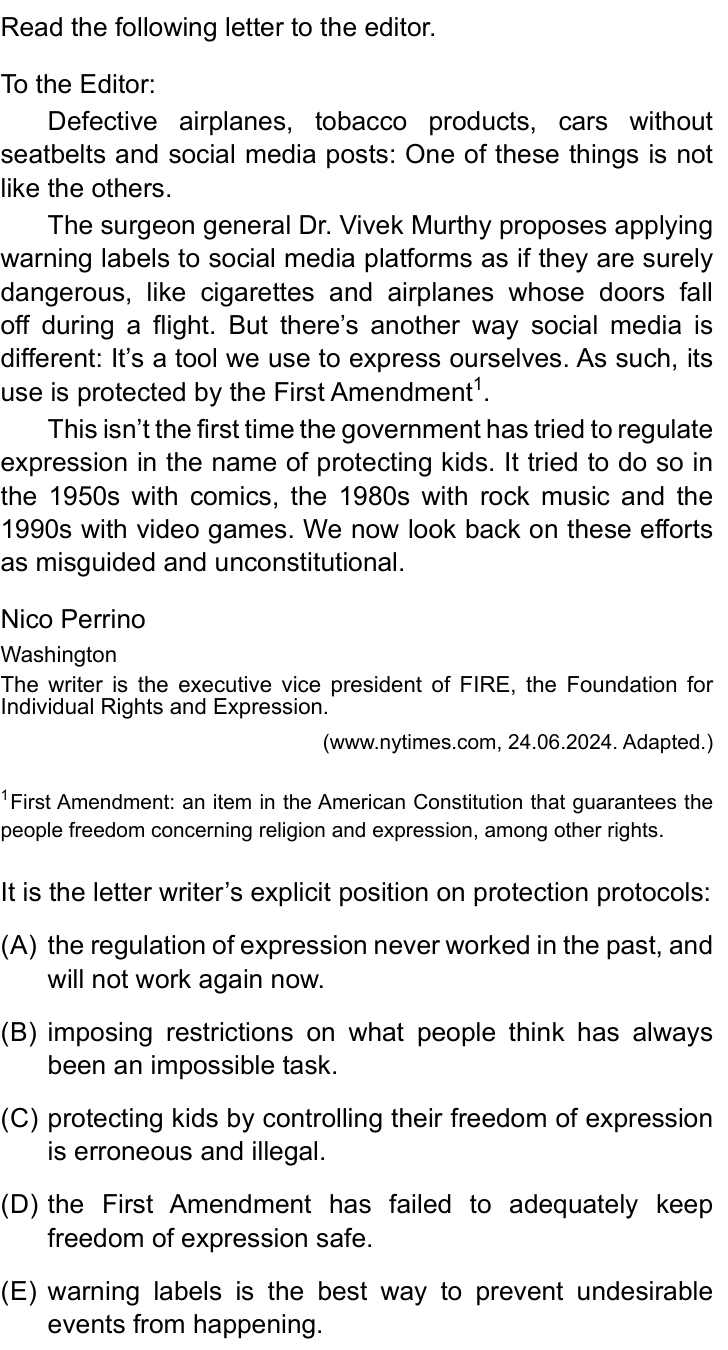
Read the following letter to the editor.
To the Editor:
Defective airplanes, tobacco products, cars without seatbelts and social media posts: One of these things is not like the others.
The surgeon general Dr. Vivek Murthy proposes applying warning labels to social media platforms as if they are surely dangerous, like cigarettes and airplanes whose doors fall off during a flight. But there’s another way social media is different: It’s a tool we use to express ourselves. As such, its use is protected by the First Amendment1.
This isn’t the first time the government has tried to regulate expression in the name of protecting kids. It tried to do so in the 1950s with comics, the 1980s with rock music and the 1990s with video games. We now look back on these efforts as misguided and unconstitutional.
Nico Perrino
Washington
The writer is the executive vice president of FIRE, the Foundation for Individual Rights and Expression.
(www.nytimes.com, 24.06.2024. Adapted.)
1 First Amendment: an item in the American Constitution that guarantees the people freedom concerning religion and expression, among other rights.
It is the letter writer’s explicit position on protection protocols:
- Athe regulation of expression never worked in the past, and will not work again now.
- Bimposing restrictions on what people think has always been an impossible task.
- Cprotecting kids by controlling their freedom of expression is erroneous and illegal.
- Dthe First Amendment has failed to adequately keep freedom of expression safe.
- Ewarning labels is the best way to prevent undesirable events from happening.
Você já respondeu questões neste aparelho. Crie sua conta grátis para guardar o histórico e refazer as que errou.
Resposta salva no seu histórico.
Reportar erro na questão
Resolução comentada
A pergunta pede a posição explícita do autor da carta sobre protocolos de proteção (os rótulos de alerta propostos para redes sociais).
O autor diz em dois pontos:
- Redes sociais são uma ferramenta de expressão, protegida pela Primeira Emenda ("its use is protected by the First Amendment").
- Tentativas anteriores de regular a expressão "in the name of protecting kids" (quadrinhos nos anos 1950, rock nos anos 1980, videogames nos anos 1990) hoje são vistas como "misguided and unconstitutional", ou seja, equivocadas e inconstitucionais.
Portanto, a posição dele é que proteger crianças controlando a liberdade de expressão é um erro ("erroneous") e ilegal, por violar a Constituição ("illegal").
Confira as demais: o texto não afirma que a regulação "nunca funcionou" nem que "não funcionará de novo"; não fala em restringir o que as pessoas pensam; não diz que a Primeira Emenda falhou, pois ele a usa como argumento a favor; e ele é contra os rótulos, não a favor.
Alternativa C.
Por que as outras alternativas estão erradas
- AO autor diz que as regulações passadas são vistas como equivocadas e inconstitucionais, não que nunca funcionaram, e não prevê o resultado futuro.
- BO texto trata de regular a expressão (quadrinhos, música, jogos), não de restringir o pensamento, e não fala em impossibilidade.
- DO autor invoca a Primeira Emenda como proteção válida; não diz que ela falhou.
- EInverte a posição do autor, que se opõe aos rótulos de alerta nas redes sociais.
Assunto: Informações explícitas e detalhes.
Reportar erro na resolução
Ver como caiu na prova
Fonte: Einstein 2025 · Prova I. Prova oficial ↗