PRÁTICA COM QUESTÕES OFICIAIS
Questão 14 do Einstein 2025
Read the text to answer questions from 11 to 14. · Prova I
When United States (US) Surgeon General Dr. Vivek Murthy pushed for a tobacco-style warning on social media, he called the mental health crisis in young people an emergency that demanded action without waiting for “perfect information.”
Even among experts, questions remain about the exact role that social media plays in the mental health of children and teens. Authors of a comprehensive new review of research on the topic say there’s still key information missing to know whether prevention programs and interventions will work.
In the study, published recently in the medical journal JAMA Pediatrics, researchers found an overall link between anxiety and depression in adolescents and the time spent on social media platforms, as well as a link between the types of activities and content they were interacting with. However, the level of impact varied enough to suggest that the findings shouldn’t be generalized to the population as a whole. “In a world increasingly saturated by digital technology, we cannot afford to design prevention programs, interventions, and regulations without knowing that they work for everyone, especially those who are most vulnerable,” wrote the study authors.
The National Academies committee specifically recommend against a social media ban. Despite potential harms — such as unhealthy social comparisons and distracting from other important healthy behaviors such as sleep, exercise and studying — social media can also benefit young people by helping to foster connection with friends and family, and with online support communities.
(Deidre McPhillips. https://edition.cnn.com, 24.06.2024. Adapted.)
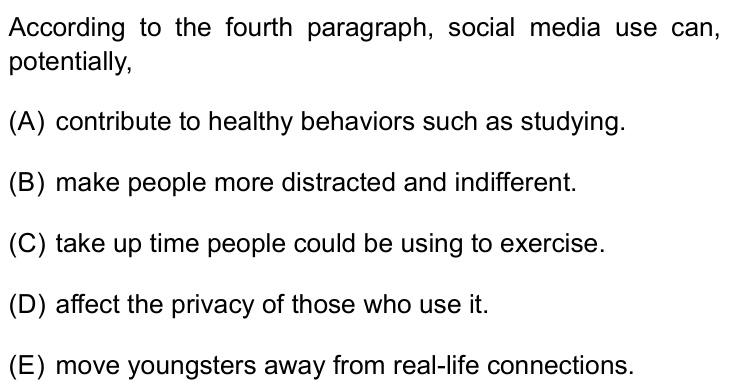
According to the fourth paragraph, social media use can, potentially,
- Acontribute to healthy behaviors such as studying.
- Bmake people more distracted and indifferent.
- Ctake up time people could be using to exercise.
- Daffect the privacy of those who use it.
- Emove youngsters away from real-life connections.
Você já respondeu questões neste aparelho. Crie sua conta grátis para guardar o histórico e refazer as que errou.
Resposta salva no seu histórico.
Reportar erro na questão
Resolução comentada
O quarto parágrafo diz que, apesar dos danos potenciais (potential harms), as redes sociais trazem prejuízos como comparações sociais pouco saudáveis e "distracting from other important healthy behaviors such as sleep, exercise and studying", ou seja, "tirar a atenção de outros comportamentos saudáveis importantes, como dormir, se exercitar e estudar".
Assim, o texto afirma que o uso das redes pode desviar o tempo e o foco que seriam dedicados ao exercício, ao sono e aos estudos. Isso corresponde à ideia de que as redes ocupam o tempo que as pessoas poderiam usar para se exercitar.
Conferindo as demais: o texto não diz que estudar seja favorecido, não fala de indiferença, não menciona privacidade e, ao contrário de afastar das conexões, diz que as redes podem ajudar a fortalecer laços com amigos e família.
Alternativa C.
Por que as outras alternativas estão erradas
- AInverte o texto: estudar aparece entre os comportamentos saudáveis prejudicados pela distração, não favorecidos.
- BO texto fala em distração, mas não menciona indiferença; acrescenta uma ideia que não está lá.
- DPrivacidade não é mencionada no parágrafo.
- EO parágrafo diz o contrário: as redes podem ajudar a manter conexão com amigos e família.
Assunto: Informações explícitas e detalhes.
Reportar erro na resolução
Ver como caiu na prova
Fonte: Einstein 2025 · Prova I. Prova oficial ↗