PRÁTICA COM QUESTÕES OFICIAIS
Questão 82 (CFS 1) da EEAR 2026
Read the text and answer questions 78, 79, 80, 81, 82, 83 and 84. · CFS 1
One man in a boat
L.G. Alexander
Fishing is my favourite sport. I often fish for hours without catching anything. But this does not worry me. Some fishermen are unlucky. Instead of catching fish, they catch old boots and rubbish. I am even less lucky. I never catch anything - not even old boots. After having spent whole mornings on the river, I always go home with an empty bag. “You must give up fishing!” my friends say. “It’s a waste of time.” But they don’t realize one important thing. I’m not really interested in fishing. I am only interested in sitting in a boat and doing nothing at all!
PRACTICE AND PROGRESS - An Integrated Course for Pre-Intermediate Students, L.G Alexander, Longman Group Limited, London.
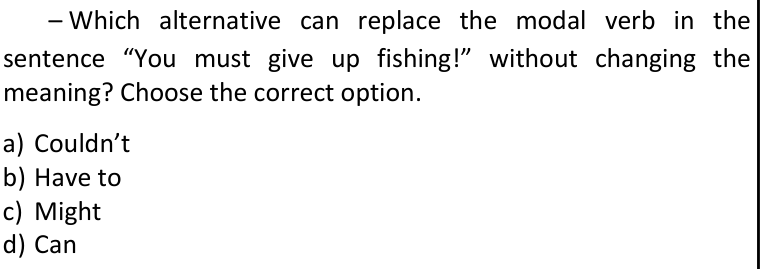
– Which alternative can replace the modal verb in the sentence “You must give up fishing!” without changing the meaning? Choose the correct option.
- ACouldn’t
- BHave to
- CMight
- DCan
Reportar erro na questão
Resolução comentada
Em "You must give up fishing!", o verbo modal must expressa obrigação forte ou necessidade: os amigos dizem que o narrador precisa parar de pescar. Precisamos de uma opção que mantenha esse sentido.
- Must (obrigação/necessidade) tem como equivalente comum have to, que também indica obrigação ou necessidade: "You have to give up fishing!".
- Couldn't indica impossibilidade ou incapacidade no passado, ou uma negação de possibilidade; não expressa obrigação.
- Might indica possibilidade fraca ("talvez"), o contrário da força de must aqui.
- Can indica capacidade, permissão ou possibilidade, não obrigação.
Portanto, a única troca que preserva o significado de obrigação é have to.
Alternativa B.
Por que as outras alternativas estão erradas
- ACouldn't expressa impossibilidade ou incapacidade, não obrigação.
- CMight indica possibilidade fraca (talvez), sem ideia de obrigação.
- DCan expressa capacidade ou permissão, não necessidade.
Assunto: Tempos verbais e verbos modais.
Reportar erro na resolução
Ver como caiu na prova
Fonte: EEAR 2026 · CFS 1. Prova oficial ↗