PRÁTICA COM QUESTÕES OFICIAIS
Questão 76 (CFS 2) da EEAR 2026
Read the text and answer questions 73, 74, 75 and 76. · CFS 2
A spaceplane breaks barriers, reaching incredible heights and speeds
Dawn Aerospace, based in Christchurch, New Zealand, is making waves in the aerospace industry with its groundbreaking approach to creating a reusable spaceplane. But why should this matter to you? Imagine a future where space travel is as routine and affordable as flying across the country. This is the vision Dawn Aerospace is working towards, and its recent achievements bring us one step closer to that reality.
Major advances in spaceplane technology
Dawn Aerospace’s latest test flight, conducted as part of its Campaign 2-2 development program, saw its uncrewed Mk-II rocket-powered aircraft reach transonic speeds of Mach 0.92 and an altitude of 50,000 feet.
This achievement represents a substantial enhancement in performance, with improvements of three to five times compared to previous metrics. The company is now ready to begin Campaign 2-3 in September, where it hopes to achieve supersonic flight for the first time. The overarching goal is to create a spaceplane that combines the performance of a first-stage rocket with the predictability and rapid turnaround of a conventional aircraft.
Future goals and aspirations
Dawn Aerospace has set ambitious targets for its Mk-II spaceplane. By the end of 2025, the company hopes to climb faster than an F-15, fly higher than a MiG-25 and exceed speeds greater than the SR-71 Blackbird. Additionally, they aspire to be the first vehicle to fly above the Karman line, defined as 62 miles altitude, twice in a single day. Many of these records have stood for over 50 years, highlighting the ambitious nature of their goals.
The company has invested approximately $10 million in the program so far and plans to complete it for under $20 million in total. Dawn Aerospace’s rapid progress through flight testing, compared to other rocket development programs, can be attributed to its core philosophy and design methodology. This approach allows the company to move quickly and confidently through flight tests while minimizing risks.
www.foxnews.com
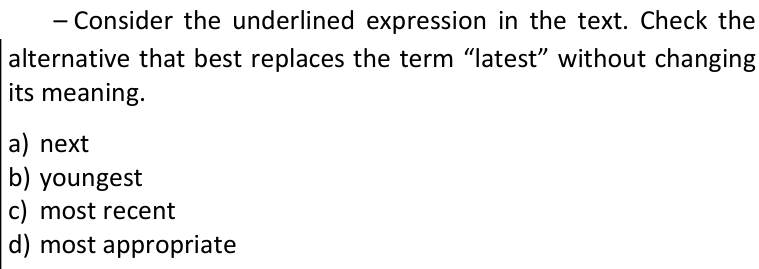
– Consider the underlined expression in the text. Check the alternative that best replaces the term “latest” without changing its meaning.
- Anext
- Byoungest
- Cmost recent
- Dmost appropriate
Reportar erro na questão
Resolução comentada
A expressão sublinhada é latest test flight. Aqui, latest é o superlativo de late e significa "mais recente", ou seja, o último voo de teste já realizado.
O texto confirma isso: o voo foi "conduzido como parte da Campaign 2-2", e a Campaign 2-3 só começa em setembro. Então o voo descrito já aconteceu e é o mais novo da série, enquanto o próximo ainda está por vir.
Agora, as opções:
- next significa "próximo", algo que ainda vai acontecer. Muda o sentido, pois o voo já foi feito.
- youngest é usado para idade de pessoas ou seres (o mais jovem), não para eventos.
- most recent quer dizer "o mais recente", exatamente o sentido de latest.
- most appropriate significa "o mais adequado", ideia de adequação e não de tempo.
Portanto, latest test flight equivale a most recent test flight.
Alternativa C.
Por que as outras alternativas estão erradas
- Anext indica futuro, mas o voo já ocorreu; o próximo seria a Campaign 2-3.
- Byoungest se refere à idade de pessoas ou seres, não é usado para um voo.
- Dmost appropriate expressa adequação, não a ideia de tempo presente em latest.
Assunto: Vocabulário em contexto e falsos cognatos.
Reportar erro na resolução
Ver como caiu na prova
Fonte: EEAR 2026 · CFS 2. Prova oficial ↗