PRÁTICA COM QUESTÕES OFICIAIS
Questão 83 (CFS 1) da EEAR 2025
Read the text and answer questions 83, 84, 85 and 86. · CFS 1
Managing globalization: if it’s here to stay, what do we know?
Daniel Altman
Two decades have passed since the word “globalization” started showing up with any frequency in discussions of business and economics. At first, the focus was on Western companies trying to compete with cheaper, sometimes better imports from Japan, South Korea, China and other countries. It was a straight fight: the battle lines were drawn along each country’s borders.
Later on, things become more complex. Asian __________________ started designing and assembling products in the West. Western companies opened up new fronts by sending jobs abroad - not just in manufacturing but in service industries as well.
At the turn of the millennium, there was a lot of talk about whether globalization was a Good Thing or a Bad Thing. One side argued that it allowed big, multinational corporations to exploit workers in poor countries to pad their profit margins. The other side retorted that the expansion of these corporations into the developing world offered the best hope for raising living standards. One side complained that globalization was creating and destroying industries too quickly for the labor force to adjust. The other side answered that these shifts were rapidly improving the world’s ability to use its resources efficiently. Now, it’s pretty clear that globalization, be it good or bad, is an Unavoidable Thing (...)
Adapted from Sharma, Pete. Reading the News, Thomson ELT, 2007.
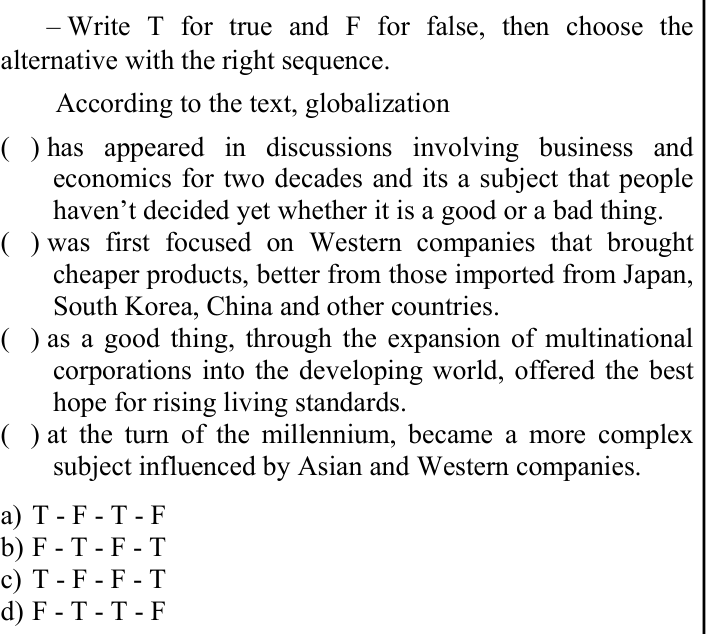
– Write T for true and F for false, then choose the alternative with the right sequence.
According to the text, globalization
( ) has appeared in discussions involving business and economics for two decades and its a subject that people haven’t decided yet whether it is a good or a bad thing.
( ) was first focused on Western companies that brought cheaper products, better from those imported from Japan, South Korea, China and other countries.
( ) as a good thing, through the expansion of multinational corporations into the developing world, offered the best hope for rising living standards.
( ) at the turn of the millennium, became a more complex subject influenced by Asian and Western companies.
- AT - F - T - F
- BF - T - F - T
- CT - F - F - T
- DF - T - T - F
Reportar erro na questão
Resolução comentada
A sequência depende de distinguir o que o texto afirma das mudanças de sentido feitas nas proposições.
A primeira é verdadeira. O início informa que a globalização aparece nas discussões de negócios e economia há duas décadas. O debate posterior apresenta argumentos favoráveis e contrários, sem concluir se ela é boa ou ruim: a conclusão é que ela é inevitável.
A segunda é falsa. As empresas ocidentais tentavam competir com produtos importados mais baratos e, às vezes, melhores. Portanto, essas características pertenciam aos importados, não aos produtos das empresas ocidentais, como sugere a afirmação.
A terceira é verdadeira. Ela reproduz o argumento favorável à globalização: a expansão das multinacionais nos países em desenvolvimento oferecia “the best hope for raising living standards” — “a melhor esperança de elevar os padrões de vida”.
A quarta é falsa. A maior complexidade aparece no segundo parágrafo, introduzida por “Later on” (“mais tarde”), sem data específica. A virada do milênio marca o debate sobre a globalização ser boa ou ruim, não o momento daquela mudança.
A sequência é T – F – T – F. Alternativa A.
Pegadinha: A quarta afirmação engana ao associar a maior complexidade à virada do milênio, data que o texto relaciona ao debate sobre os efeitos da globalização.
Por que as outras alternativas estão erradas
- BInverte o julgamento das quatro afirmações.
- CConsidera falsa a terceira afirmação e verdadeira a quarta, contrariando o argumento e a cronologia do texto.
- DConsidera falsas a primeira e verdadeiras a segunda e a quarta, contrariando o texto.
Assuntos: interpretação de texto, língua inglesa.
Reportar erro na resolução
Ver como caiu na prova
Fonte: EEAR 2025 · CFS 1. Prova oficial ↗