PRÁTICA COM QUESTÕES OFICIAIS
Questão 82 (CFS 1) da EEAR 2025
Read the text and answer questions 80, 81 and 82. · CFS 1
Many studies about language learning ask the question: What makes a good language learner?
There are some things that good language learners do and some things they don’t do. Here are some of the most useful suggestions from studies:
- Don’t be afraid of making mistakes. People often get things wrong. Good language learners notice their mistakes and learn from them.
- Do group activities. People use language to communicate with other people. A good language learner always looks for opportunities to talk with other students.
- Make notes during every class. Notes help you to remember new language. Look at your notes when you do your homework.
- Use a dictionary. Good language learners often use dictionaries to check the meaning of words they don’t know. They also make their own vocabulary lists.
- Think in the language you’re learning outside the classroom. When you’re shopping or walking down the street, remember useful words and phrases. Sometimes, when you’re at home, say new words to practise your pronunciation.
- Do extra practice. Test and improve your language, reading and listening skills with self-study material. You can find a lot of this online.
- Imagine yourself speaking in the language. Many good language learners can see and hear themselves speaking in the language. This helps their motivation.
- Enjoy the process. Good language learners have fun with the language. Watch a TV series or film, listen to songs, play video games or read a book. It’s never too late to become a good language learner.
https://learnenglish.britishcouncil.org/skills/reading/a2-reading/study-skills-tips
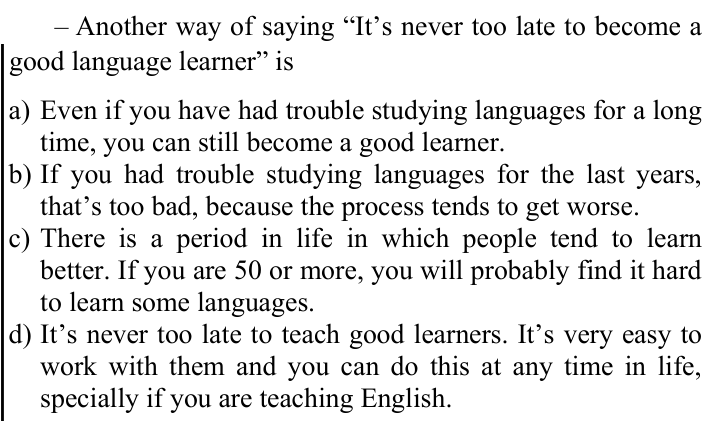
– Another way of saying “It’s never too late to become a good language learner” is
- AEven if you have had trouble studying languages for a long time, you can still become a good learner.
- BIf you had trouble studying languages for the last years, that’s too bad, because the process tends to get worse.
- CThere is a period in life in which people tend to learn better. If you are 50 or more, you will probably find it hard to learn some languages.
- DIt’s never too late to teach good learners. It’s very easy to work with them and you can do this at any time in life, specially if you are teaching English.
Reportar erro na questão
Resolução comentada
A frase "It's never too late to become a good language learner" significa, literalmente, "nunca é tarde demais para se tornar um bom aprendiz de línguas". Ou seja, não importa a idade nem o histórico de dificuldades: sempre dá tempo de melhorar.
Vamos comparar com as alternativas:
- A ideia central é: nunca é tarde, em qualquer momento da vida a pessoa ainda pode virar um bom aprendiz.
- A alternativa (A) diz que, mesmo com muito tempo de dificuldade nos estudos ("even if you have had trouble... for a long time"), a pessoa ainda pode se tornar um bom aprendiz ("you can still become a good learner"). Isso é a mesma mensagem, com outras palavras.
- A (B) afirma que o processo tende a piorar com o tempo, o que é o oposto da frase original.
- A (C) diz que existe uma idade ideal e que, depois dos 50, fica difícil. Isso contradiz "nunca é tarde demais".
- A (D) muda o assunto: fala de ensinar bons aprendizes ("teach"), e não de aprender ("become").
Portanto, só a (A) reformula corretamente a ideia do texto.
Alternativa A.
Por que as outras alternativas estão erradas
- BDiz que o processo piora com o tempo, o oposto da ideia de que nunca é tarde.
- CDefende que há idade ideal e que após os 50 é difícil, contradizendo "never too late".
- DTroca aprender (become a learner) por ensinar (teach), mudando o sentido.
Assuntos: paráfrase, interpretação de texto.
Reportar erro na resolução
Ver como caiu na prova
Fonte: EEAR 2025 · CFS 1. Prova oficial ↗