PRÁTICA COM QUESTÕES OFICIAIS
Questão 45 (CFS 2) da EEAR 2024
Read the text and answer questions 40, 41, 42, 43, 44 and 45. · CFS 2
Help wanted: $78,000 a year to taste candy while sitting on your couch
Alexandra Peers
Candy Funhouse, an online shop that sells from chocolate bars to gummies and licorice, is hiring for a $78,000 a year, work-from-home job as its Chief Candy Officer. Duties include: “leading candy board meetings, being the head taste tester and all things fun. Several thousand candidates have already applied for the position”, said Chief Executive Officer Jamal Hejazi. He noted that he’s been surprised by the number of applications and the elaborate videos of entire families offering to share the tasting duties and the salary. (...) Candy Funhouse, based outside of Toronto, is headed by a quartet of 20-and-30-something-year-old siblings who grew up in the area and _______ parents owned donut shops and a local restaurant. (...) Hejazi noted that reports on social media claiming that the Chief Candy Officer will be required to eat 3,500 pieces of candy per month are incorrect. “That’s too many”, Hejazi said.
Adapted from https://edition.cnn.com/2022/08/01/business-food/candy-tasting-job-posting/index.html
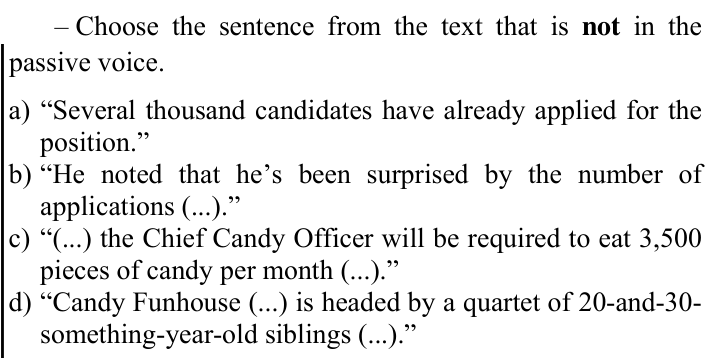
– Choose the sentence from the text that is not in the passive voice.
- A“Several thousand candidates have already applied for the position.”
- B“He noted that he’s been surprised by the number of applications (...).”
- C“(...) the Chief Candy Officer will be required to eat 3,500 pieces of candy per month (...).”
- D“Candy Funhouse (...) is headed by a quartet of 20-and-30-something-year-old siblings (...).”
Reportar erro na questão
Resolução comentada
Na voz passiva, o sujeito sofre a ação, e a estrutura é verbo to be + particípio passado. Para achar a frase que não está na passiva, procure aquela em que o sujeito pratica a ação.
- (A) Several thousand candidates have already applied: o sujeito (os candidatos) pratica a ação de se candidatar. Have applied é present perfect na voz ativa, e applied é só o particípio do verbo ativo, sem be. Está na ativa.
- (B) he's been surprised: has been + surprised (to be + particípio). O sujeito he é quem recebe a surpresa. Passiva.
- (C) will be required: will be + required. O sujeito, o Chief Candy Officer, é quem será obrigado. Passiva.
- (D) is headed by a quartet: is + headed, com agente introduzido por by. A empresa é chefiada por quatro irmãos. Passiva.
Portanto, a única frase na voz ativa é a que usa o present perfect simples, com have + particípio, mas sem o verbo to be.
Alternativa A.
Pegadinha: A alternativa B engana por conter "been" e um particípio, o que faz parecer present perfect ativo, mas é passiva (has been surprised).
Por que as outras alternativas estão erradas
- B"has been surprised" é to be + particípio, com o sujeito recebendo a ação: voz passiva.
- C"will be required" é to be + particípio, com o sujeito sofrendo a ação: voz passiva.
- D"is headed by" traz to be + particípio e o agente com by: voz passiva.
Assunto: Tempos verbais e verbos modais.
Reportar erro na resolução
Ver como caiu na prova
Fonte: EEAR 2024 · CFS 2. Prova oficial ↗