PRÁTICA COM QUESTÕES OFICIAIS
Questão 44 (CFS 1) da EEAR 2024
Read the text and answer questions 40, 41, 42, 43 and 44. · CFS 1
Kids can show anxiety symptoms early on
Kristen Rogers - CNN
Excessive clinginess to parents can be a sign a child is struggling with an anxiety disorder, experts have said.
(...)
Anxiety disorders are marked by persistent and excessive worries. While someone with generalized anxiety might worry about various everyday things, someone with social anxiety typically has ‘intense or persistent fears or worries about being judged negatively by other people’, said Rachel Busman, a New York-based clinical psychologist and cognitive and behavioral consultant _______ specialized in anxiety.
One fifth of children worldwide have anxiety symptoms that are clinically elevated, or worse than what is considered normal, according to a 2011 study.
Anxiety symptoms can be difficult to spot, but the sooner parents notice signs, the earlier mental health professionals ‘can help parents and kids understand what is happening’, said Dr. Rebecca Baum, a professor of general pediatrics and adolescent medicine at the University of North Carolina.
Children with anxiety might begin to avoid anxiety-inducing situations. This behavior can facilitate a cycle that makes their fears bigger and bigger.
Adapted from https://edition.cnn.com/2022/05/16/health/anxiety-early-signs-in-kids-wellness/index.html
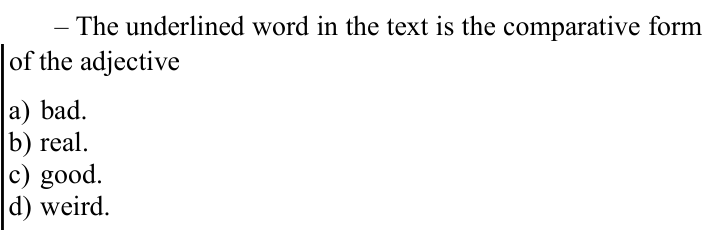
– The underlined word in the text is the comparative form of the adjective
- Abad.
- Breal.
- Cgood.
- Dweird.
Reportar erro na questão
Resolução comentada
O comparativo é a forma que o adjetivo assume para comparar dois elementos. Alguns adjetivos têm comparativo irregular, que não se forma com -er nem com more.
No texto, a palavra sublinhada é worse, em "worse than what is considered normal" ("pior do que o que é considerado normal"). Ela compara os sintomas de ansiedade clinicamente elevados com o nível normal, e a presença de than confirma a comparação.
Os comparativos irregulares mais cobrados são:
- good → better
- bad → worse
- far → farther/further
Portanto, worse é o comparativo de bad (mau, ruim). Os outros adjetivos das alternativas não têm worse como comparativo: real e weird formam o comparativo de maneira regular (more real, weirder), e o comparativo de good é better.
Alternativa A.
Por que as outras alternativas estão erradas
- Breal forma o comparativo de modo regular (more real), não worse.
- Co comparativo de good é better, e worse tem sentido oposto.
- Dweird forma o comparativo com -er (weirder), sem relação com worse.
Assunto: Classes de palavras.
Reportar erro na resolução
Ver como caiu na prova
Fonte: EEAR 2024 · CFS 1. Prova oficial ↗