PRÁTICA COM QUESTÕES OFICIAIS
Questão 44 (CFS 1) da EEAR 2020
Read the text to answer questions 44, 45, 46 and 47. · CFS 1
The cost of a cigarette
A businesswoman’s desperate need for a cigarette on an 8-hour flight from American Airlines ________ in her being arrested and handcuffed, after she was found lighting up in the toilet of a Boeing 747, not once but twice. She ___________ because she _______ violent when the plane landed in England, where the police subsequently arrested and handcuffed her. Joan Norrish, aged 33, yesterday ________ the first person to be prosecuted under new laws for smoking on board a plane, when she was fined £440 at Uxbridge magistrates’ court.
Adapted from Innovations , by Hugh Dellar and Darryl Hocking.
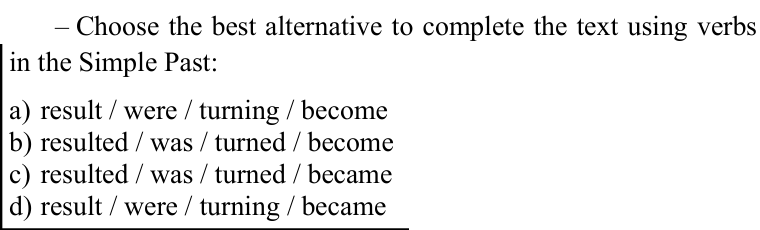
– Choose the best alternative to complete the text using verbs in the Simple Past:
- Aresult / were / turning / become
- Bresulted / was / turned / become
- Cresulted / was / turned / became
- Dresult / were / turning / became
Reportar erro na questão
Resolução comentada
O texto narra um fato já concluído, então todos os verbos das lacunas devem estar no Simple Past. Vamos lacuna por lacuna.
-
"A businesswoman's desperate need ... ________ in her being arrested": o sujeito é singular ("need") e o fato é passado. Usa-se "resulted in" (passado de "result in"). Isso elimina "result" (A e D).
-
"She ________ because she ...": a frase é voz passiva no passado, "she was arrested" ("ela foi presa"). Como o sujeito é "she", o verbo é "was", não "were". Isso elimina A e D de novo.
-
"because she ________ violent when the plane landed": "turn violent" significa "tornar-se violenta". No passado fica "turned" (violent é adjetivo, depois do verbo). "Turning" é gerúndio, não é Simple Past.
-
"Joan Norrish ... yesterday ________ the first person to be prosecuted": "yesterday" marca o passado, e o verbo é "to become" (tornar-se). O Simple Past de "become" é "became", e "become" sozinho é o infinitivo ou o particípio, não o passado.
A sequência correta é: resulted / was / turned / became.
Alternativa C.
Pegadinha: A alternativa B engana por acertar três lacunas e trocar apenas "became" por "become", que é um passado irregular fácil de esquecer.
Por que as outras alternativas estão erradas
- Ausa "result" (presente), "were" com sujeito singular, "turning" (gerúndio) e "become" (não é o passado).
- Bacerta as três primeiras lacunas, mas usa "become" no lugar do passado "became", apesar de "yesterday".
- Dusa "result" (presente), "were" com "she" e "turning" (gerúndio), embora termine certo em "became".
Assunto: Tempos verbais e verbos modais.
Reportar erro na resolução
Ver como caiu na prova
Fonte: EEAR 2020 · CFS 1. Prova oficial ↗