PRÁTICA COM QUESTÕES OFICIAIS
Questão 42 (CFS 1) da EEAR 2020
Read the text to answer questions 41, 42 and 43. · CFS 1
Grounding
Grounding is a common form of punishment for young people who disobey their parents. Grounding means that they are not allowed to go out, after school or on weekends, for a certain period of time. This could be from one day to ____ month or more, depending upon the gravity of the offense. During that time, though, they must continue to go to school, to work if they have a job, and do other errands approved by their parents.
____ term “grounding” is ____ aviation term. A plane is grounded when it is not allowed to fly for any reason. Similarly, pilots or other flying personnel are grounded when they are not allowed to fly because of illness or for disobeying the rules.
Adapted from Life in the USA: A Simplified reader on American Culture, book 1.
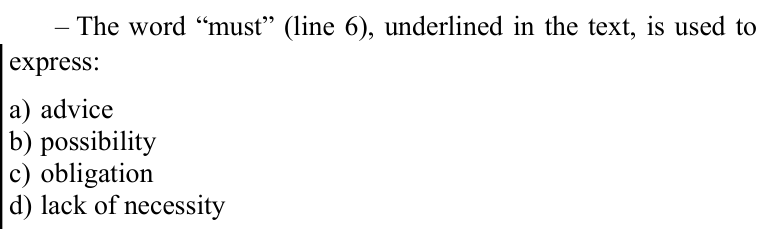
– The word “must” (line 6), underlined in the text, is used to express:
- Aadvice
- Bpossibility
- Cobligation
- Dlack of necessity
Reportar erro na questão
Resolução comentada
O verbo modal must pode expressar obrigação (algo que precisa ser feito), dedução ("ele deve estar em casa") ou proibição, quando vem na forma negativa (mustn't).
Para descobrir o sentido aqui, veja o contexto da frase: "During that time, though, they must continue to go to school, to work if they have a job, and do other errands approved by their parents."
- O texto trata de adolescentes de castigo (grounding), que não podem sair depois da escola nem nos fins de semana.
- A frase com must usa "though" (porém) para marcar a exceção: mesmo de castigo, eles têm de ir à escola, trabalhar e fazer as tarefas aprovadas pelos pais.
- Isso não é um conselho, pois não é uma sugestão (should). Também não é possibilidade (may/might). Trata-se de algo imposto, que não depende da vontade deles.
- Falta de necessidade seria don't have to / needn't, o oposto do que o texto diz.
Portanto, must expressa obrigação.
Alternativa C.
Por que as outras alternativas estão erradas
- Aconselho seria expresso por should ou ought to; aqui os pais impõem a regra, não sugerem.
- Bpossibilidade seria may, might ou could; o texto fala de algo que deve ser feito.
- Dfalta de necessidade seria don't have to ou needn't, sentido contrário ao do texto.
Assunto: Tempos verbais e verbos modais.
Reportar erro na resolução
Ver como caiu na prova
Fonte: EEAR 2020 · CFS 1. Prova oficial ↗