PRÁTICA COM QUESTÕES OFICIAIS
Questão 38 (CFS 2) da EEAR 2009
Read the text and answer questions 37, 38, 39 and 40. · CFS 2
How horses can sleep standing up and
not fall over?
Most of us need eight hours sleep a night. Horses can get by with only half that amount – and unlike us they are able to fall asleep standing up, without falling over! In the wild, horses are prey to wolves and other animals. Lying down, they are much more vulnerable than they are standing up. So over millions of years their bodies have developed a way of staying upright even when they are asleep. Although most horses no longer live in the wild, they can still fall asleep as their ancestors used to. The reason they are able to do this is a unique system of ligaments – the cords which bind bones together . A horse’s ligaments act like a sling over its whole body. These can lock its joints into a fixed position, so it can stand upright without any conscious muscular effort while it sleeps. It is a pity human beings have not developed a way of doing this. It could be very handy for long queues or travelling on crowded trains!
GLOSSARY:
prey: presa
(to)bind: atar; ligar; amarrar
sling: ligadura
like: como
queue: fila
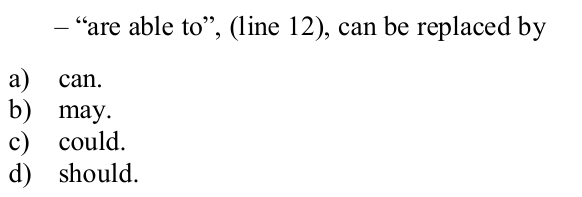
– “are able to”, (line 12), can be replaced by
- Acan.
- Bmay.
- Ccould.
- Dshould.
Você já respondeu questões neste aparelho. Crie sua conta grátis para guardar o histórico e refazer as que errou.
Resposta salva no seu histórico.
Reportar erro na questão
Resolução comentada
A expressão "be able to" indica capacidade, habilidade. No texto, a frase é "The reason they are able to do this is a unique system of ligaments", ou seja, "a razão pela qual eles são capazes de fazer isso...".
Para substituir, precisamos de um verbo modal que também expresse capacidade no presente:
- can: capacidade/habilidade no presente. É o equivalente direto de "am/is/are able to". Serve.
- may: expressa permissão ou possibilidade ("talvez"), não capacidade.
- could: é o passado de capacidade (ou condicional). O texto está no presente, então não cabe.
- should: expressa conselho ou recomendação ("deveria"), sentido completamente diferente.
Assim, a frase fica: "The reason they can do this is a unique system of ligaments", mantendo o sentido original: os cavalos conseguem dormir em pé graças ao sistema de ligamentos.
Alternativa A.
Por que as outras alternativas estão erradas
- B"May" expressa permissão ou possibilidade, não capacidade física.
- C"Could" é capacidade no passado ou condicional, mas o trecho está no presente.
- D"Should" indica conselho ou obrigação ("deveria"), mudando o sentido.
Assunto: Tempos verbais e verbos modais.
Reportar erro na resolução
Ver como caiu na prova
Fonte: EEAR 2009 · CFS 2. Prova oficial ↗