Como pensou
We need solve. Need understand problem. Portuguese. Board equilateral triangle subdivided into 36 equilateral triangles. Two cells painted yellow. Equivalence if one obtained from other by rotation 120° about intersection of bisectors (center). Count non-equivalent paintings. Need choose among.
We need parse grid size. Equilateral triangle subdivided into 36 small equilateral triangles. Standard side length n subdivided has n^2 small equilateral triangles? Wait number of small equilateral triangles of unit side in triangular grid side n equals n^2? Let's verify n=1 ->1, n=2 ->4 (3 up +1 down), n=3 ->9 (6 up +3 down), n=4 ->16, n=6 ->36. Yes n=6. The images show side length 6? Count rows likely 6.
We need color exactly two of 36 small triangles yellow. Equivalence under rotations by 120° around center (order 3). Need number of orbits of 2-element subsets under C3 action. Since rotations by 120 and 240; no reflection. Burnside: (1/3)(total subsets + fixed by 120 + fixed by 240? Actually rotations 120 and 240 have same fixed sets? Need compute). Number of orbits = (1/3)(N + F + F?) where F = number of 2-subsets invariant under 120 rotation = subsets with elements fixed individually (since set size 2, cannot swap pairs unless cycles length? rotation of cells may fix some cells, and cycles of length 3; a 2-subset invariant under 120 must consist of cells each fixed by rotation, because any nonfixed orbit size 3 requires 3 elements). Rotation 120 of triangular board: cells? Center at centroid. There is one small triangle at center? Need determine under 120 rotation about centroid: for n=6 triangular grid, are there cells fixed? A small equilateral triangle can be mapped to itself under 120 rotation only if its center is at rotation center? Wait a small equilateral triangle centered at origin can be invariant under 120 rotation if its orientation? The triangular grid has up/down triangles. Under 120 rotation, an upward small triangle remains upward? Equilateral triangle rotated by 120 about its own center maps to itself. A downward triangle rotated by 120 maps to itself too (as set). So if a small triangle is centered at board center, it fixed. For n=6, center of big triangle coincides with center of one small triangle? Let's examine. The centroid of triangular grid side 6 may be a vertex intersection? In images, red bisectors meet at a point. There is a small upward yellow triangle right above center? Wait images show red medians meet at a vertex? Let's inspect: big triangle rows. The center of an equilateral triangle is at distance from base. For n=6, subdivision has horizontal lines at integer heights 0..6. Centroid height = altitude/3? From base? Actually centroid at 1/3 altitude from base. If altitude measured from base, center y = h/3 = (√3/2 *6)/3 = √3. So horizontal line y=√3, which is at row line 2 from base? Unit small triangles have height √3/2. y=√3 = 2*(√3/2). So center lies on a horizontal grid line. In triangulation, center is intersection of medians, maybe vertices. In images red lines meet at a vertex. Looking: red from top to base center, and from lower left vertex to side midpoint, etc. The three red meet at a point in interior, appears vertex of grid, not center of a small triangle. Let's count: big side 6. Center is at row height 2 units from base, at midpoint horizontally. This is a grid vertex (since row y=2, horizontal positions). So no cell centered at center. A 120 rotation may fix no small triangle? Wait could a small triangle surrounding center? Center is a vertex shared by 6 triangles; rotation cycles them. No cell invariant because area small triangle centered not at center. For n multiple of 3? Need be careful. The rotation center might be center of a small downward/up triangle depending n mod 3. For n=6, center is a vertex, so no fixed cells. Then F=0, orbits = N/3 = C(36,2)/3 = 630/3=210. That's option A. But likely too easy? Options include 630 (if ignoring rotation?) and 210. But question might have nontrivial because rotations of 120 can map pair to itself swapping two cells if rotation by? For order 3, a 2-subset cannot be invariant by swapping two under a 120 rotation (permutation has order 3, cannot have transposition). unless pair includes one fixed and one fixed. So if no fixed cells, no fixed pair, orbits 210. Option A.
But wait images: First configuration: two yellow triangles. Second is rotation 120? Need count non-equivalent. Maybe rotations not only 0,120,240, but "uma rotação de 120°" could mean one rotation to be equivalent, maybe also repeated? It says "por uma rotação de 120°" meaning obtained by a 120° rotation; but equivalence is transitive? If A equiv B via +120, B equiv C via +120, so A,C via +240. So group.
But options 315,420 etc suggest maybe they counted ordered pairs? Let's verify. Total unordered pairs C(36,2)=630. Divide by 3 =210. Options include 210. Why other numbers? Maybe if there are fixed cells, Burnside yields (630 + 2f choose?)/3. If f=?? For n=6, if rotation fixes 3 or etc, result maybe 210 + something. Let's recalc possible f. Number of fixed cells under 120 rotation on triangular board side n=6? Center is vertex, none fixed. But wait small triangles at corner? Under rotation, top corner cell maps to bottom left etc. no fixed. So f=0. Thus 210. But then why option 315? If erroneously include rotations by 0 and 120 only? (630+F)/2=315 if F=0. Option B. They include. Option C 420? For C(36,2)=630, /? 630*2/3=420. Maybe applying rotation by 120 but not distinguish direction? Hmm.
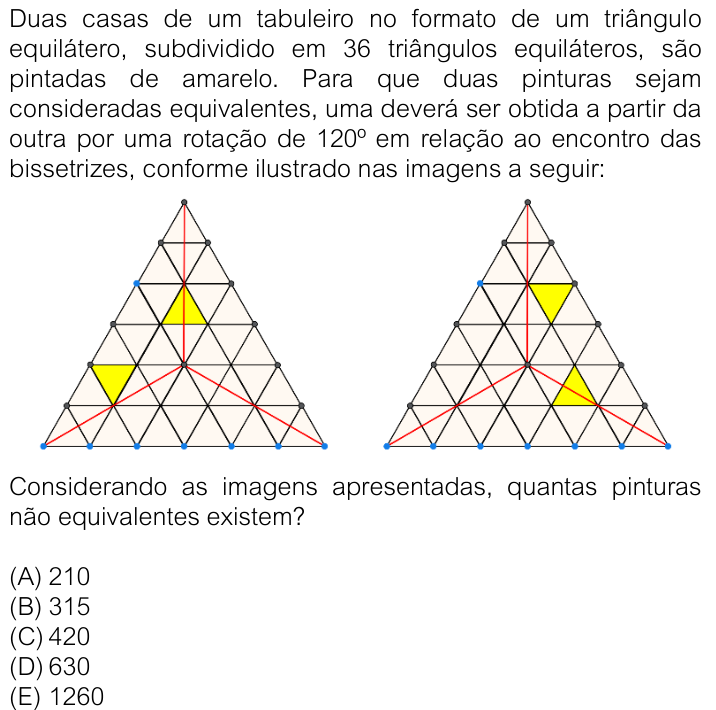
Let's not jump. Need fully parse image: "Duas casas de um tabuleiro no formato de um triângulo equilátero, subdividido em 36 triângulos equiláteros, são pintadas de amarelo. Para que duas pinturas sejam consideradas equivalentes, uma deverá ser obtida a partir da outra por uma rotação de 120° em relação ao encontro das bissetrizes, conforme ilustrado nas imagens a seguir:" Then images. "Considerando as imagens apresentadas, quantas pinturas não equivalentes existem?" Options.
Could "36 triângulos equiláteros" mean a triangular board subdivided into 36 **congruent** equilateral triangles? Standard side 6 gives 36 small triangles. Yes.
Need maybe count of "pinturas" could mean choose two **casas** (triangles). The board has 36 cells. Two cells painted. Equivalent under rotation 120. We did.
But wait: Are triangles all considered "casas"? Upwards and downwards; rotation by 120 about center maps orientation? A 120 rotation preserves upward/downward? It rotates by 120; an equilateral triangle pointing up after 120° remains? An equilateral triangle pointing up rotated 120° around its own center remains up; around external center, orientation vector rotates by 120. Upward triangle orientation vector angle 90° from base; rotated 120 becomes 210°, which points down-left? But the triangular tiling's upward triangle vertices: orientation can be classified as "up" (one vertex up) and "down" (one vertex down). Rotation by 120 of an up-pointing small triangle yields? Let's test big triangle has 3-fold; if one small up triangle rotates by 120 around centroid, its orientation (a vertex direction) rotates from up to down-left, but in the triangular lattice there are only up/down relative to page? Actually an equilateral triangle can have 6 orientations as cells? In triangular tiling, all small triangles are either up (apex upward) or down (apex downward), only two. Rotating an up triangle by 120° about an external point could yield a triangle with apex? Example upright equilateral triangle: vertices at angles 90,210,330. Rotate vertices by 120 -> angles 210,330,90; same set of vertices orientation? Wait as a shape centered at its center, rotating by 120 maps to itself because equilateral. But orientation vector apex rotates 120, yet set of vertices same. However relative to page, an upright triangle rotated 120 around its own center remains upright (same set). That seems contradictory: a triangle pointing up at center; vertices at 90 (top), 210 (bottom-left), 330 (bottom-right). Rotate by 120: top vertex moves to 210 (bottom-left), bottom-left moves to 330, bottom-right moves to 90. The set unchanged. So orientation unchanged as set. For a cell not centered at rotation origin, rotating its vertices by 120 gives a translated triangle whose vertices relative to its center are same as original set, so an up cell maps to up cell? But in triangular tiling there are also down cells. Let's use equilateral triangular cell pointing up, vertices (0,0),(1,0),(0.5,√3/2). Rotate by 120 around origin: vertices (0,0),(-0.5,-√3/2),(-? compute 0.5,0.866 rotated -> cos120*0.5 - sin120*.866 = -0.25-0.75=-1, y=0.433-0.433=0?) Wait result (-1,0), plus. Coordinates: (0,0),(-0.5,-0.866),(-1,0). This triangle has apex? Vertices form downward? It is a down triangle maybe? Hmm the orientation set relative to translation: centroid (-0.5,-0.288); vertex differences: (0.5,0.288), (0,-0.577), (-0.5,0.288). Apex downward. So rotating about external point changes up to down? Let's re-evaluate. Rotating an equilateral triangle around its own center by 120 gives same set; but that's an orientation-preserving symmetry mapping vertices cyclically, not translating. Under rotation about arbitrary origin, the image of a cell may have center rotated; the cell shape at its center is rotated by 120 around its own center too? Decomposition: rotation about O = translation of center + rotation about new center by same angle. Thus image cell shape is original rotated about its own center by 120, which is same set. Wait if an up cell rotated about its center by 120 equals itself (set upright). So image should be upright. My coordinate rotation about origin of a cell including origin as a vertex: the cell center is (0.5,0.288). Rotation about origin by 120: center -> (-0.5,-0.288)? Let's compute center (0.5,0.28866) rotate: x'=cos*0.5 - sin*0.28866= -0.25-0.25=-0.5, y'=sin*0.5+cos*0.28866=0.433-0.144=0.2887. Not (-0.5,-0.288) I guessed. Vertex set: (0,0); (1,0)->(-0.5,-0.866); (0.5,0.866)->(-1,0). These relative to new center (-0.5,0.2887): (0.5,-0.2887), (0,-1.1547), (-0.5,-0.2887). That's an upward triangle? Apex? The unique top? Points at y -0.2887,-1.1547,-0.2887; apex bottom. Hmm if center y? Let's identify: This has horizontal base at y=0? Vertices transformed: (0,0),(-0.5,-0.866),(-1,0). That's downward-pointing triangle (apex bottom? Actually top base from (0,0) to (-1,0), third below: apex down). It is down. But original cell was up with base from (0,0) to (1,0), apex up. Why decomposition fails? Because rotating about its center by 120 maps the set to itself, yes, but the "cell" as an unlabeled set after translation? Wait rotated image of all points in cell = {R(O + x): x in cell}. If decompose around cell center c: R(c+y)=R(c)+R(y). R(y) rotates vector y by 120. For an equilateral triangle centered at c, the set of y is invariant under 120 rotation. Therefore R(cell)=R(c)+cell. So shape remains up at center R(c). My coordinate map should yield an up triangle centered at R(c). Did I choose vertices wrong? Original up cell with vertices (0,0),(1,0),(0.5,0.866). Its center is average (0.5,0.2887). The set y = vertices - center: (-0.5,-0.2887),(0.5,-0.2887),(0,0.5774). Rotate y by 120: (-0.5,-0.2887)->(0.5,-0.2887)? Let's compute: cos=-0.5, sin=0.866. For (-0.5,-0.2887): x'=0.25+0.25=0.5, y'=-0.433+0.144=-0.2887. yes maps to (0.5,-0.2887). The set invariant. Good. Then R(c)=(-0.5,0.2887). Add y set: vertices = (-1,0),(0,0),(-0.5,0.866). That's an upward triangle with base from (-1,0) to (0,0), apex (-0.5,0.866). But I computed vertex (0.5,0.866) rotated to (-1,0) yes; (1,0) rotated ->(-0.5,-0.866), not in set? Wait R(1,0)=(-0.5,-0.866), that's not among new triangle vertices. Hmm original vertices were (0,0),(1,0),(0.5,0.866). Rotate all: (0,0),(-0.5,-0.866),(-1,0). That's downward shape. But decomposition says R(c)+set y = vertices? Let's compute R(c) for c=(0.5,0.2887): R(c)=(-0.5,0.2887). Add rotated y set: y vertices: (-0.5,-0.2887)->(0.5,-0.2887); (0.5,-0.2887)->(-0.5,-0.2887)? compute: x'= -0.25+0.25=0; y'=0.433+0.144=0.577? Let's carefully. Rotation matrix 120: (x,y)->(-1/2 x -√3/2 y, √3/2 x -1/2 y).
For y1=(-0.5,-0.288675): x'=0.25+0.25=0.5; y'=-0.433+0.144=-0.288675.
For y2=(0.5,-0.288675): x'=-0.25+0.25=0; y'=0.433+0.144=0.57735.
For y3=(0,0.57735): x'=0-0.5=-0.5; y'=0-0.288675=-0.288675.
Set is (0.5,-0.2887),(0,0.5774),(-0.5,-0.2887), not original y set. Ah because rotating y by 120 of an **upward triangle centered at origin** gives? Wait original y set vertices: top (0,0.577), bottom-left(-0.5,-0.289), bottom-right(0.5,-0.289). Rotate each by 120: top -> (-0.5,-0.289), bottom-left -> (0.5,-0.289), bottom-right -> (0,0.577). This is same set! My computed for y2? y2=(0.5,-0.2887) rotate ->? x' = -0.25 +0.25=0; y'=0.433+0.144=0.577 yes top. y3=(0,0.577) rotate ->(-0.5,-0.289). y1=(-0.5,-0.289) rotate ->(0.5,-0.289). Set same. Good. Then R(c)+set y = (-0.5,0.2887)+ {(0,0.577),(-0.5,-0.289),(0.5,-0.289)} = (-0.5,0.866),(-1,0),(0,0). That is up. But direct rotate original vertices gave (0,0),(-0.5,-0.866),(-1,0). Are these different? Because R(original vertex) = R(c+y) = R(c)+R(y). Since R(y) set = y set, result = R(c)+y set. Direct compute R(0.5,0.866): x'=-0.25-0.75=-1, y'=0.433-0.433=0. So (-1,0). R(1,0)=(-0.5,-0.866). R(0,0)=(0,0). Those are (0,0),(-1,0),(-0.5,-0.866), which is down. But according to decomposition, R(c)+y set includes (-0.5,0.2887)+(0,0.577)=(-0.5,0.866), not (-0.5,-0.866). Which is correct? Wait c=(average) = (0.5,0.2887). But is that the center of equilateral triangle? Average is (0.5,0.2887) yes. Rotate c: x'=-0.25-0.25=-0.5, y'=0.433-0.144=0.2887. Add original y set vertices relative to center:
Original vertex (0.5,0.866) relative to c: (0,0.5774). That's top. R(c)+ relative top (not rotated) = (-0.5,0.866). But actual rotated top vertex R(0.5,0.866)=(-1,0). Why R(c)+ (relative rotated) differs? Wait R(c+y) = R(c)+R(y). R(y for top) = top rotated = (-0.5,-0.2887). Then R(c)+R(y)=(-1,0). Ah I used y set invariant, but y set is invariant as set, yes includes element (0,0.5774) but R(top)=bottom-left. Adding R(c)+bottom-left = (-0.5,0.2887)+(-0.5,-0.2887)=(-1,0). The set R(c)+R(S) = R(c)+S since S invariant. Thus R(c)+S should equal original rotated vertices. But R(c)+S = {(-0.5,0.866),(-1,0),(0,0)}. Contains (-0.5,0.866), but direct doesn't. The error: S (vertices relative to center) for original up triangle is not invariant under 120? Let's list S: original vertices (0,0),(1,0),(0.5,0.866), center c=(0.5,0.2887). Relatives: (-0.5,-0.2887),(0.5,-0.2887),(0,0.5774). This set is an **upward triangle centered at origin**? Actually an upward triangle centered at its centroid has one vertex at top and base bottom. Yes. Rotation by 120 of an equilateral triangle **set** about its centroid maps vertices cyclically: top (0,0.577) -> (-0.5,-0.2887) (bottom-left). Yes invariant. Let's rotate S: top -> (-0.5,-0.2887) in S; bottom-left (-0.5,-0.2887) rotate ->? x'=0.25+0.25=0.5, y'=-0.433+0.144=-0.2887, in S; bottom-right -> (0,0.577). invariant. So R(c)+S = S shifted to R(c). This set is same shape orientation as S: upward. But direct rotating all points should also map the triangle to a triangle of same orientation (because rotation preserves orientation). So why direct vertices gave down? Recompute direct R(0.5,0.866): x' = -0.5*0.5 -0.866*0.866 = -0.25-0.75=-1.0; y'=0.866*0.5 + (-0.5)*0.866 =0.433-0.433=0. So (-1,0). R(1,0)=(-0.5,0.866)? y'=0.866*1 -0 =0.866, not -0.866! Formula above had y' = √3/2 x -1/2 y, yes for (1,0) y'=0.866. I earlier wrote -0.866 (using angle 240?). So rotated vertices: (0,0),(-0.5,0.866),(-1,0) = up. Good. Rotation by 120 preserves up/down? It maps up to up, down to down? But a triangle pointing up under 120 around its center remains up because set invariant; yes. Under rotation around external center, orientation remains up. So up cells map to up cells, down to down? Wait an equilateral triangle pointing down rotated 120 about its center also set invariant (down). So yes orientation (up/down) preserved under rotations by multiples 120? Actually a 60° rotation would flip up/down; 120 preserves.
But big triangular board itself: rotating by 120 maps the set of up cells to up cells? The board has 21 up cells and 15 down cells for n=6? Formula: n(n+1)/2 up =21; n(n-1)/2 down=15. 21 not divisible by 3? 21 divisible by3 yes; 15 divisible by3. Good. No issue.
Now about fixed cells: A small triangle (up or down) fixed as set under 120 rotation about center if its center is at center? Because rotation by 120 around its own center preserves cell. If its center not at O, can a small triangle map to itself? A rotation about O has no other fixed point; for set invariant, its centroid maps to centroid, so centroid=O. Thus only cell centered at O could be fixed. For n=6, O is vertex; no cell centered. For n multiple of? So f=0.
However, wait big triangle side length 6; centroid at height h/3 from base = (n√3/2)/3 = n√3/6. For n=6 =√3. Grid vertices y coordinates are k√3/2, k=0..6 if base horizontal y=0. y=√3 = 2*(√3/2), indeed vertex row. x coordinate center: base midpoint? At y=2, grid vertices spacing 1? Big triangle at height 2 has width? Need coordinate. Base length 6, apex at x=3,y=6h? Let's set base vertices (0,0),(6,0), apex (3,3√3). Centroid (3,√3). At y=√3 (row k=2 from base), vertices x =? lines slope; x positions: from left edge x = y/(2√3?) Wait horizontal row has vertices at x = ? For y=2*(√3/2)=√3, row from base is k=2, segment endpoints left x = k/2? Let's set big base from (0,0) to (6,0), apex (3,3√3). Rows horizontal at y=k√3/2. Left boundary x = k/2, right = 6 - k/2. For k=2: left=1, right=5. Vertices at x=1,2,3,4,5? Center x=3 yes vertex. So center is vertex, not cell centroid. No fixed.
Thus answer 210.
But let's consider if "rotação de 120°" could include only clockwise, and equivalence defined directed? "uma deverá ser obtida a partir da outra por uma rotação de 120°" If only one direction, the relation is not symmetric? But "equivalentes" implies if A can become B by +120, then B can become A by -120 (=240), which is also a rotation of 120? Hmm -120 is not 120? In Portuguese "uma rotação de 120°" might mean angle magnitude 120, including both directions? Usually rotation of 120° clockwise or counterclockwise? They illustrate one arrow? Need check. The two images: first shows two yellows (one central above, one lower left). Rotating first by 120° clockwise or counter? Let's map. Center is vertex. First yellow: an upward triangle above center? Actually central yellow just above center? And lower left downward? Rotating 120 clockwise: top central moves lower right? Second image: central downward? Wait in second, one yellow near top center (downward?) and one lower right (upward?); Need see.
Let's identify image coordinates with side n=6. Need understand rotation direction. First image: There is a yellow triangle at center top? Let's label rows. Big triangle apex top. Center intersection red at row from top? In first, yellow central is just above intersection? It appears a small upward triangle whose bottom vertex is the center intersection (red lines meet at its bottom vertex). There is another yellow lower-left: a downward triangle on row 3? In second, yellow near top center is a downward triangle? It lies above left? Actually second image: yellow central? It seems just above intersection too, but pointing down? Wait rotation by 120 should rotate entire pattern; the central cell adjacent to the center intersection cycles among the three triangles around the center: there are six small triangles around the center vertex (center is a vertex). Rotating by 120 cycles them in two orbits of 3: upward? Need.
If the center is a vertex, small triangles meeting at center: 6 around. Rotating 120 gives two orbits of 3 triangles around center. In first, yellow central might be one of these; second after rotation is another. The other yellow likewise. So no fixed pair.
Total arrangements = choose 2 cells =630. Since group of 3 acts freely on pairs? Need if any pair invariant under 120? Since no cell fixed, but could a pair be mapped to itself by 120 by swapping the two cells? As said permutation of two elements under a 120 rotation? Wait a 120 rotation as a permutation of cells has cycles length 3 or 1. Restricted to a 2-element set invariant as a set, both cells must be fixed or form a 2-cycle. Cycles length 2 impossible because 3-cycle permutation. But note on a set of two labeled cells, applying 120 twice can swap? The group element of order 3 cannot induce transposition on a 2-set. So invariant pair only fixed cells. f=0 => no. Action free on ordered? For unordered pairs, stabilizer trivial. Orbit size 3. So 210.
Could there be rotations 0,120,240 and pairs where configuration invariant under 240 but not 120? If invariant under 240 (order 3), also under inverse? 240 generates group, so invariant under 120 as 240^2. Same.
Thus A.
Need provide explanation in Portuguese. But perhaps need address possible alternative: If one uses Burnside. We can explain board has 36 casas; total ways choose two = C36,2=630. Rotation by 120 around center; for side 6, the center is a vertex of grid, so no small triangle is fixed by rotation. Therefore no painting of two cells remains identical after 120 rotation (because a fixed painting would require the two cells individually fixed or swapped in 2-cycle, impossible). Thus every equivalence class has exactly 3 distinct paintings. Count=630/3=210. Need ensure "center is a vertex not center of cell" verified maybe in image red lines meet at a vertex. The image shows red bisectors meet at a vertex. So rotation has no fixed "casa". We can also mention no configuration fixed under 120. Thus.
Let's craft final concise with calculations. Include answer line exactly. Final.