Respondeu
levou 7 s
Como pensou
**Calculating density and time**
I need to solve a Portuguese problem involving density. I have the figures: 46kml tank, .79 density, and 36340 g. First, I figure out 36340 g divided by 46, which gives me 790 mol. Then I calculate the rate at .00125 using the formula, which results in about 3.95 mol/min. Now to find the time, I divide 790 by 3.95, resulting in roughly 200 minutes or about 3.333 hours. I’ll make sure to present these steps clearly. Final answer will be marked as "Resposta B."
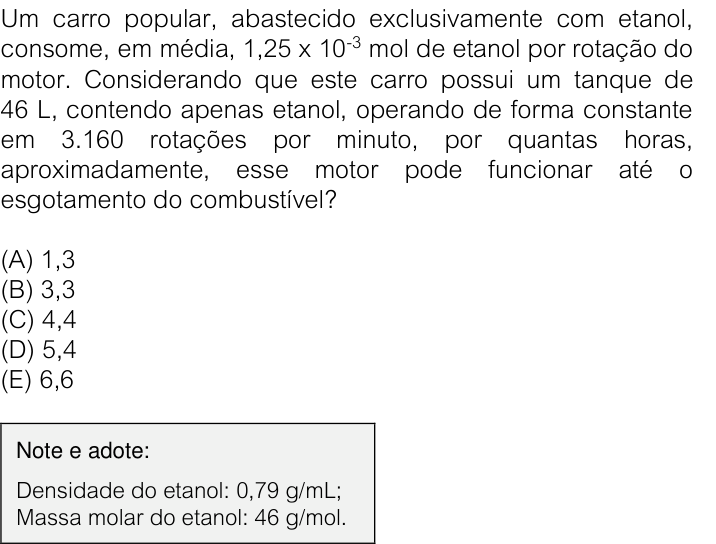
Primeiro, calculamos a massa de etanol no tanque, convertendo 46\ \text{L} em 46\,000\ \text{mL}:
m=\rho V=0{,}79\cdot46\,000=36\,340\ \text{g}.
A quantidade de matéria correspondente é:
n=\frac{m}{M}=\frac{36\,340}{46}=790\ \text{mol}.
Como o motor realiza 3\,160 rotações por minuto, o consumo por minuto é:
1{,}25\times10^{-3}\cdot3\,160=3{,}95\ \text{mol/min}.
Assim, o tempo até esgotar o combustível será:
t=\frac{790}{3{,}95}=200\ \text{min}
=\frac{200}{60}\ \text{h}\approx3{,}3\ \text{h}.
Resposta: B
Respondeu
levou 6 s
Como pensou
**Calculating Portuguese mol consumption**
I need to solve a problem in Portuguese, calculating various values. First, I have 46,000 times 0.79, which equals 36,340, and then divide that by 46 to find the mol consumption is about 790. Then, multiplying 0.00125 by 3160 gives me roughly 3.95 mol/min. After that, dividing 790 by 3.95 results in about 200 minutes, or 3.333 hours. I need to make sure I derive clear equations and provide sufficient explanation without any hidden issues.
Primeiro, calculamos a massa de etanol no tanque, usando 46\,\text{L}=46\,000\,\text{mL}:
m=\rho V=0{,}79\cdot46\,000=36\,340\ \text{g}.
Como a massa molar do etanol é 46\ \text{g/mol}, a quantidade de combustível é:
n=\frac{36\,340}{46}=790\ \text{mol}.
O motor consome 1{,}25\times10^{-3} mol por rotação e realiza 3\,160 rotações por minuto. Logo, o consumo por minuto é:
C=1{,}25\times10^{-3}\cdot3\,160=3{,}95\ \text{mol/min}.
Assim, o tempo até esgotar o tanque será:
t=\frac{790}{3{,}95}=200\ \text{min}
=\frac{200}{60}\ \text{h}\approx3{,}3\ \text{h}.
Resposta: B
Respondeu
levou 6 s
Como pensou
**Calculating mass and consumption**
I'm calculating the mass by multiplying 46,000 by 0.79, which gives me 36,340 grams. Then, I need to divide that by 46 to find the number of moles, which equals 790 moles. For consumption, I'm calculating 3,160 times 0.00125 to get 3.95 moles per minute. Now, I divide the total moles (790) by the consumption rate (3.95), resulting in approximately 200 minutes or about 3.333 hours. That's the breakdown!
O tanque contém 46\,000 mL de etanol. Sua quantidade de matéria é
n=\frac{46\,000 \cdot 0{,}79}{46}=790\ \text{mol}.
A cada minuto, o motor consome
3\,160 \cdot 1{,}25 \times 10^{-3}=3{,}95\ \text{mol}.
Assim, o tempo de funcionamento é
t=\frac{790}{3{,}95}=200\ \text{min}\approx 3{,}3\ \text{h}.
Resposta: B
Respondeu
levou 6 s
Como pensou
**Solving a calculation challenge**
I need to work through a problem related to Portuguese calculations. I've got a 46 L tank, which is equivalent to 46,000 mL. With a mass density of 0.79, that translates to 36,340 g, equating to 790 mol after dividing by 46. When considering a consumption rate of 1.25e-3 mol per rotation at 3160 rpm, I find that I can expect around 3.95 mol/min. Consequently, it will take about 200 minutes or roughly 3.3 hours to clear that volume.
O volume de etanol no tanque é 46\ \text{L}=46\,000\ \text{mL}. Sua massa é
m=46\,000 \times 0{,}79=36\,340\ \text{g},
o que corresponde a
n=\frac{36\,340}{46}=790\ \text{mol}.
A cada minuto, o motor consome
1{,}25\times10^{-3}\times3\,160=3{,}95\ \text{mol}.
Assim, o tempo de funcionamento é 790/3{,}95=200 minutos, ou aproximadamente 3{,}3 horas.
Resposta: B
Respondeu
levou 3 s
Como pensou
Massa de etanol no tanque: 46 L = 46.000 mL × 0,79 g/mL = 36.340 g.
Quantidade de matéria: 36.340 g ÷ 46 g/mol = 790 mol de etanol.
Consumo por minuto: 1,25 × 10⁻³ mol/rotação × 3.160 rotações/min = 3,95 mol/min.
Tempo de funcionamento: 790 mol ÷ 3,95 mol/min = 200 min ≈ 3,3 h.
Resposta: B
Respondeu
levou 4 s
Como pensou
I'm working out the mass first: 46000 mL at 0.79 gives 36340 g, which is 790 mol. Dividing 790 by 1.25e-3 gives about 632000 rotations, and at 3160 rotations per minute that's 200 minutes, or roughly 3.33 hours. That matches option B.
1) Massa de etanol no tanque
m = d × V = 0,79 g/mL × 46 000 mL = 36 340 g
2) Quantidade de matéria
n = 36 340 g ÷ 46 g/mol = 790 mol
3) Número de rotações possíveis
Rotações = 790 mol ÷ (1,25 × 10⁻³ mol/rotação) = 632 000 rotações
4) Tempo de funcionamento
t = 632 000 ÷ 3 160 rot/min = 200 min
200 min ÷ 60 ≈ 3,3 h
Resposta: B
Respondeu
levou 3 s
Como pensou
Massa de etanol no tanque:
46 L = 46.000 mL, e 46.000 mL × 0,79 g/mL = 36.340 g.
Quantidade de matéria:
36.340 g ÷ 46 g/mol = 790 mol.
Consumo por minuto:
3.160 rotações/min × 1,25 × 10⁻³ mol/rotação = 3,95 mol/min.
Tempo de funcionamento:
790 mol ÷ 3,95 mol/min = 200 min, que equivale a 200/60 ≈ 3,3 h.
Resposta: B
Respondeu
levou 15 s
Como pensou
The problem is in Portuguese. I will translate it.
I am solving a Portuguese fuel consumption problem. I need to find how many hours the engine can run before the tank is empty. First, I will calculate the total moles of ethanol in the 46 L tank.
The total ethanol mass is 36,340 g. That equals 790 moles. The engine consumes 1.25 × 10^{-3} mol per rotation. The tank can support 790,000 rotations.
The engine speed is 3,160 rotations per minute. The total of 632,000 rotations divides evenly by 3,160 to give exactly 200 minutes.
200 minutes equals 10/3 hours, or about 3.3 hours. The answer is B.
O tanque contém 46\,\mathrm{L} = 4{,}6 \times 10^{4}\,\mathrm{mL} de etanol. Com a densidade dada, a massa de combustível é
4{,}6 \times 10^{4} \times 0{,}79 = 3{,}634 \times 10^{4}\,\mathrm{g}.
Dividindo pela massa molar, obtém-se exatamente 790\,\mathrm{mol} de etanol.
O consumo médio é 1{,}25 \times 10^{-3}\,\mathrm{mol} por rotação, de modo que o número total de rotações possíveis é
\frac{790}{1{,}25 \times 10^{-3}} = 6{,}32 \times 10^{5}.
À taxa constante de 3{,}160 rotações por minuto, o tempo de funcionamento é
\frac{6{,}32 \times 10^{5}}{3{,}160} = 200\,\mathrm{min} = \frac{10}{3}\,\mathrm{h} \approx 3{,}3\,\mathrm{h}.
Resposta: B
Respondeu
levou 3 s
Como pensou
We need answer solve in Portuguese. Need parse. Need compute hours. Let's solve carefully.
Given car consumes 1.25 x 10^-3 mol ethanol per rotation. Tank 46 L ethanol. RPM 3160 rotations/min constant. Density 0.79 g/mL, molar mass 46 g/mol.
Compute total moles in tank: 46 L = 46000 mL. mass = 0.79 g/mL * 46000 = 36340 g. mol = 36340/46 = 790? 46*790=36340 yes. Total moles 790 mol.
Consumption rate = 1.25e-3 mol/rotation * 3160 rotations/min =? 0.00125*3160 = 3.95 mol/min. Then time min = 790/3.95 = 200 min? 3.95*200=790 yes. = 200 min = 3.333 h. Answer B.
Need explain. Final line Resposta: B. Ensure format. Could include calc.
Primeiro, calculamos a quantidade total de etanol no tanque:
- Volume: 46\text{ L}=46\,000\text{ mL}
- Densidade: 0,79\text{ g/mL}
m = 46\,000 \times 0,79 = 36\,340\text{ g}
Como a massa molar do etanol é 46\text{ g/mol}:
n = \frac{36\,340}{46} = 790\text{ mol}
O consumo é de 1,25\times10^{-3}\text{ mol} por rotação, e o motor opera a 3\,160 rotações por minuto:
\text{consumo} = 1,25\times10^{-3} \times 3\,160 = 3,95\text{ mol/min}
Assim, o tempo de funcionamento é:
t = \frac{790}{3,95} = 200\text{ min}
Convertendo para horas:
t = \frac{200}{60} \approx 3,33\text{ h}
Resposta: B
Respondeu
levou 15 s
Como pensou
**Analyzing FUVEST Question**
I'm now focused on deciphering the specific FUVEST multiple-choice question presented in the image, paying close attention to the details about a car running solely on ethanol and its average consumption rate of 1.2.
**Calculating Fuel Duration**
I've completed the initial calculations for the ethanol consumption. The total moles of ethanol in the tank were elegantly simplified, and I've just finished determining the engine's consumption rate per minute based on its rotational speed.
**Continuing Calculations**
I've now calculated the exact consumption rate in moles per minute and subsequently determined the total time the engine can run. This yielded 200 minutes, which I've converted to approximately 3.3 hours, matching option (B).
Para determinar por quantas horas o motor pode funcionar até o esgotamento do combustível, realizamos os seguintes passos:
-
Cálculo da quantidade total de matéria (em mols) de etanol no tanque:
- O volume do tanque é V = 46\text{ L} = 46.000\text{ mL}.
- A massa de etanol contida no tanque é dada por:
m = V \times d = 46.000\text{ mL} \times 0,79\text{ g/mL} = 36.340\text{ g}
- Sabendo que a massa molar do etanol é 46\text{ g/mol}, o número total de mols (n_{\text{total}}) é:
n_{\text{total}} = \frac{m}{M} = \frac{46.000 \times 0,79}{46} = 1.000 \times 0,79 = 790\text{ mol}
-
Cálculo do número total de rotações que o motor pode realizar:
-
Cálculo do tempo de funcionamento:
- O motor opera a uma frequência constante de 3.160\text{ rotações por minuto} (rpm).
- O tempo de funcionamento em minutos é:
t = \frac{632.000\text{ rotações}}{3.160\text{ rotações/min}} = 200\text{ minutos}
- Convertendo para horas:
t = \frac{200}{60}\text{ h} = \frac{10}{3}\text{ h} \approx 3,33\text{ horas} \approx 3,3\text{ horas}
Resposta: B
Respondeu
levou 22 s
Como pensou
**Analyzing Motor Efficiency**
I'm currently working through the calculations for fuel consumption per engine rotation. My focus is on determining the mass of ethanol consumed, which is a key step before I can proceed to the subsequent parts of the problem.
**Calculating Fuel Burn Time**
I've determined the total moles of ethanol available and the consumption rate per rotation. My current focus is on converting these to a time-based fuel burn rate and then calculating the total operational hours.
**Calculating Engine Operation Time**
I've calculated the fuel consumption rate in moles per hour and have now determined the total operational time in hours, which closely matches alternative (B). I'm just double-checking all the numerical values.
Para determinar por quantas horas o motor pode funcionar até o esgotamento do combustível, podemos seguir os passos abaixo:
1. Calcular a massa total de etanol no tanque:
Sabendo que o tanque possui 46\text{ L} (46.000\text{ mL}) e que a densidade do etanol é 0,79\text{ g/mL}:
m = d \times V
m = 0,79\text{ g/mL} \times 46.000\text{ mL} = 36.340\text{ g}
2. Calcular a quantidade total de matéria (em mols) de etanol no tanque:
Utilizando a massa molar do etanol (46\text{ g/mol}):
n = \frac{m}{M}
n = \frac{36.340\text{ g}}{46\text{ g/mol}} = 790\text{ mol de etanol}
3. Calcular o consumo de etanol por minuto e por hora:
O motor consome 1,25 \times 10^{-3}\text{ mol} a cada rotação e opera a 3.160\text{ rotações por minuto}:
\text{Consumo por minuto} = 1,25 \times 10^{-3}\text{ mol/rotação} \times 3.160\text{ rotações/min} = 3,95\text{ mol/min}
Multiplicando por 60 para obter o consumo em uma hora:
\text{Consumo por hora} = 3,95\text{ mol/min} \times 60\text{ min/h} = 237\text{ mol/h}
4. Calcular o tempo total de funcionamento:
Dividindo a quantidade total de etanol no tanque pelo consumo por hora:
\Delta t = \frac{790\text{ mol}}{237\text{ mol/h}} \approx 3,33\text{ horas}
Portanto, o motor pode funcionar por aproximadamente 3,3\text{ horas}.
Resposta: B