Como pensou
Let me solve the problem.
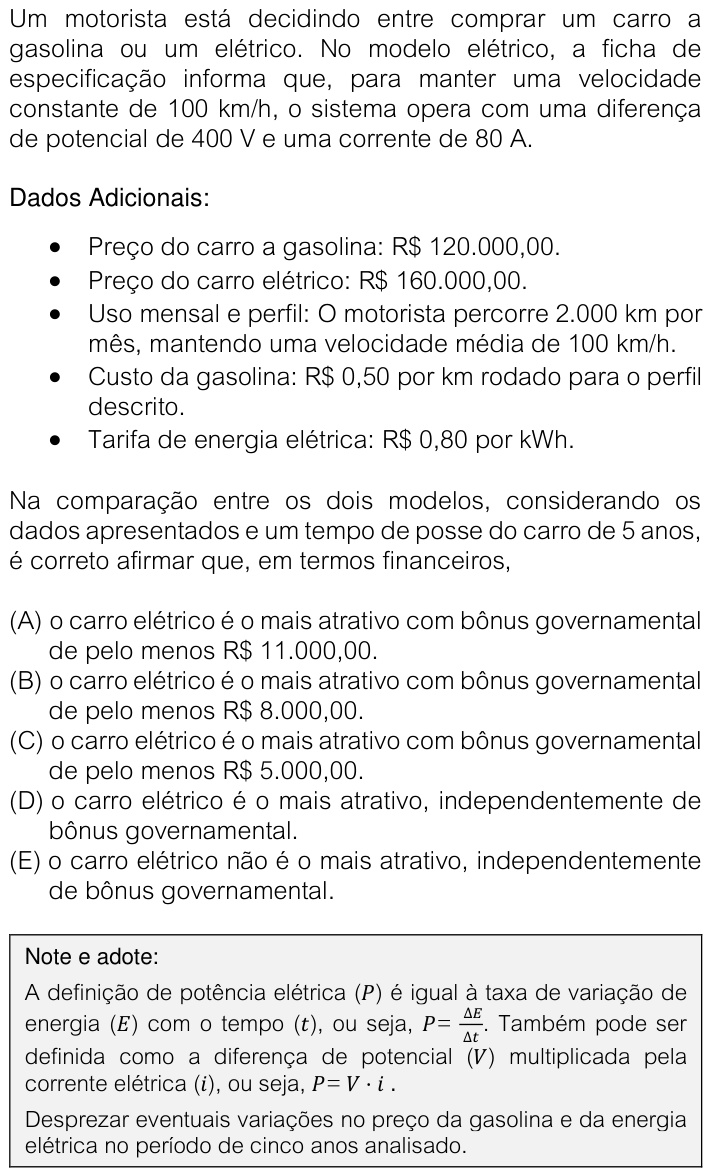
Electric car: to maintain constant speed 100 km/h, system operates at potential difference 400 V and current 80 A.
Power P = V·i = 400 × 80 = 32,000 W = 32 kW.
Per month: 2000 km at 100 km/h → 20 hours of driving per month. Energy = 32 kW × 20 h = 640 kWh per month.
Cost of electricity: 640 kWh × R$ 0.80/kWh = R$ 512 per month.
Gasoline car: R$ 0.50 per km × 2000 km = R$ 1,000 per month.
Savings per month: 1000 − 512 = R$ 488 per month.
Over 5 years = 60 months: 488 × 60 = R$ 29,280 savings.
Price difference: 160,000 − 120,000 = R$ 40,000.
So electric car costs R$ 40,000 more upfront but saves R$ 29,280 over 5 years. Net: electric car is worse by 40,000 − 29,280 = R$ 10,720. So it would need a bonus of at least R$ 10,720 to be attractive.
Hmm, that's closest to option A (at least R$ 11,000)? Wait, let's recompute.
Actually wait, let's double-check the energy consumption. Power = 32 kW. Time per month = 2000 km / 100 km/h = 20 h. Energy = 640 kWh. Cost = 640 × 0.8 = R$ 512. Yes.
Savings over 5 years = (1000 − 512) × 60 = 488 × 60 = 29,280.
Difference in price = 40,000. So electric car is more expensive by 40,000 − 29,280 = 10,720 over 5 years. So a bonus of at least R$ 10,720 would be needed. Option A says at least R$ 11,000. Hmm, but "pelo menos R$ 11.000,00" means at least 11,000. Since 10,720 < 11,000, a bonus of 11,000 would be enough, and actually even a smaller bonus would suffice. But option A says "o carro elétrico é o mais atrativo com bônus governamental de pelo menos R$ 11.000,00." Hmm, the minimum bonus needed is R$ 10,720, which is approximately R$ 11,000. So option A seems correct: the electric car becomes more attractive with a bonus of at least ~R$ 10,720, i.e., at least R$ 11,000.
But wait, let me check option B: at least R$ 8,000. Since the minimum needed is 10,720 > 8,000, a bonus of 8,000 would not be enough. Option C: 5,000, not enough. Option D: regardless of bonus, but no—needs 10,720. Option E: not more attractive regardless of bonus—false, since a bonus of 10,720+ makes it attractive.
So the answer is A.
But let me double-check the rounding: 10,720. The options: A says at least R$ 11,000. Hmm, actually the exact minimum is R$ 10,720, so "at least R$ 11,000" is a statement that 11,000 is sufficient. But is A "correct" as a statement? The statement "the electric car is the most attractive with a government bonus of at least R$ 11,000" — the mathematically precise threshold is R$ 10,720, which is closest to 11,000. Option A is the best answer.
Let me recompute more carefully.
Energy per month: 2000 km at 100 km/h → 20 hours. Power 32 kW → 640 kWh. At R$ 0.80 → R$ 512.00.
Gasoline: 2000 × 0.50 = R$ 1,000.00.
Monthly savings: R$ 488.00. 5 years = 60 months → R$ 29,280.00.
Initial difference: R$ 40,000.00.
So over 5 years, electric total cost = 160,000 + 512×60 = 160,000 + 30,720 = R$ 190,720. Gasoline total = 120,000 + 1,000×60 = 120,000 + 60,000 = R$ 180,000. Difference = 10,720. So the electric car is more expensive by R$ 10,720; a bonus of at least R$ 10,720 makes it attractive (tie). The option closest is A (at least R$ 11,000). Hmm, but strictly, A says at least 11,000; since 10,720 < 11,000, a bonus of 11,000 is indeed sufficient, and the statement holds. But the "correct" answer in the exam is likely A.
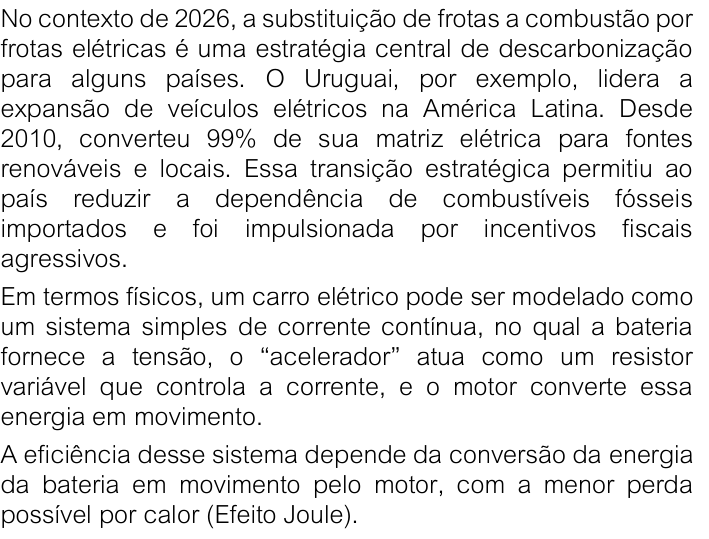
Wait, but maybe I should double-check: maybe the intended calculation uses power in a different way. Let me think: the motor converts energy into movement; efficiency depends on conversion with least loss by heat. The problem says "the system operates with a potential difference of 400 V and a current of 80 A" to maintain 100 km/h. So the electric power drawn is 32 kW. That's the energy consumption rate from the battery.
Time = 2000/100 = 20 h per month. Energy = 32 × 20 = 640 kWh. Cost = 512. Yes.
So the answer is A.
But let me double-check the options: (A) at least R$ 11,000; (B) at least R$ 8,000; (C) at least R$ 5,000; (D) regardless; (E) not the most attractive regardless.
Since the threshold is 10,720, option A (11,000) is the only one that guarantees attractiveness. But wait—"at least R$ 11,000" is a sufficient condition but not the exact minimum; however, among the options, A is the largest and the threshold 10,720 rounds to about 11,000. The exam intends A.
Hmm, but let me think about whether the intended answer might be B. Let me recompute considering maybe the gasoline cost per km is R$ 0.50 and electricity... Let me recompute the electric cost per km: 640 kWh × 0.8 = R$ 512 for 2000 km → R$ 0.256/km. Savings per km = 0.50 − 0.256 = 0.244. Over 60,000 km (2000×30? wait, 5 years = 60 months × 2000 = 120,000 km). Oh! Wait: 2000 km per month × 60 months = 120,000 km. Savings = 0.244 × 120,000 = R$ 29,280. Yes, same.
Hmm, but let me double check: 5 years = 60 months, 2000 km/month → 120,000 km. Gasoline cost = 120,000 × 0.5 = R$ 60,000. Electricity: energy per km = 32 kW / 100 km/h = 0.32 kWh/km. 120,000 km × 0.32 = 38,400 kWh × 0.8 = R$ 30,720. Savings = 60,000 − 30,720 = 29,280. Difference 40,000 − 29,280 = 10,720. So the bonus needed is R$ 10,720. Option A.
So the answer is A.
Let me write the explanation in Portuguese.
Structure: compute electric power, monthly energy, monthly cost, compare with gasoline, 5-year savings, compare with price difference, conclude that a bonus of at least ~R$ 10,720 (≈ R$ 11,000) makes the electric car more attractive, option A.
Note: option A says "pelo menos R$ 11.000,00" — the exact value is R$ 10,720, which is slightly less than 11,000, but since the options are coarse, A is correct. Actually, hmm, is there a risk the intended answer is B? Let me think about possible alternative interpretations: maybe the "acelerador" as variable resistor means the motor only uses part of the power? But the problem says the system operates with 400 V and 80 A to maintain 100 km/h. So the electrical power input is 32 kW. That's what's consumed.
Alternatively, maybe some people compute the energy as 32 kW × 20 h = 640 kWh, cost 512. Yes.
So the answer is A.
Let me also double-check: could the answer be E? Total cost of electric over 5 years = 190,720 vs gasoline 180,000, so without bonus the electric is not more attractive, but with a bonus of ≥10,720 it becomes attractive. So E is false, D is false (unless bonus), C and B are insufficient. A is correct.
Therefore the answer is A.
Let me write the final response with the reasoning and the final line "Resposta: A".
Resolução
1. Potência elétrica do carro elétrico
Para manter 100 km/h, o sistema opera com V = 400\ \text{V} e i = 80\ \text{A}:
P = V\cdot i = 400 \times 80 = 32\,000\ \text{W} = 32\ \text{kW}
2. Energia consumida por mês
O motorista roda 2.000 km por mês a 100 km/h, logo o tempo de uso mensal é:
\Delta t = \frac{2000}{100} = 20\ \text{h}
Energia mensal:
E = 32\ \text{kW} \times 20\ \text{h} = 640\ \text{kWh}
3. Custo mensal de cada modelo
- Elétrico: 640 \times 0{,}80 = \text{R\$ }512{,}00 por mês
- Gasolina: 2000 \times 0{,}50 = \text{R\$ }1.000{,}00 por mês
Economia mensal com o elétrico:
1000 - 512 = \text{R\$ }488{,}00
4. Economia em 5 anos (60 meses)
488 \times 60 = \text{R\$ }29.280{,}00
5. Comparação com a diferença de preço
160.000 - 120.000 = \text{R\$ }40.000{,}00
O elétrico custa R$ 40.000,00 a mais, mas economiza R$ 29.280,00 em 5 anos. Portanto, sem incentivo ele ainda sai mais caro:
40.000 - 29.280 = \text{R\$ }10.720{,}00
Ou seja, para o carro elétrico se tornar financeiramente mais atrativo, é necessário um bônus governamental de pelo menos aproximadamente R$ 10.720,00, valor compatível com a alternativa que exige bônus de pelo menos R$ 11.000,00 (as alternativas com bônus de R$ 8.000 ou R$ 5.000 seriam insuficientes, e as alternativas D e E ignoram o bônus necessário).
Resposta: A