Correção FUVEST 2027 · 1ª faseAcompanhe a resolução de cada questão da 1ª fase, ao vivoAcompanhar
IA ao vivo / FUVEST 2027 · 1ª fase

COMPARE OS RACIOCÍNIOS

Questão 31

Gabarito oficial: C. ← 30 32 →

A questão

Questão 31

Respostas das IAs

GPT-6 Astra

C

Respondeu

levou 6 s

Como pensou
**Explaining calculations clearly** I need to clarify that I’m working with Portuguese terms and some specific calculations. The numbers I have include 6 m, h1 of 1.056, h2 of 2.82, and a difference of 1.764 C. I should emphasize reading the tangent given tg25 of 0.47, and I need to explain that the initial percent is not referring to angles. Finally, I want to ensure that my final output consists of four concise paragraphs featuring the equations.

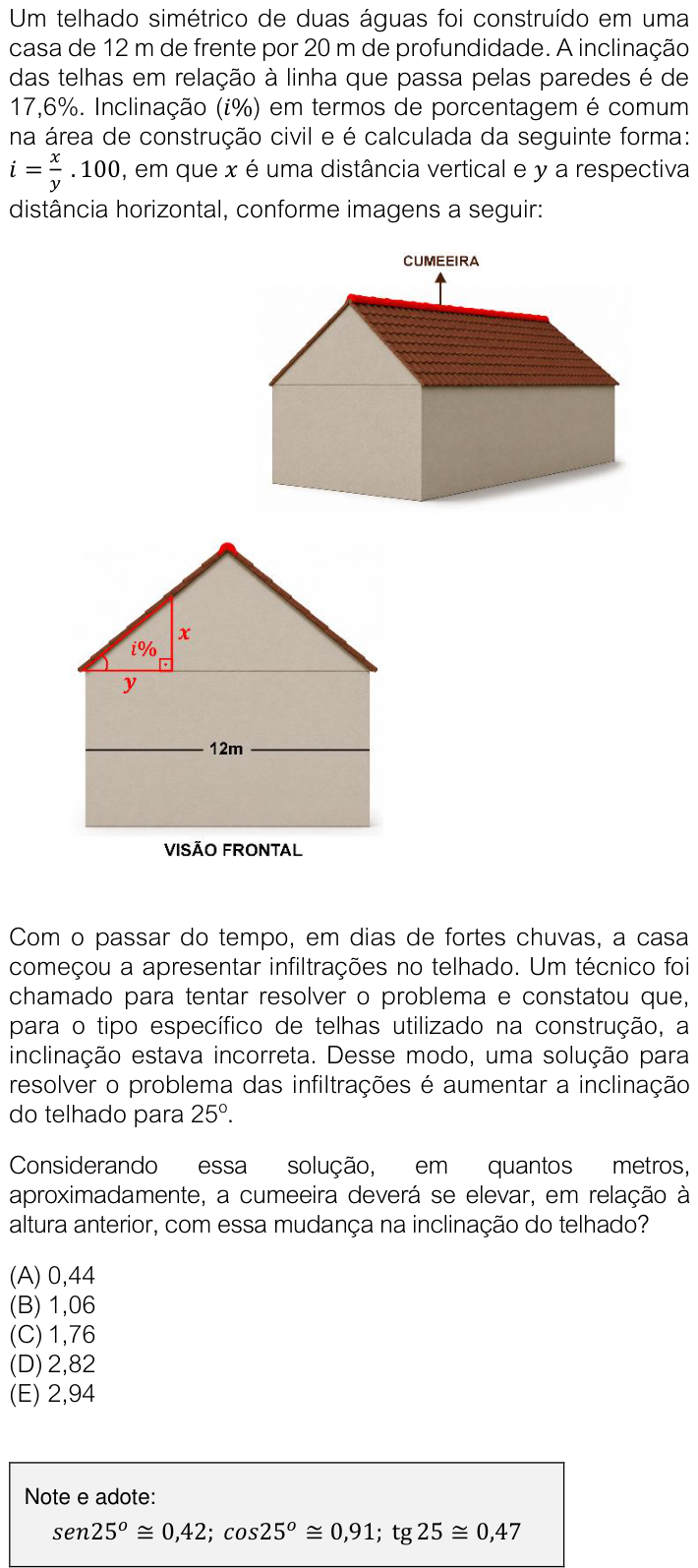
Como o telhado é simétrico, a distância horizontal entre uma parede lateral e a projeção da cumeeira é metade da largura da casa:

y=\frac{12}{2}=6\text{ m}.

A altura inicial da cumeeira em relação à linha que passa pelo topo das paredes é dada pela inclinação de 17,6\%:

\frac{h_1}{6}\cdot100=17,6 \quad\Rightarrow\quad h_1=1,056\text{ m}.

Com a nova inclinação de 25^\circ, usamos a tangente:

\tan25^\circ=\frac{h_2}{6} \quad\Rightarrow\quad h_2\approx6\cdot0,47=2,82\text{ m}.

Logo, a cumeeira deverá ser elevada em:

\Delta h=2,82-1,056=1,764\text{ m}\approx1,76\text{ m}.

Resposta: C

GPT-6.1 Sol

C

Respondeu

levou 4 s

Como pensou
**Clarifying calculations** I need to explain something in Portuguese clearly. First, I have some figures that need to be adjusted: 6, starting at 1.056 and ending at 2.82, which gives a difference of 1.764. I'll choose option C here. Also, I should include a distinction of 17.6% for a ratio of .176. I think there's an irrelevant 20 that I don't need to address. I'll keep the formulas and calculations concise to avoid confusion.

Como o telhado é simétrico, a distância horizontal entre uma parede lateral e a projeção da cumeeira é metade da largura da casa:

y=\frac{12}{2}=6\text{ m}.

A inclinação inicial é de 17,6%, portanto a altura inicial da cumeeira em relação ao topo das paredes é:

\frac{h_1}{6}\cdot100=17,6 \quad\Rightarrow\quad h_1=6\cdot0,176=1,056\text{ m}.

Com a nova inclinação de 25°, usando \tan25^\circ\approx0,47:

\frac{h_2}{6}=\tan25^\circ \quad\Rightarrow\quad h_2\approx6\cdot0,47=2,82\text{ m}.

Logo, a cumeeira deverá se elevar em:

\Delta h=h_2-h_1=2,82-1,056=1,764\approx1,76\text{ m}.

Resposta: C

GPT-6.1 Terra

C

Respondeu

levou 4 s

Como pensou
**Calculating values** I need to find the results for these calculations. First, I multiply 6 by 0.176, which equals 1.056. Then, I do 6 times 0.47, resulting in 2.82. Next, I find the difference between these two, which is 1.764, and I could round that to 1.76 Celsius when explaining the temperature change. It’s all pretty straightforward, but I care about getting the math right to ensure clarity!

Como o telhado é simétrico, a distância horizontal entre a parede e a cumeeira é metade da frente da casa: 12/2 = 6 m.

A altura inicial da cumeeira em relação às paredes é

h_1 = 6 \cdot 0{,}176 = 1{,}056\text{ m}.

Com a nova inclinação de 25^\circ, a altura será

h_2 = 6 \cdot \operatorname{tg}25^\circ \approx 6 \cdot 0{,}47 = 2{,}82\text{ m}.

Portanto, a elevação necessária é

h_2-h_1 = 2{,}82-1{,}056 \approx 1{,}76\text{ m}.

Resposta: C

GPT-6 Luna

C

Respondeu

levou 4 s

Como pensou

Como o telhado é simétrico e a frente da casa mede 12 m, a distância horizontal de cada parede até a cumeeira é 12/2=6 m.

A inclinação inicial é de 17{,}6\%, então a altura da cumeeira em relação às paredes era:

0{,}176\cdot 6=1{,}056\text{ m}.

Com a nova inclinação de 25^\circ, a altura passa a ser:

6\cdot \tan 25^\circ \approx 6\cdot 0{,}47=2{,}82\text{ m}.

Logo, a cumeeira deverá se elevar aproximadamente:

2{,}82-1{,}056=1{,}764\text{ m}\approx 1{,}76\text{ m}.

Resposta: C

Claude Fable 5.1

C

Respondeu

levou 3 s

Como pensou

Dados: a casa tem 12 m de frente, telhado simétrico de duas águas, então a distância horizontal de cada água é y = 6 m.

Altura inicial da cumeeira (inclinação 17,6%):

i = (x/y)·100 → 17,6 = (x/6)·100 → x = 0,176 · 6 = 1,056 m ≈ 1,06 m

Altura nova da cumeeira (inclinação 25°):

tg 25° = x'/y → x' = 6 · 0,47 = 2,82 m

Elevação da cumeeira:

Δx = 2,82 − 1,06 = 1,76 m

Resposta: C

Claude Opus 5.5

C

Respondeu

levou 3 s

Como pensou
I'm working out the height at half the width of 6 m: the original is 0.176 × 6 ≈ 1.056 m, and the new one at 25° is 6 × tan 25° ≈ 2.82 m. The difference comes to about 1.76 m, which matches option C.

Resposta: (C) 1,76 m

  1. Geometria do telhado. O telhado é simétrico e a frente da casa mede 12 m. Assim, a cumeeira fica no meio, e cada água tem uma distância horizontal de y = 6 m.

  2. Altura inicial da cumeeira. A inclinação é de 17,6 %, ou seja, x/y = 0,176.
    Então x = 0,176 · 6 = 1,056 m.

  3. Nova altura com inclinação de 25°. A tangente do ângulo relaciona a altura com a distância horizontal: tg 25° = x/6.
    Então x = 6 · 0,47 = 2,82 m.

  4. Elevação da cumeeira. 2,82 − 1,056 = 1,764 ≈ 1,76 m.

Resposta: C

Claude Sonnet 5.5

C

Respondeu

levou 2 s

Como pensou

A casa tem 12 m de frente, e o telhado é simétrico, então a distância horizontal da parede até a vertical que passa pela cumeeira é y = 6 m.

Altura inicial: a inclinação de 17,6% dá x/y = 0,176, logo x = 0,176 · 6 = 1,056 m.

Altura final: com inclinação de 25°, x = 6 · tg 25° ≈ 6 · 0,47 = 2,82 m.

Elevação da cumeeira: 2,82 − 1,056 ≈ 1,764 m, ou seja, aproximadamente 1,76 m.

Resposta: C

Grok 4.7

C

Respondeu

levou 13 s

Como pensou
The problem is in Portuguese about a roof. The house is 12 m wide and 20 m deep. The symmetric roof spans 12 m from wall to wall, with the ridge at the center. The horizontal distance from a wall to the ridge is 6 m. The current tile inclination is 17.6%, so the vertical rise over that 6 m span is being calculated. The current vertical rise is 1.056 m. The target is a 25° slope to the horizontal. The horizontal distance from the wall to the ridge remains 6 m. The new vertical rise is 2.82 m. The difference from the current height is 1.764 m, which rounds to 1.76 m. The correct answer is option (C).

A casa tem 12\,\mathrm{m} de frente e o telhado é simétrico de duas águas, de modo que a distância horizontal da parede até a cumeeira é y=6\,\mathrm{m}.

A inclinação atual de 17{,}6\% significa

\frac{x}{y}=0{,}176\implies x=0{,}176\cdot 6=1{,}056\,\mathrm{m}.

Com a nova inclinação de 25^\circ, a altura da cumeeira passa a ser

x'=6\cdot\operatorname{tg}25^\circ=6\cdot 0{,}47=2{,}82\,\mathrm{m}.

A elevação da cumeeira é, portanto,

2{,}82-1{,}056=1{,}764\approx 1{,}76\,\mathrm{m}.

Resposta: C

DeepSeek V4.1 Flash

C

Respondeu

levou 9 s

Como pensou
We need answer in Portuguese. Need solve. Need parse. Need be careful. Need solve problem. We need determine increase in height of ridge (cumeeira) when roof slope changes from 17.6% to 25°, given symmetric two-water roof over house 12 m front by 20 m depth. Inclination in relation to line through walls? Need understand geometry from image. Front view: width 12 m horizontal; roof symmetric, apex at center. For each side, horizontal distance from wall/eave to ridge = half width = 6 m? Image shows y as horizontal distance from eave? It marks i% angle at eave between horizontal and roof, x vertical at some point maybe not at apex? Image shows x vertical from eave level to roof at a point horizontally y from eave; triangle similar to half roof. So slope i = x/y *100. For full half-roof horizontal run y=6 m (half 12). Vertical rise to ridge x = (i/100)*6 for initial, and x'=6*tan25° for final. Increase = 6*(tan25 - 0.176). Given tan25≈0.47. Initial slope 17.6% = 0.176. Difference =0.47-0.176=0.294; *6=1.764 m. Option C 1,76. But check given sin/cos maybe can compute tan=0.42/0.91=0.4615, not 0.47. They gave tg25≈0.47. Use 0.47 gives 1.764. If use 0.466? 6*(0.466-0.176)=1.74 ~1.76. C. Need explain. Need maybe mention relevant distances: "profundidade 20 m" irrelevant to height? The roof extends along depth, not affecting front slope. House front width 12m, half-span 6m. Symmetric two waters. Need answer final with line "Resposta: C". Ensure not too verbose. But user asks resolve and explain. Need include detailed steps. Let's craft in Portuguese. Need maybe compute initial height at ridge x0 = 17.6/100 *6=1.056 m. New x1 = 6 * tan25° = 6*0.47=2.82 m. Increase = 2.82 -1.056 =1.764 ≈1.76 m. Option C. Check if alternative D 2.82 is final height, E 2.94 maybe full width? A 0.44 maybe difference? Good. Need final answer with line exactly "Resposta: C" (maybe last line). Use "Resposta: C". Done.

A inclinação percentual é dada por i=\frac{x}{y}\cdot 100, em que x é a altura vertical e y é a distância horizontal.

Como o telhado é simétrico e a frente da casa tem 12\,m, cada “água” do telhado tem:

y=\frac{12}{2}=6\,m

Na situação inicial, a inclinação é 17,6\%, então:

17,6=\frac{x_0}{6}\cdot 100
x_0=6\cdot 0,176=1,056\,m

Na nova situação, a inclinação será 25^\circ. Assim, a nova altura da cumeeira em relação ao beiral será:

x_1=6\cdot \operatorname{tg}25^\circ

Usando \operatorname{tg}25^\circ \approx 0,47:

x_1=6\cdot 0,47=2,82\,m

Logo, a elevação adicional da cumeeira será:

\Delta x=x_1-x_0=2,82-1,056=1,764\,m

Aproximadamente:

\Delta x \approx 1,76\,m

Portanto, a alternativa correta é a C.

Resposta: C

Gemini 3.8 Flash

C

Respondeu

levou 8 s

Como pensou
**Analyzing roof inclination** I'm currently processing the details of a symmetrical gable roof for a 12m x 20m house. My focus is on understanding the 17.6% slope in relation to the wall lines. **Calculating roof rise** I'm analyzing the implications of increasing the roof inclination from 17.6% to 25 degrees to address current infiltration issues. My current focus is on determining the necessary elevation change of the ridge line. **Evaluating roof height** I've calculated the initial ridge height at approximately 1.056 meters based on the existing 17.6% slope. Now, I'm determining the new ridge height for a 25-degree inclination, which appears to be around 2.82 meters.

Para resolver a questão, devemos determinar a altura inicial da cumeira, a nova altura após a alteração da inclinação e a diferença entre essas alturas.

  1. Identificação da distância horizontal (y):
    Como a casa tem 12\text{ m} de frente e o telhado é simétrico de duas águas, a cumeira fica localizada no ponto médio da largura da casa:

    y = \frac{12}{2} = 6\text{ m}

  2. Cálculo da altura inicial da cumeira (x_1):
    A inclinação inicial é dada por i = 17,6\%. Utilizando a fórmula fornecida:

    i = \frac{x_1}{y} \cdot 100 \implies 17,6 = \frac{x_1}{6} \cdot 100

    \frac{x_1}{6} = 0,176 \implies x_1 = 6 \cdot 0,176 = 1,056\text{ m}

  3. Cálculo da nova altura da cumeira (x_2):
    Com a inclinação aumentada para 25^\circ, utilizamos a tangente desse ângulo:

    \operatorname{tg}(25^\circ) = \frac{x_2}{y}

    Dado que \operatorname{tg}(25^\circ) \cong 0,47:
    0,47 = \frac{x_2}{6} \implies x_2 = 6 \cdot 0,47 = 2,82\text{ m}

  4. Elevação da cumeira (\Delta x):

    \Delta x = x_2 - x_1 = 2,82 - 1,056 = 1,764\text{ m} \approx 1,76\text{ m}

Portanto, a cumeira deverá se elevar aproximadamente 1,76\text{ m}.

Resposta: C

Gemini 4 Argon

C

Respondeu

levou 19 s

Como pensou
**Analyzing Exam Question** I'm currently deciphering the specifics of this FUVEST-style multiple-choice question. My focus is on understanding the geometric details of the symmetrical, pitched roof and its dimensions relative to the house's frontage and depth. **Calculating Roof Height** I've determined the initial vertical height of the roof ridge using the provided 17.6% slope and the house's 12m width, which implies a 6m horizontal distance. This calculation yields an initial ridge height of 1.056 meters. **Evaluating Roof Angle** I've now calculated the new roof ridge height using the proposed $25^\circ$ inclination, resulting in 2.82 meters. I'm now determining the difference between this and the previous height.

Para determinar o quanto a cumeeira deverá se elevar em relação à altura anterior, precisamos calcular a altura inicial e a altura final do telhado a partir da linha horizontal que passa pelo topo das paredes.

1. Cálculo da distância horizontal (y) até o centro do telhado:
Como o telhado é simétrico de duas águas e a frente da casa mede 12\text{ m}, a projeção horizontal do ponto mais alto (cumeeira) fica exatamente no meio dessa medida:

y = \frac{12}{2} = 6\text{ m}

2. Cálculo da altura inicial da cumeeira (x_1):
Inicialmente, a inclinação é de i = 17,6\%. Utilizando a fórmula dada no enunciado para y = 6\text{ m}:

i = \frac{x_1}{y} \cdot 100

17,6 = \frac{x_1}{6} \cdot 100

x_1 = \frac{17,6 \cdot 6}{100} = 1,056\text{ m} \cong 1,06\text{ m}

3. Cálculo da nova altura da cumeeira (x_2):
Com a mudança da inclinação para um ângulo de 25^\circ, a razão entre a distância vertical (x_2, cateto oposto) e a distância horizontal (y = 6\text{ m}, cateto adjacente) passa a ser dada pela tangente de 25^\circ:

\text{tg } 25^\circ = \frac{x_2}{y}

0,47 = \frac{x_2}{6}

x_2 = 0,47 \cdot 6 = 2,82\text{ m}

4. Cálculo da elevação da cumeeira (\Delta x):
A diferença entre a altura final e a altura inicial é:

\Delta x = x_2 - x_1

\Delta x = 2,82 - 1,056 = 1,764\text{ m} \cong 1,76\text{ m}

Portanto, a cumeeira deverá se elevar aproximadamente 1,76\text{ m}.

Resposta: C