PRÁTICA COM QUESTÕES OFICIAIS
Questão 30 da UNESP 2027
Leia o texto para responder às questões de 24 a 30. · Conhecimentos Gerais
The European Union-Mercosur agreement is a big
deal in the world of geoeconomics
The European Union (EU) and Mercosur, a bloc of South American countries, first started negotiating their trade deal last century. That the two blocs signed that deal in January 2026, after more than 25 years of negotiations, highlights how things have changed. The United States is retreating from globalization and raising tariffs. Chinese competition threatens businesses in both Latin America and Europe, and countries are increasingly obsessed with guaranteeing secure supplies of critical raw materials, of which Latin America has plenty. Anticipating such challenges, the EU and Mercosur completed their negotiations in 2024, though agreeing to approve the deal took Europe another year. On January 17th, 2026 the two sides formally sign it at a ceremony in Paraguay.
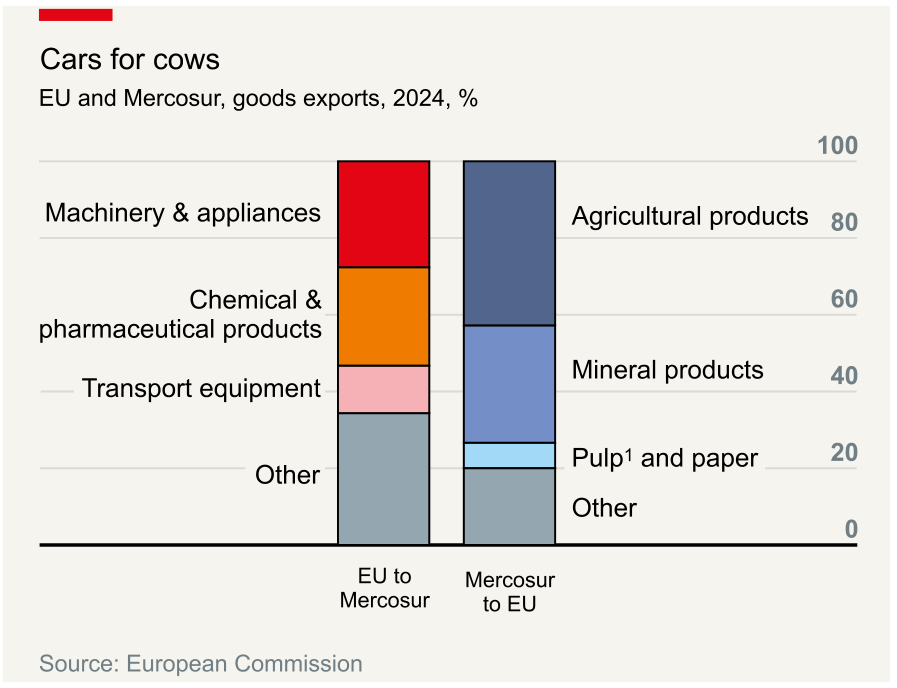
1pulp: a cellulosic material mainly from wood used in making paper.
The quarter-century negotiating delay is the fault of protectionist lobbies on both sides of the Atlantic, especially European farmers, who fear a flood of cheap beef and sugar. Some called the deal “cows for cars”, suggesting the winners would be Latin American farmers and European industry. Predictably, France led the opposition: it stood firm to the very end on January 9th, 2026, when it was joined by Poland and a few smaller EU states in opposing the deal in an internal EU vote-count. Germany and other northern European export powerhouses were more enthusiastic, as was Spain, with its close ties to Latin America. The pact won the support of a “qualified” majority of EU countries, as weighted by population, after a raise in subsidies for farmers helped induce Italy to switch sides. It opens up markets in four longstanding Mercosur members: Brazil, Argentina, Paraguay and Uruguay. Venezuela has been suspended from the bloc and is thus not included. Bolivia, the newest member, could join the trade agreement in the coming years.
The deal is a major event in what has come to be called “geoeconomics”, or the interaction between geopolitics and the economy. It is the biggest element of a wider attempt to strengthen ties with Latin America and diversify European trade and supply chains. Such ties help develop Latin American industries that the EU can count on if others cut it off, such as critical raw-material extraction and refinement. Rejecting Mercosur at the request of domestic farmers would have been an own goal for Europe.
(www.economist.com, 11.01.2026. Adaptado.)
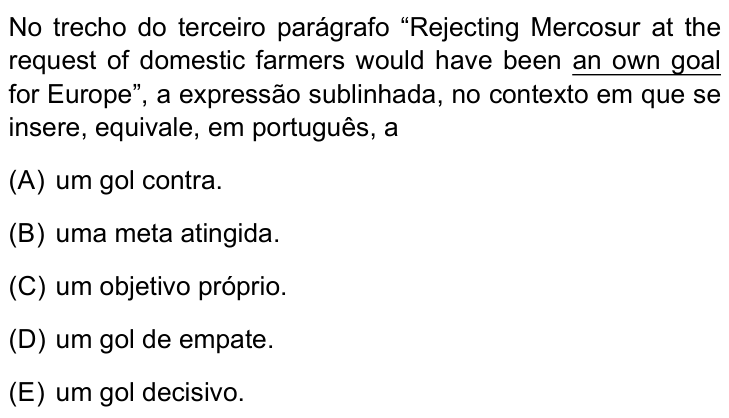
No trecho do terceiro parágrafo “Rejecting Mercosur at the request of domestic farmers would have been an own goal for Europe”, a expressão sublinhada, no contexto em que se insere, equivale, em português, a
- Aum gol contra.
- Buma meta atingida.
- Cum objetivo próprio.
- Dum gol de empate.
- Eum gol decisivo.
Você já respondeu questões neste aparelho. Crie sua conta grátis para guardar o histórico e refazer as que errou.
Resposta salva no seu histórico.
Reportar erro na questão
Resolução comentada
"Own goal" é uma expressão idiomática do futebol: é o gol que um jogador faz contra o próprio time, o nosso "gol contra". Por extensão, passou a designar uma ação que acaba prejudicando quem a praticou.
Veja o contexto do trecho:
- O texto diz que rejeitar o acordo com o Mercosur, a pedido dos agricultores europeus, "would have been an own goal for Europe".
- Antes, o texto explica que o acordo ajuda a diversificar o comércio europeu e a garantir matérias-primas críticas, caso outros países cortem o fornecimento à UE.
- Rejeitá-lo, portanto, faria a Europa perder essas vantagens, prejudicando a si mesma.
É exatamente o sentido de "gol contra": a Europa atingiria os próprios interesses.
O erro mais comum é traduzir palavra por palavra, "own" (próprio) e "goal" (objetivo ou meta), e escolher "objetivo próprio". O sentido figurado do futebol, porém, prevalece no contexto.
Alternativa A.
Pegadinha: A alternativa C engana quem traduz literalmente "own goal" como "objetivo próprio", sem reconhecer a expressão idiomática do futebol.
Por que as outras alternativas estão erradas
- B"Uma meta atingida" é tradução solta de "goal" e ignora que a expressão indica prejuízo, não êxito.
- CTradução literal palavra por palavra ("own" = próprio, "goal" = objetivo) que desconsidera o sentido idiomático.
- D"Gol de empate" não existe como sentido da expressão e não indica prejuízo causado a si mesmo.
- E"Gol decisivo" sugere algo positivo e importante, o oposto do sentido de autoprejuízo.
Assunto: Expressões idiomáticas e phrasal verbs.
Reportar erro na resolução
Ver como caiu na prova
Fonte: UNESP 2027 · Conhecimentos Gerais. Prova oficial ↗