PRÁTICA COM QUESTÕES OFICIAIS
Questão 26 (meio de ano) da UNESP 2026
Leia o texto para responder às questões de 21 a 26. · Conhecimentos Gerais
Leia o texto para responder às questões de 21 a 26.
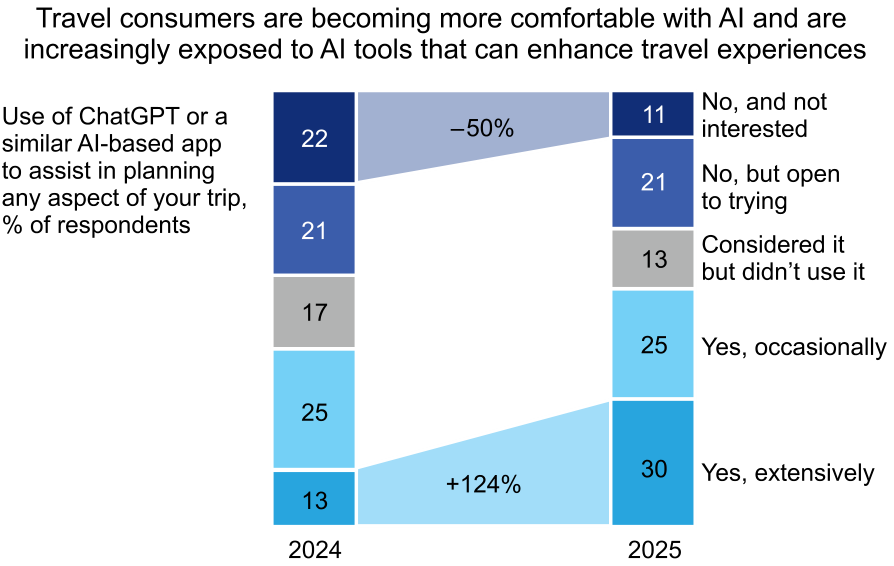
Artificial Intelligence (AI) adoption in the travel industry has accelerated sharply, and travelers are also embracing AI. More than half of the United States (US) respondents to the 2025 Skift US Travel Tracker Survey say they have used AI tools for trip planning, with AI use rising notably over 2024.
Yet, the travel and hospitality sectors still trail others in AI maturity, note Senior Partner Alex Cosmas and coauthors. Key barriers include siloed data1, outdated systems, and limited tech investment, when it comes to personal services. However, agentic AI2 can help amplify AI’s transformative potential, allow the sector to overcome these challenges, and enhance both efficiency and human connection for improved travel experiences.
(www.mckinsey.com, 20.11.2025. Adaptado.)
1 siloed data: a set of information that can be accessed only by certain groups within an organization.
2 agentic AI: autonomous AI that runs independently in order to execute and optimize workflows. It can make decisions, plan and adapt to achieve goals with little or no human intervention.
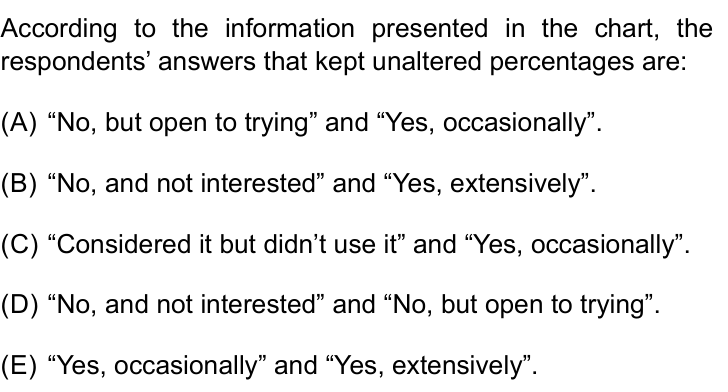
According to the information presented in the chart, the respondents’ answers that kept unaltered percentages are:
- A“No, but open to trying” and “Yes, occasionally”.
- B“No, and not interested” and “Yes, extensively”.
- C“Considered it but didn’t use it” and “Yes, occasionally”.
- D“No, and not interested” and “No, but open to trying”.
- E“Yes, occasionally” and “Yes, extensively”.
Você já respondeu questões neste aparelho. Crie sua conta grátis para guardar o histórico e refazer as que errou.
Resposta salva no seu histórico.
Reportar erro na questão
Resolução comentada
A pergunta pede as respostas cujas porcentagens não mudaram de 2024 para 2025. Basta comparar, em cada categoria, o valor das duas colunas do gráfico:
- "No, and not interested": 22\% \to 11\% (caiu, variação de -50\%).
- "No, but open to trying": 21\% \to 21\% (igual).
- "Considered it but didn't use it": 17\% \to 13\% (caiu).
- "Yes, occasionally": 25\% \to 25\% (igual).
- "Yes, extensively": 13\% \to 30\% (subiu, variação de +124\%).
Portanto, só duas categorias mantiveram o mesmo percentual: "No, but open to trying" e "Yes, occasionally".
Alternativa A.
Por que as outras alternativas estão erradas
- BAs duas categorias mudaram: de 22% para 11% e de 13% para 30%.
- C"Considered it but didn't use it" caiu de 17% para 13%; só "Yes, occasionally" ficou igual.
- D"No, and not interested" caiu pela metade (22% para 11%); só "No, but open to trying" ficou igual.
- E"Yes, extensively" subiu de 13% para 30%; só "Yes, occasionally" ficou igual.
Assunto: Informações explícitas e detalhes.
Reportar erro na resolução
Ver como caiu na prova
Fonte: UNESP 2026 · meio de ano · Conhecimentos Gerais. Prova oficial ↗