PRÁTICA COM QUESTÕES OFICIAIS
Questão 26 da UNESP 2026
Leia o texto para responder às questões de 23 a 28. · Conhecimentos Gerais
Dr. Mariangela Hungria will receive the $500,000 award for her work to utilize biological processes to sustainably improve crop1 nutrition, yields2 and productivity. The scientist whose discoveries helped Brazil become a global agricultural powerhouse has been named the 2025 World Food Prize Laureate.
Dr. Mariangela Hungria, a microbiologist from São Paulo, has developed dozens of biological seed and soil treatments that help crops source nutrients through soil bacteria, significantly increasing yields of major crops while also reducing the need for synthetic fertilizer. Her products are estimated to have been used across more than 40 million hectares in Brazil, saving farmers up to US$40 billion a year in costs while avoiding more than 180 million metric tons of \ce{CO2} equivalent emissions per year.
Dr. Hungria’s work has helped improve yields of wheat, corn, rice, common beans, and other major crops, including soybean, which is now Brazil’s top agricultural export. Over her 40-year career with the Brazilian Agricultural Research Corporation (Embrapa), national soybean production increased from 15 million tons in 1979 to an anticipated 173 million tons in the next harvest3 in 2025.
Dr. Hungria, who overcame prejudices against women and young mothers in academia to be named one of the 100 most powerful women in agriculture in Brazil by Forbes magazine in 2021, said she was inspired by Dr. Norman Borlaug, the father of the Green Revolution and founder of the World Food Prize. “I like to say that he made the Green Revolution possible, and we had this great opportunity to start a ‘micro green revolution’ — a green revolution, but with microorganisms,” she added. “I can’t quite believe I am now receiving the World Food Prize. Many people questioned me and my abilities throughout my career but I believed in what I was doing and persevered. The role of women in agriculture, from farming to science, deserves more recognition. I hope my achievement inspires others to pursue their passions in science.”
(www.worldfoodprize.org, 13.05.2025. Adaptado.)
1 crop: cultivated plant that is grown as food, especially grain, fruit or vegetable.
2 yields: the full amounts of an agricultural product.
3 harvest: the crops that are cut and collected.
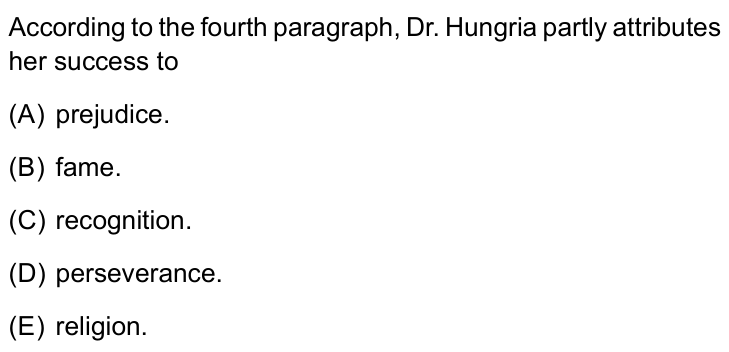
According to the fourth paragraph, Dr. Hungria partly attributes her success to
- Aprejudice.
- Bfame.
- Crecognition.
- Dperseverance.
- Ereligion.
Você já respondeu questões neste aparelho. Crie sua conta grátis para guardar o histórico e refazer as que errou.
Resposta salva no seu histórico.
Reportar erro na questão
Resolução comentada
A questão pede o que, segundo o quarto parágrafo, a pesquisadora aponta como parte do seu sucesso.
No quarto parágrafo, Dr. Hungria diz: "Many people questioned me and my abilities throughout my career but I believed in what I was doing and persevered". Em português: "Muitas pessoas me questionaram, e a minhas capacidades, ao longo da carreira, mas eu acreditei no que fazia e perseverei".
Ou seja, apesar das dúvidas dos outros, ela atribui sua trajetória à persistência e à confiança no próprio trabalho. O verbo persevered vem do substantivo perseverance, que é exatamente a palavra da alternativa D.
Confira as demais ideias do parágrafo:
- O preconceito (prejudices) aparece como obstáculo que ela superou, não como causa do êxito.
- A fama não é citada como fator de sucesso.
- O reconhecimento é algo que ela defende para o papel das mulheres na agricultura (deserves more recognition), não uma causa do seu sucesso.
- Religião não é mencionada.
Alternativa D.
Por que as outras alternativas estão erradas
- AO preconceito foi um obstáculo que ela superou, não algo a que atribui o sucesso.
- BA fama não é mencionada no parágrafo como causa do sucesso.
- CO reconhecimento é algo que as mulheres na agricultura merecem receber, não um fator que levou ao sucesso dela.
- ENão há nenhuma referência à religião no texto.
Assunto: Informações explícitas e detalhes.
Reportar erro na resolução
Ver como caiu na prova
Fonte: UNESP 2026 · Conhecimentos Gerais. Prova oficial ↗