PRÁTICA COM QUESTÕES OFICIAIS
Questão 86 da UFPR 2026 (inglês)
The following text is reference to questions 84 to 86. · 1ª fase
Lights out: Why all-night parties are in decline around the world
Tighter regulations, higher costs, and the “most sober” generation hit the nightlife industry hard.
Nightclubs around the world are closing their doors earlier than ever before, and some of the world's biggest party hotspots are hosting fewer all-night parties. Club owners and party organizers face tighter regulations and higher costs. But the real culprit is simply that this generation of young people is less interested in club culture than previous generations were.
The Financial Times recently updated an analysis of late-night dance parties. The newspaper found that the number of nightclubs open past 3 a.m. has decreased in 12 out of 15 global cities it analyzed.
So it’s true. From Barcelona to New York and Manchester to Melbourne, the party is ending earlier than ever before.
Nightclubs are also facing competition from day clubs. Several big cities have seen an increase in events that end early in the evening.
Young people today are just not into clubbing like previous generations were. The idea of drinking a lot, dropping a lot of money on drinks and staying out well past sunrise – well, that idea doesn’t appeal to the newer generation of young people. One commentator called Gen Z the “most sober” generation yet.
Younger people are more educated about sleep. More young people say they get eight to nine hours of sleep per night. It’s hard to do that when you’re partying until six or eight in the morning.
Nightclubs won’t completely die out any time soon. But the industry needs to adapt, or else it will continue to shrink.
Available in: https://plainenglish.com/lessons/late-night-parties. Adapted.
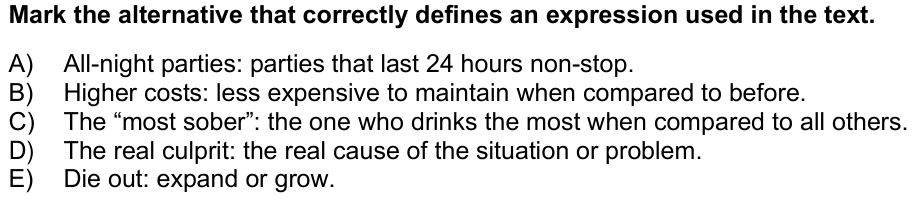
Mark the alternative that correctly defines an expression used in the text.
- AAll-night parties: parties that last 24 hours non-stop.
- BHigher costs: less expensive to maintain when compared to before.
- CThe “most sober”: the one who drinks the most when compared to all others.
- DThe real culprit: the real cause of the situation or problem.
- EDie out: expand or grow.
Reportar erro na questão
Resolução comentada
A questão pede a definição correta de uma expressão sublinhada no texto. Vamos conferir cada uma pelo sentido que ela tem no contexto.
- All-night parties são festas que duram a noite toda (até o amanhecer), e não 24 horas seguidas. O texto fala de festas que vão até "six or eight in the morning".
- Higher costs significa "custos mais altos". A definição dada diz o contrário ("menos caro").
- The "most sober" é a geração mais sóbria, ou seja, a que menos bebe. A definição dada diz que é a que mais bebe, o oposto.
- The real culprit é, literalmente, "o verdadeiro culpado". No texto, o sentido é a verdadeira causa do problema: o declínio das festas se deve principalmente ao menor interesse dos jovens pela cultura de clubes. A frase seguinte confirma isso: "this generation... is less interested in club culture".
- Die out significa desaparecer, extinguir-se gradualmente. A definição dada (expandir) é o contrário. O texto diz que as casas noturnas "won't completely die out any time soon", isto é, não vão desaparecer tão cedo.
Só a definição da expressão the real culprit está correta.
Alternativa D.
Por que as outras alternativas estão erradas
- Aall-night significa a noite toda, até de manhã, não 24 horas ininterruptas.
- Bhigher costs são custos mais altos, e não menores; a definição inverte o sentido.
- Cmost sober é a geração que menos bebe; a alternativa diz o oposto.
- Edie out é desaparecer ou se extinguir, não expandir ou crescer.
Assunto: Expressões idiomáticas e phrasal verbs.
Reportar erro na resolução
Ver como caiu na prova
Fonte: UFPR 2026 · 1ª fase. Prova oficial ↗