PRÁTICA COM QUESTÕES OFICIAIS
Questão 90 da UFPR 2019 (inglês)
O texto a seguir é referência para as questões de 86 a 90. · 1ª fase
Ancient dreams of intelligent machines: 3,000 years of robots
The French philosopher René Descartes was reputedly fond of automata: they inspired his view that living things were biological machines that function like clockwork. Less known is a strange story that began to circulate after the philosopher’s death in 1650. This centred on Descartes’s daughter Francine, who died of scarlet fever at the age of five.
According to the tale, a distraught Descartes had a clockwork Francine made: a walking, talking simulacrum. When Queen Christina invited the philosopher to Sweden in 1649, he sailed with the automaton concealed in a casket. Suspicious sailors forced the trunk open; when the mechanical child sat up to greet them, the horrified crew threw it overboard.
The story is probably apocryphal. But it sums up the hopes and fears that have been associated with human-like machines for nearly three millennia. Those who build such devices do so in the hope that they will overcome natural limits – in Descartes’s case, death itself. But this very unnaturalness terrifies and repulses others. In our era of advanced robotics and artificial intelligence (AI), those polarized responses persist, with pundits and the public applauding or warning against each advance. Digging into the deep history of intelligent machines, both real and imagined, we see how these attitudes evolved: from fantasies of trusty mechanical helpers to fears that runaway advances in technology might lead to creatures that supersede humanity itself.
(Disponível em: <https://www.nature.com/articles/d41586-018-05773-y>.)
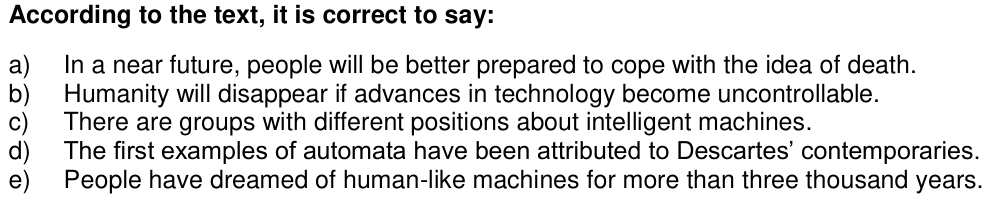
According to the text, it is correct to say:
- AIn a near future, people will be better prepared to cope with the idea of death.
- BHumanity will disappear if advances in technology become uncontrollable.
- CThere are groups with different positions about intelligent machines.
- DThe first examples of automata have been attributed to Descartes’ contemporaries.
- EPeople have dreamed of human-like machines for more than three thousand years.
Você já respondeu questões neste aparelho. Crie sua conta grátis para guardar o histórico e refazer as que errou.
Resposta salva no seu histórico.
Reportar erro na questão
Resolução comentada
Para acertar, compare cada alternativa com o que o texto afirma, sem acrescentar nada.
No último parágrafo, o texto diz que as máquinas semelhantes a humanos despertam "hopes and fears" (esperanças e medos) há quase três milênios. Quem as constrói espera superar limites naturais. Outros ficam aterrorizados e repelidos pela "unnaturalness". O texto afirma ainda que, hoje, essas "polarized responses persist, with pundits and the public applauding or warning against each advance". Ou seja, há quem aplauda e quem alerte contra cada avanço: existem grupos com posições diferentes sobre as máquinas inteligentes.
Confira as demais:
- O texto não fala em futuro próximo nem em lidar melhor com a morte.
- Os "fears" são sobre avanços descontrolados que might lead a criaturas que superem a humanidade. É um receio, não uma previsão de desaparecimento.
- Descartes é apenas um exemplo; o texto remonta a quase três mil anos, e não atribui a ele os primeiros autômatos.
- O texto diz "nearly three millennia", isto é, quase três mil anos. "More than three thousand" exagera o período.
A ideia central do trecho sobre as reações atuais é a divisão de opiniões.
Alternativa C.
Pegadinha: A alternativa E engana ao trocar "quase três milênios" por "mais de três mil anos", mudando o sentido do número.
Por que as outras alternativas estão erradas
- AO texto não faz previsão sobre o futuro nem sobre as pessoas lidarem melhor com a morte.
- BTransforma um medo ("might lead to") em certeza de que a humanidade desaparecerá.
- DO texto não diz que os primeiros autômatos foram atribuídos a contemporâneos de Descartes; ele só era fã de autômatos.
- EO texto diz "nearly three millennia" (quase três mil anos), não mais de três mil.
Assunto: Informações explícitas e detalhes.
Reportar erro na resolução
Ver como caiu na prova
Fonte: UFPR 2019 · 1ª fase. Prova oficial ↗